“Blood Dawn: World War II and the Making of Modern Asia” by Hans Van de Ven
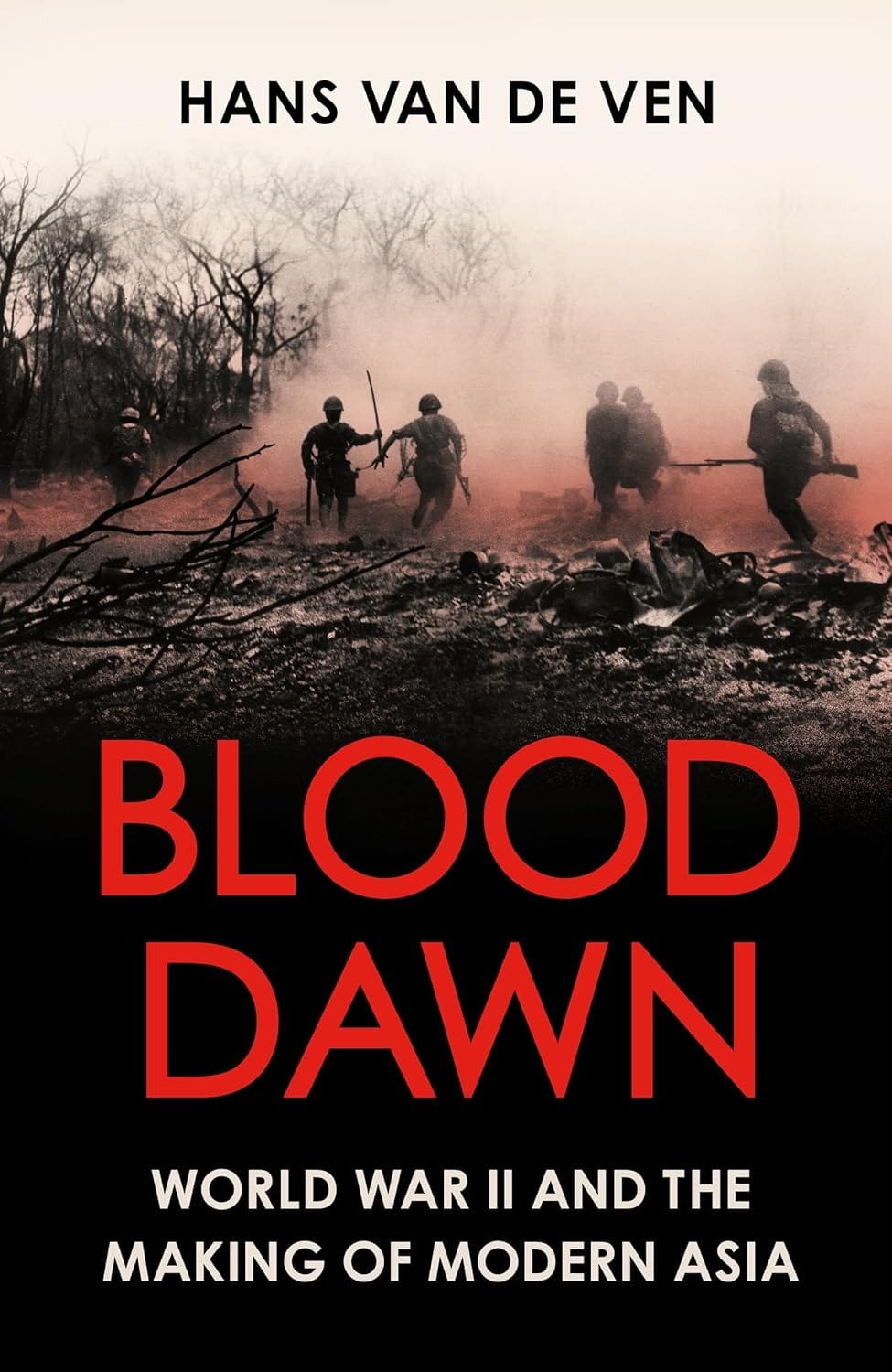
World War II, as Hans Van De Ven writes in his new book Blood Dawn, reordered Asia’s geopolitics. During the war, national independence movements in Asia whose origins dated back to the First World War and in some cases earlier, emerged stronger in the wake of Japan’s defeat. The surrender of Japan to the Allies in September 1945 did not mark the end of the fighting in Asia. China suffered through five more years of civil war. India sought independence from an exhausted British empire, even as it experienced bitter and deadly ethnic and religious divisions among its people. The Dutch East Indies soon coalesced into Indonesia, but not without struggles with their colonial overseers and internal bloodletting. World War II began the end of European/American colonialism and Japanese conquests in Asia, but what replaced them wasn’t much better for Asian peoples and in some instances was a lot worse.
Van De Ven, professor of modern Chinese history at Cambridge University and a visiting professor at Peking University, notes that World War II helped “transform Asia from a world of empire into a region of nation-states”. Asia, of course, had imperial trappings long before the Europeans and Americans established colonial empires there, but Van De Ven’s focus is Asia from the late 19th century to the Second World War and its immediate aftermath. He is a critic of Western imperialism and colonialism in all its forms—British, American, Dutch and French. But he recognises that the end of Western imperialism and Japan’s conquests in Asia led to what Archibald Wavell, then Viceroy of India, called “the horrors of peace”. “With the departure of the Americans and British from the scene”, Van De Ven writes, “the future of Indonesia, India, and China would be left to those with little interest in compromise”.
In China, Chiang Kaishek and Mao Zedong revived their brutal civil war that preceded World War II. Van De Ven notes that Mao’s communists were on the verge of defeat prior to Japan’s invasion of China but rallied during the war as Chiang’s forces did the bulk of the fighting against Japan and Chiang’s regime suffered from rampant inflation and corruption in its ranks. Mao’s communists benefitted from Soviet aid while the United States gradually reduced its assistance to Chiang’s government in its deeply flawed effort to mediate between the two sides.
In India, Britain’s governing elite, with a few exceptions like Winston Churchill, sought to gradually move towards Indian independence, but Indian leaders like Gandhi, Nehru and Jinnah would not wait–they had been waiting for more than 30 years–setting the stage for massive bloodletting and a partition of the country along religious lines (Hindu and Muslim).
In Indonesia, war’s end brought immediate chaos as nationalist leader Sukarno, who had worked with Japan during the war (as had some Indian leaders) based on promises of independence, resisted Dutch and British attempts to restore pre-war imperial control. The result, Van De Van writes, was that “chaotic, horrific violence … spread throughout Indonesia”.
Van De Ven does not shy away from cataloguing some of the horrors inflicted by the regimes in Asia that succeeded Western colonialism, but one gets the sense that he has some admiration for the political leaders who helped forge independent nation-states out of colonial empires. In a chapter of the book titled “Bandung”, Van De Ven praises Sukarno’s instigated conference of non-aligned nations held at Bandung in 1955, as a “symbol of decolonisation in political, economic, and cultural spheres”. He has much praise for China’s Zhou Enlai, Mao Zedong’s right-hand man in mass repression and mass murder. The “Bandung generation”, as the great British historian Paul Johnson noted in Modern Times, was a collection of professional politicians who liked to hold forth “about international morality on the world stage”, denouncing Western imperialism and championing the rise of the Third World, even as they did what was necessary to gain and maintain power.
Van De Ven concludes Blood Dawn with the observation that he has seen up close.
China’s development from a desperately poor society full of debilitating tension in the 1980s into a country in which virtually everybody has shelter, food, and a roof above their heads; its upper classes are prosperous, and the social atmosphere is noticeably more relaxed.
China, he writes, is an example of Asia’s “new stability”. But as it comes with increasing state surveillance, it is not the type of “stability” all might choose. China is furthermore also now in a position to seek to become the economic and political hegemon of the western Pacific. In the end, that may be the greatest consequence of World War II in Asia.