“Darkness and Other Stories” by Razia Sajjad Zaheer
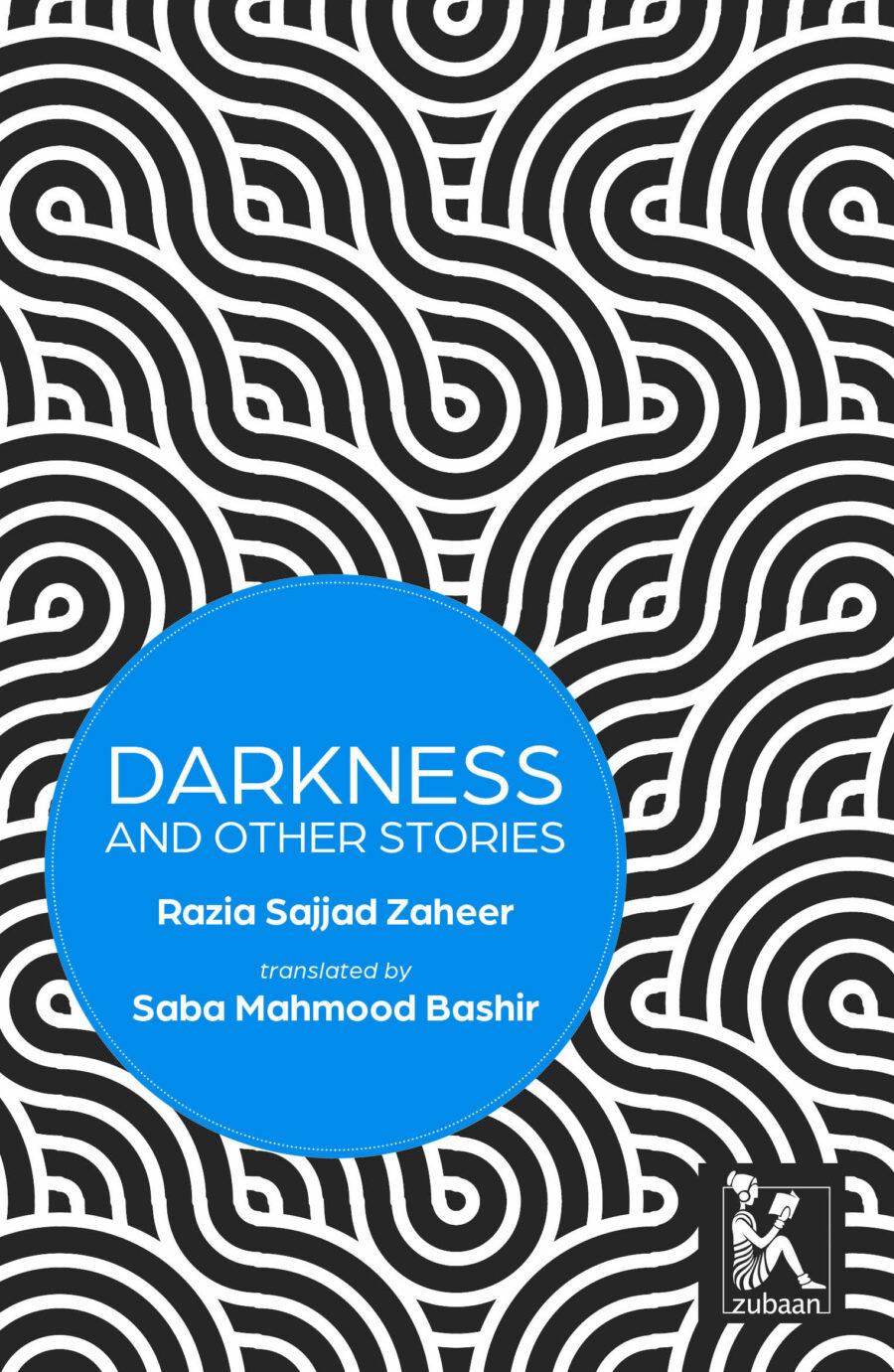
Although Razia Sajjad Zaheer’s collection Darkness and Other Stories was written following India’s partition in 1947, it simmers with relevance today. Women still confront misogyny and sexism. They continue to be judged for their choices—sometimes by their own kind—and must often accept a lower social status.
In the opening story “Darkness”, an educated Muslim author cowers in fear in a desolate first-class railway compartment as the train snakes from Delhi to Amritsar. Although she flinches at the sight of a Sikh gentleman “with a kirpan” and his cohorts, she learns that the men are fans of her writing.When the train stops in the middle of nowhere, she hears language that’s familiar:Lifting the shutter, she asked in the dialect that they had used: ‘Why has the train stopped, bhaiyya? What is the reason?’
One of the workers stopped and looked at her, quite surprised, ‘Mata ji, you seem to belong to our part of the land!’
For a split second, she wanted to leap out of the train and hug this person from her land and weep and say, ‘Aye!’ But by now a number of people had gathered close to her window.
It’s an endearing exchange where the use of “bhaiyya” (brother) and “mata” (mother) transcend language, religion, ideology and the “darkness” of the title.In “Salt”, a moving narrative of longing for one’s homeland, Safia is about to leave for Lahore when a woman makes a request asking if Safia would bring her some “Lahori salt” that she dearly misses. After Partition, Lahore is in Pakistan; she’s now in India.Leaving behind eyes filled with longing, flowing tears, long sighs and trembling lips, the train made its way to the border. The Pakistani police got off at Attari and the Indian police got in, but it was impossible to figure out who was Indian and who Pakistani, where Lahore ended and where Amritsar began. One land, one language, similar faces, similar mannerisms; the only difficulty was that there were guns on both sides.
At her death in 1979, Razia Sajjad Zaheer was one of the most accomplished but least celebrated women writers working in Urdu.
The thread symbolizing human connection runs through all the stories in this collection, regardless of how simple or superficial the situation or dilemma might first appear to be. In “Low Caste”, when low-caste Shamli, in an abusive relationship, seeks empathy and support from Sultana, the latter’s high caste prevents her from extending it.
“Shawl” describes an old man’s determination to cling to an heirloom—a shawl handed down by an ancestor—until the day he dies. “Yes, Sir” shines a light on the exact moment a connection is built after an old postman leaves and another arrives to replace him. The pillar in the eponymous story is an old man called Baba who has lived in the narrator’s employ for decades. When his overworked employer is taunted by a relative to the extent that she sobs in frustration, it is the servant Baba who consoles her, sharing harrowing stories from his own life, and pulling her back from self-pity.The love stories of two women, the older Rama Devi and the younger Sheela, are identical in “Two Hearts One Tale”; yet, how one copes is an eye-opener to the other. Sometimes, connection hinges on mutual dependence as we see in the story called “Who Is The Bigger Trader?” It is a brilliant narrative about a raspy old couple reliant on each other in their dotage; their actions are moving yet their motives seem questionable when we consider that their bond was forged in the hell of marital woes. Raggedy Babulal is a noble presence in “Emperor”, living every day as it arrives into his life, expecting nothing from it and owning little during the course of it. “The Husk of Seed” is a paean to motherhood. It is a reminder that even though motherhood is elusive for some women, every mother, even one who is a courtesan, finds a modicum of fulfilment when her child is safe and secure.Saba Mahmood Bashir’s translation is sharp and lyrical.
The irony of Zaheer’s collection is that it is bookended by “Darkness” in which an educated woman finds herself mired in skepticism, and a story titled “Flames” in which an illiterate gregarious woman, desperately seeking an education, willfully educates herself only to watch her books burned by her abusive husband.
Saba Mahmood Bashir’s translation is sharp and lyrical and the characters in these stories illuminate the author’s own demons. In her translator’s note, Bashir offers context to the times in which Zaheer worked and tended to her children and notes how she read several family biographies to understand the exigencies of her life: “the difficulties that she must have faced bringing up her daughters can scarcely be imagined.” Bashir also remarks on the technical challenges of translating Zaheer’s liberal wordplay, especially the use of homonyms “that, when translated, lose the homonymous quality that the source language imparted to them.”When author Razia Sajjad Zaheer passed away in New Delhi in 1979, she was one of the most accomplished but least celebrated women writers working in Urdu. While their family life was upended by Zaheer’s husband’s political activism and prison sentence in Pakistan, she stayed back in India teaching at a Lucknow college, penning short stories for magazines and working on translations into Urdu. It comes as no surprise that Zaheer was a prominent member of Progressive Writers’ Association, an organization driven by a manifesto that linked literature to social and political change.Zaheer left behind a voluminous legacy: Six novels, at least seven collections of short stories and more than forty translations, including those from Bertolt Brecht’s Life of Galileo (as Galileo), Gorky’s biography (as Zindagi ki Shahrah Par), and Mulk Raj Anand’s Seven Summers (as Saat Saal), among others. Darkness and Other Stories is not the writing of a woman who was a mere observer; Razia Sajjad Zaheer was working in the trenches, painfully aware of the persistent agonies of those in the margins.