“Everyday Tang: On What We Can Learn From a Dynasty” by Xiaolu Guo
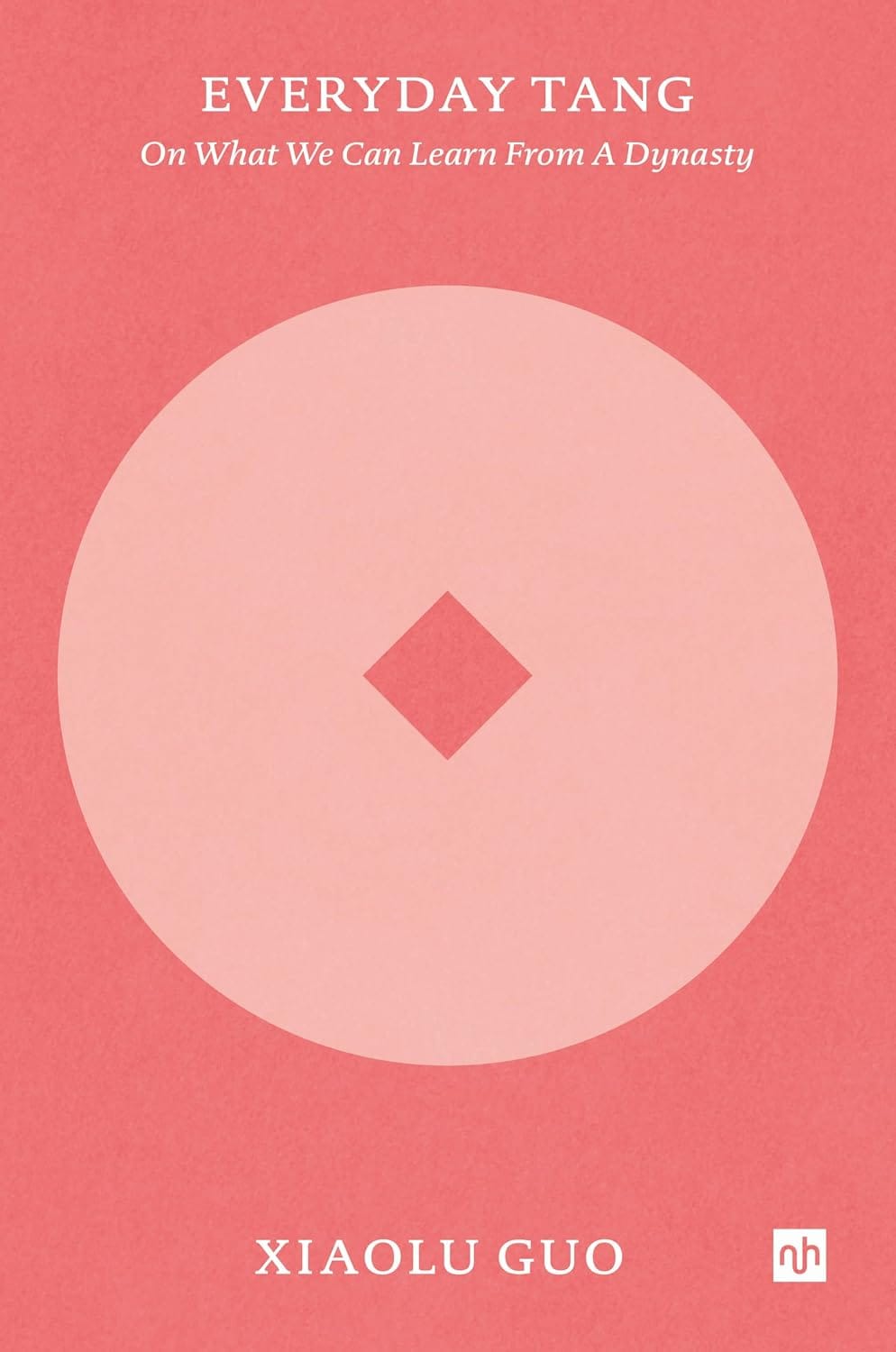
A near-desperate Chinese migrant mother, long estranged from her own cultural inheritance, takes her British daughter to China before adolescence makes history lessons an even harder sell. In Xi’an, they squat beside a flowerbed, sharing half a watermelon while the mother tries to bring ancient dynasties to life. The daughter spits out a few seeds. Her attention is harder to secure.
Part travelogue, part personal reckoning, Everyday Tang: On What We Can Learn from a Dynasty follows Xiaolu Guo and her eleven-year-old daughter, Moon, through China in the summer of 2024. Guo hopes to recover something worth passing on. History obliges with powerful empresses, tattooed courtiers, eunuchs and poets whose unruly desires would complicate any school lesson. The women alone make the Tang worth visiting, though not all their stories are suitable for children.
Guo is drawn to their intelligence, artistic achievement and sexual appetite, but the woman at the top gives her pause. When Moon asks whether Empress Wu (624-705 CE) was a feminist, her mother answers: “Just because she is a female emperor does not make her a feminist.” For a book seeking inspiration in the Tang, this is a useful reminder that power does not necessarily mean greater freedom. Female ambition need not come with plans for anyone else’s liberation or happiness. The throne has changed occupants, not its terms—a distinction that would hardly trouble Claire Underwood in House of Cards or Cersei Lannister in Game of Thrones.
Wu was hardly the obvious candidate for an imperial future: a twelve-year-old girl whom Guo describes as neither aristocratic by birth nor beautiful enough at court. “It was her destiny, really,” declares Guo’s tour guide (who claims a family connection to the empress). To illustrate, she tells a story from Wu’s very early years at court, long before she became empress:
One day, the court servants were having trouble controlling a horse. The animal was wild and dangerous. Wu Zetian jumped out from among the group of eunuchs and ladies-in-waiting. She beat the horse with a hefty stick, but the animal would not obey her. Then she brought out a knife. As the animal was becoming increasingly uncontrollable, she plunged the knife into the animal’s throat and the horse dropped dead immediately. The emperor was impressed by such a brave young lady, and from that moment on he became very fond of her.
What a taste in women—or, more precisely, teenage girls. Wu continued to seduce the emperor’s ninth son and successor, whom she married. From empress consort, she climbed all the way to the centre of power, ruling through her husband and then her sons before finally ruling in her own right. Guo admires Wu’s sexual independence, including her affair with a Buddhist monk, which began when she was sixty-one. But Wu’s freedom did not protect the women who served her from her cruelty. Shangguan Wan’er (664-710 CE) makes that painfully visible. In Guo’s telling, literary talent takes her from palace servitude to drafting imperial commands. Here is a woman doing the work of government, not merely decorating its chambers. She helps put authority into words; authority, in turn, writes on her face. Wu spares her life but has her face tattooed as punishment for disobedience. She continues to serve at court, bearing a permanent mark of disgrace, though Guo could not establish what she had done to incur Wu’s anger.
The proximity of cultivation and cruelty becomes still more uncomfortable in the chapter on eunuchs and courtesans. Eunuchs had existed in China for more than 3,000 years—effectively, Guo suggests, for as long as the imperial court itself. She calls it a paradox that “a culture that produced so many eunuchs at the same time produced the highest population on the globe, even in that distant epoch.” She then draws a parallel between the castration of eunuchs and the sexual exploitation of courtesans:
One is about the removal of sexual function, the other is about the reduction of a person to a sexual function. Both involve a kind of distortion of human life, an obliteration of the sexual self, and the castration of the eunuch’s body is similar to the castration (or obliteration) of the courtesan’s desire.
Both groups could be highly educated, accomplished and indispensable to the court. Neither usefulness nor intimacy guaranteed ownership of their own bodies. The palace depended on people whose bodies and desires it claimed the right to organise. Access to power came with terms and conditions written into flesh.
Then there is Yu Xuanji (840-868 CE), whom Guo introduces as a Tang counterpart to Sappho. Guo suggests that she may have earned her living entertaining men as one of the “singing girls.” Her poems offer desire, disappointment and a voice that refuses to sound safely ancient. Yet Yu is accused of murdering her maid and executed by being cut in two at the waist. Guo acknowledges uncertainty about the account’s accuracy. That uncertainty matters. The sensational life threatens to swallow the poems, while the wish to recover a neglected woman writer can tempt a reader to tidy away what is disturbing. Mistress and servant do not occupy the same position simply because both are women. These episodes complicate Guo’s attraction to the Tang as an age of female possibility. At times she reaches enthusiastically towards calling it feminist; elsewhere, she recognises how narrowly its freedoms were distributed. That tension is more revealing than a verdict on whether Tang women had it better. Talent might secure employment, beauty attracts patronage, and sexual confidence defies convention. None necessarily protected a woman from punishment.
The present supplies its own quieter correction. Early in the journey, a hotel receptionist tells Guo that she has a master’s degree in Tang art but could find work only at the front desk. Upstairs, the celebrated past awaits discovery; downstairs, someone trained to explain it hands over the keys. Guo’s most telling encounters allow the grandeur and the disappointment to share a room. The inheritance she offers her daughter contains both.