“Invisible Hands: Fabrication, Forgery, and the Art of Islamic Ceramics” by Margaret S Graves
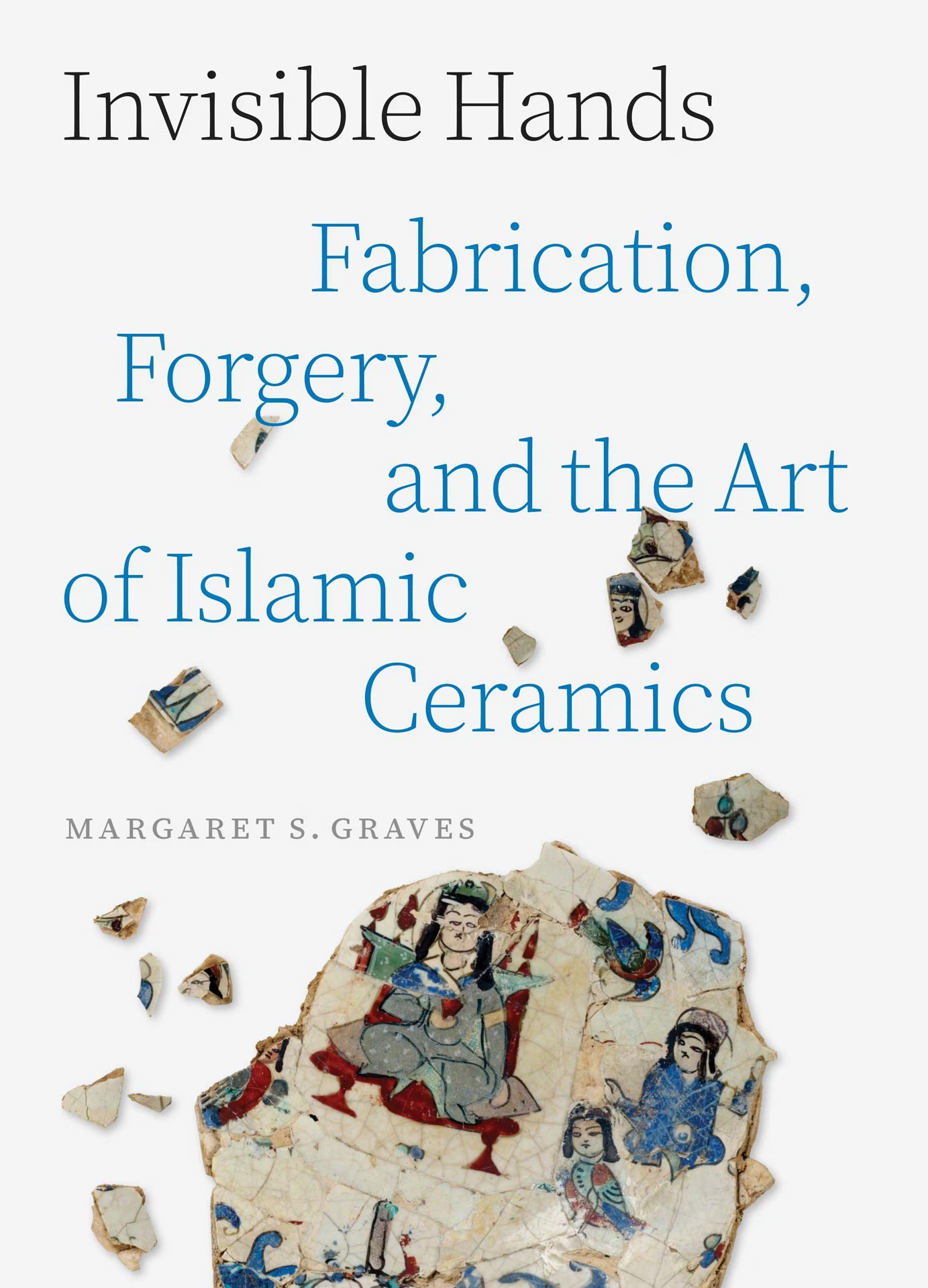
It normally makes a great difference to art “history” if a given object is authentic or fabricated. And yet, the fabrication of any given object, to say nothing of a class of objects, carries within its own history: one not always of fraud, but also of gatekeeping on the one hand and exploitation on the other. The story of Islamic era objects that began to flood the museums and the market around the turn of the 20th century is one such story.
In her book Invisible Hands: Fabrication, Forgery, and the Art of Islamic Ceramics, Margaret S Graves shows that most of these ceramics were not objects in fact antiquities at all: they belonged to the contemporary period. She argues that their antique value was an aura bestowed upon them by dealers and brokers who posed as aficionados, authenticators, and experts in an economic environment conducive for such transactions: wealthy collectors were eager to portray themselves as people with taste and knowledge while passing off of contemporary objects as medieval was facilitated by the rise of museums, the market and the banking system. People from cross-cultural communities, multilingual and familiar with the people and cultures of both Middle East and Western Europe could pose as aficionados and experts at sourcing the ceramics while also promoting them through articles and museums catalogues and exhibitions.
With sophisticated technologies such as CT scanning, computed tomography, thermoluminiscence testing, chromium detection, and more, scholars can now trace the presence of more than one layer of painting and glazing on many ceramics. Scans show the presence of screws, copper wires, cardboard strips. Old and new parts are sutured together through bricolage using adhesives such as animal glues, fish glue, potash silicate, and so on. One scan shows a fingerprint on the overpaint layer of a ceramic. Some objects are examples of true forgery: new made objects passed off as old ones but many have a genuinely antique underpinning. Graves’s detective work is not dependent on technology; she also brings expertise and a keen eye. For instance, some paintings that look like they belong to medieval Iran are actually reflections of the early 20th-century’s perception of medieval Iran.
Graves acknowledges that much of this tinkering has been known for quite some time. Her perspective, however, is that the discussion has been oversimplified as a mere real-versus-fake conversation: fakes get exposed and gullible scholars and collectors are shamed for having been fooled. Graves has a different story to tell: these ceramics deserve to be seen as examples of care and not of fraud. Whoever worked on them were conscious of the historical as well as cultural value of these objects and deserve to be seen as custodians and artisans: they did not desecrate the objects or harm them. In some cases, such as overpainting, the artisans did not obscure older, important parts of the previous layers of painting on the ceramics. It is not uncommon to see these objects as works of genius because putting mismatched parts together requires greater skill than creating something afresh. Graves sees them as a “metaphysical achievement suturing together multiple historical moments.” Each act of adding a new layer shows that the artisans were conscious of the fact that they were harmonising parts with the whole.
Both surface level changes and bricolage are not any different from conventional restoration practices. In fact, ceramics lustering and most other techniques that went into the making of these objects continue to be in demand. Therefore, Graves’s point is that these objects deserve some space within art history as art and not dismissed as forgeries.
Not all museums can afford to get their objects examined; testing is expensive. But some museums might be unwilling to ask uncomfortable questions about the objects or the wealthy, connected donors that provided them. The “Great Find”, as Graves calls it, is also a great story, one unchallenged and “puffed by the hot air of salesmanship” that presents these ceramics as “fine” and “masterpieces”.
What should we do with those histories and how should we honor the skills of all those unrecorded and invisible hands? … It is ultimately through our imaginations that we create the fibers of empathy, that essential human quality that underpins any functional society and makes us feel, sometimes quite viscerally, that we can access and even momentarily inhabit the experiences of others … What, then, are the possible futures for all these fabricated and collected bowls, cups, pitchers, and dishes? … They have the potential to illuminate not just medieval ceramic techniques but also the workings of modern skilled labor economies and the place of artifacts within regimes of knowledge and acquisition.
All that glitters may not be gold; it might be something better and more valuable.
