“Mother of the World” by Olivier Hein
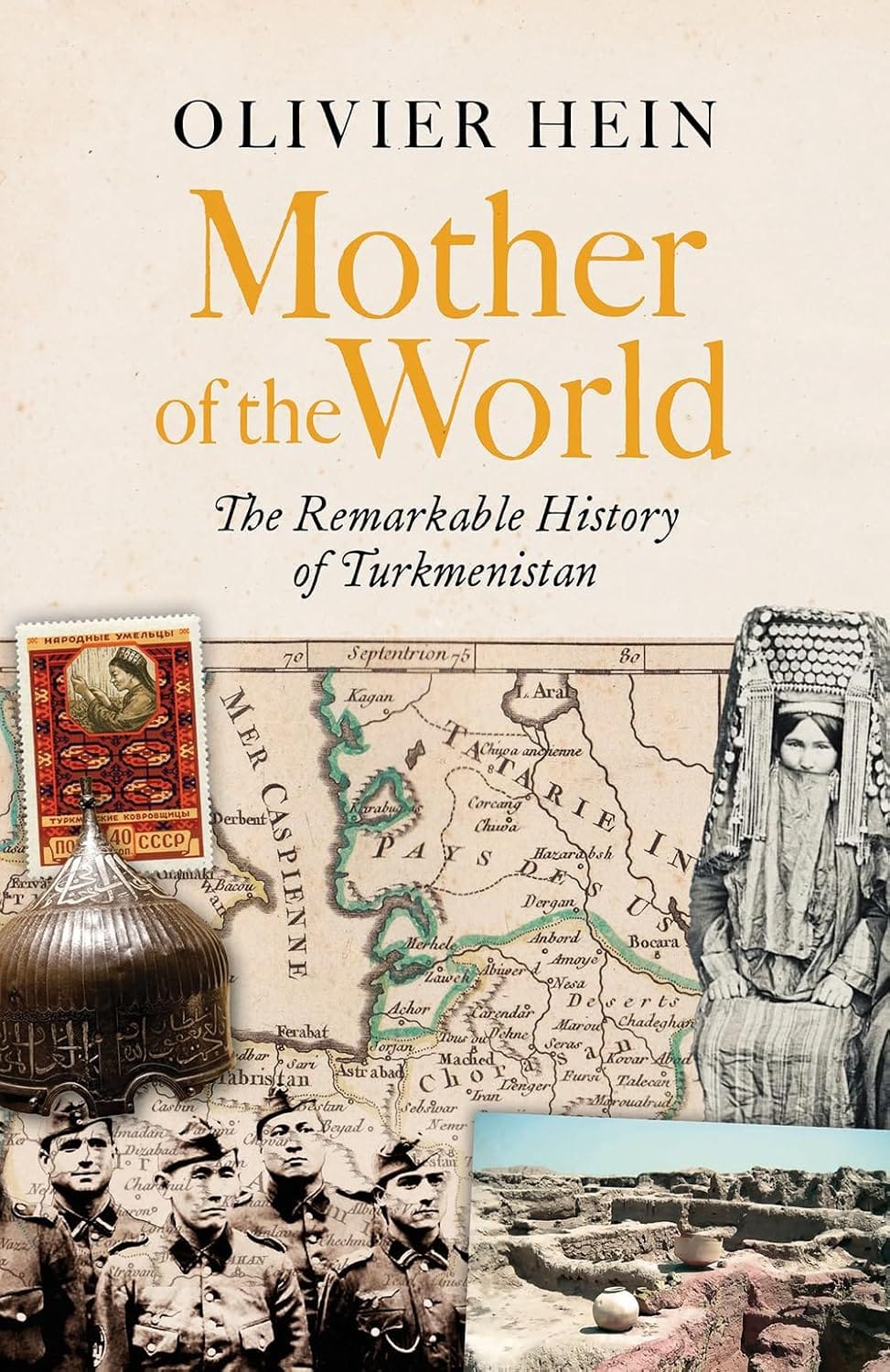
Olivier Hein’s Mother of the World: The Remarkable History of Turkmenistan announces its ambitions early. Where most national histories begin with political dynasties or patterns of migration, Hein starts tens of millions of years ago with the geological processes that formed the Karakum Desert. It is an unusual choice and a revealing one. From the outset, this is less a conventional history of a people than a history of a place whose identity, borders and inhabitants have never fully aligned.
That tension between geography and identity runs through the book. Hein repeatedly returns to a central question: is this the history of Turkmenistan, or of the Turkmen? For much of the first half, the answer appears to be neither, or perhaps only partly. The opening chapters present the region as a corridor of empires, a territory crossed and contested rather than settled. Greeks, Parthians, Mongols and Turks pass through the narrative; figures such as Genghis Khan and Timur appear briefly, shaping the region without contributing to any continuous national story.
Hein is clearly aware of the difficulty. Modern Turkmenistan’s borders sit uneasily atop a much older and more diffuse cultural geography, one in which many important figures emerged from lands now beyond the republic’s boundaries. Even the poet Magtymguly Pyragy, the best-known figure in Turkmen literary history, was born in what is now Iran. Rather than resolving this tension, Hein embraces it, presenting Turkmen identity as something assembled over time from shared memory and tribal connections rather than fixed territory.
If this occasionally creates a sense of drift, it also allows Hein to pursue a broader argument. His project is partly one of historical repositioning. He seeks to show that the lands of modern Turkmenistan were not peripheral but central to the economic, cultural and spiritual history of Eurasia. The Silk Road is presented not simply as a route passing through the region but as a system in which ancient cities such as Nisa played important intermediary roles, linking Roman and Chinese markets through networks of exchange. Hein also explores possible connections between the region and the origins of Zoroastrianism, suggesting a historical lineage that would place Turkmenistan close to the development of one of the world’s earliest major religious traditions.
These arguments are most convincing when grounded in specific places, particularly the oasis city of Merv. Hein’s account of Merv is one of the book’s strongest sections. For a time, he argues, the city ranked among the great urban centres of the medieval world: a hub of trade, scholarship and religious diversity where Christian bishops, Buddhist pilgrims and Islamic scholars intersected. Its population may have reached into the hundreds of thousands. The Mongol destruction of Merv in the 13th century therefore appears not simply as another conquest but as the loss of a major centre within the Silk Road network.
Yet the book’s broader challenge remains. The connection between these ancient achievements and the modern Turkmen state is often difficult to sustain. Hein’s narrative sometimes seems caught between celebrating the deep history of the region and linking that history to a contemporary national framework. The result is a balance between historical survey and cultural advocacy.
It is only in the later chapters that the Turkmen themselves move decisively to the centre of the story. Emerging more clearly from the 11th century onwards and gradually coalescing from tribal groupings, they become a recognisable political and cultural force before being displaced by successive invasions, most notably those of the Mongols. Their return in the 16th century suggests continuity, but this autonomy was later constrained by Russian imperial expansion in the 19th century.
Hein’s account of this period is effective. The siege of Geok Tepe in 1881, in which around 20,000 Turkmen were killed, stands as a defining moment of both tragedy and resistance. From there, the transition into Soviet rule marks another major shift, with the creation of Turkmenistan as a defined territorial entity accompanied by pressures toward linguistic standardisation and cultural control.
Curiously, however, the Soviet era receives relatively brief treatment. Compared with the extensive coverage of antiquity and the medieval period, the 20th century passes quickly. The same is true of Hein’s discussion of Saparmurat Niyazov, the country’s first post-Soviet leader, whose rule has shaped many outside perceptions of Turkmenistan. Known for renaming months, erecting rotating golden statues and issuing highly personal decrees, Niyazov is often the focal point of international attention.
Hein, wary of what he describes as “cheap, easy stories”, devotes surprisingly little space to him. This approach is consistent with the book’s broader tone. Hein is clearly sympathetic to Turkmenistan. His admiration is evident in his discussions of the country’s horses, carpets and cultural traditions, and in his determination to emphasise its historical achievements rather than its more recent eccentricities. At times this can feel overly defensive. Yet it also serves as a corrective to accounts that reduce the country to stereotype.
The final sections, which focus on archaeology, reinforce this aim. Hein highlights the relatively recent study of sites such as Gonur Depe, arguing that the Turkmen desert may once have been home to a major ancient civilisation. That many of these discoveries only gained wider attention after the collapse of the Soviet Union, he suggests, reflects the region’s long-standing marginalisation within global scholarship.
… in a literary landscape where Turkmenistan remains little known, Hein has produced a thoughtful and worthwhile introduction to a country whose history is richer and more complex than many outsiders realise.
As a work of history, Mother of the World is not without shortcomings. Its chronological structure is accessible but can limit analytical depth, and the central tension between land and people remains only partly resolved. Yet these limitations are closely tied to the book’s ambitions. Hein is not simply recounting events; he is making a case for a different way of understanding a country and its place in history.
The result is a book that is uneven but engaging, partisan yet informative. Readers may occasionally feel the author’s sympathies pulling the narrative in a particular direction. Even so, in a literary landscape where Turkmenistan remains little known, Hein has produced a thoughtful and worthwhile introduction to a country whose history is richer and more complex than many outsiders realise.