“Aurangzeb ‘Alamgir and the Mughal Empire” by Munis D Faruqui
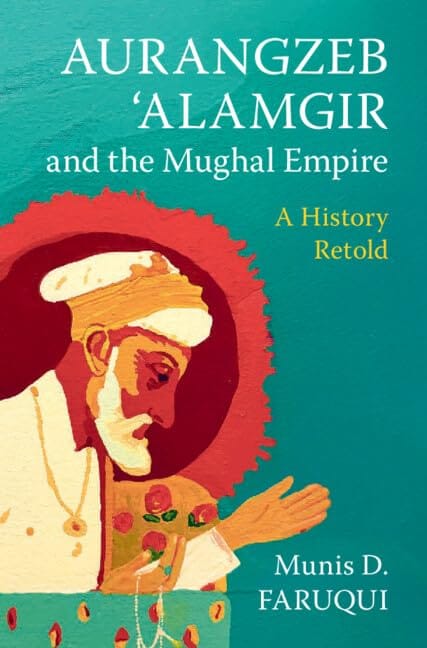
The battle lines around Emperor Aurangzeb’s posthumous reputations are clearly drawn. On one side, the monumental five-volume history by Jadunath Sarkar over a century ago defined the last great Mughal as a bigot, a fanatic, a bloodthirsty tyrant, and the gravedigger of the empire. Moreover, some claim that the brother whom Aurangzeb defeated and executed in the fratricidal civil war, Dara Shikoh, represented a missed chance for the Mughals to reconcile Islam and Hinduism. On the defenders’ side Audrey Truschke and Robert Eaton debate not so much the facts of the reign but the rulers’ motives, and whether Aurangzeb’s actions crossed any lines laid by his predecessors on the throne.
One cannot imagine the reputation of even a controversial monarch like England’s Henry VIII generating such heated debates, but neither is one surprised. A historian does not write in a vacuum. The animosities around Aurangzeb reflect the passions of communal rivalry going back to the (rescinded) partition of Bengal in 1905 and the tragic partition of India and Pakistan in 1947.
Truschke’s and Eaton’s defenses of Aurangzeb can be summed up in WS Gilbert’s lyrics: “Any monarch on a first-class throne, if he wants to call his throne his own, must get through more dirty work than ever I do.” Faruqui’s new biography clearly follows this line of argument, offering plenty of supporting evidence.
By many measures, Aurangzeb, who took the throne name ‘Alamgir, achieved more than any previous Mughal ruler. He added most of southern India to his inherited northern lands, uniting the sub-continent for the first time since Ashoka, leaving frontiers similar to the present day country (less Pakistan, of course). His domain became the premier trading and manufacturing power globally, surpassing even Qing China, with its greater population. The Indian economy was larger than western Europe. This attracted crowds of merchants from Portugal, France, England and even Denmark. They left accounts of fabulous riches. And yet, after 49 years of reign, clouds gathered over the empire.
So, let’s return to Sarkar’s final charge against Aurangzeb: grave digger of the Mughal empire. Munis Faruqi’s new biography does not so much offer a rebuttal as provide a compelling account of where this dutiful, capable, hard-working and well-informed monarch went wrong.
Faruqi’s analysis relies on untapped archival sources. Like a Kremlinologist, he analyses not just texts, but physical spaces, like where a particular person chose to, or was allowed to be buried. Mughal marital alliances are patiently deciphered for significance. Original research into the institution of the imperial harem and the role of princesses and eunuchs in governing the empire brings to life the world of the Mughals as never before. It becomes clear that looking only at the emperor’s public actions is much less than half the picture. The politics and strategies of sisters, daughters, and their servants had a huge role in shaping Aurangzeb’s reign. An enormous dynastic machine lay behind the throne, one that both empowered the emperor and imprisoned him.
These dynamics provide many clues to Aurangzeb’s final failures. The Mughal elite, including the 5,000 members of the harem, absorbed a lot of resources. Each courtier, prince, princess and even servants expected to receive lavish gifts: horses, elephants, and the jeweled luxuries we admire in museums around the world today. Traditionally, the empire had relied on agricultural taxes and conquest tribute to pay for this largesse. Danger lay in the possibility that there would not be cash to go around.
The empire resembled more and more a Ponzi scheme. To hold the empire together, Aurangzeb offered ranks and riches to buy loyalty, recruit new subjects, or to placate rebels. Later, the supply of gifts fell short of the amount required to satisfy everyone’s ambitions. Then, the Ponzi scheme went into reverse when more elite members revolted because they did not get what they felt they deserved. The long and economically unjustified wars of Aurangzeb’s reign set this machine into an unstoppable downward spiral. First, the burden of the non-productive elite had increased with each generation of elite, and secondly, conquests in Arakan, Afghanistan and the arid south did not yield as much cash as the earlier Mughal conquests of merchant powerhouses like Gujarat or Bengal.
The emperor felt helpless about his inability to provide for all the demands for money. As Faruqi says:
Although [he] knew of the growing chaos and sought to alleviate the distress, he never offered any big fixes. A deep sense of failure about the needs of the Mughal nobility and their dependents haunted him to the end of his life.
There is irony in the fact that India as a whole was becoming richer, with new classes of urban elites making money from trade and manufacturing. The empire had difficulty enlisting this wealth, aligned as the Mughals were to an older, feudal-style, land-based system. One reason why Aurangzeb reinstituted the unpopular jizya tax on non-Muslims was precisely to raise money from the newly rich middle class, which was mostly Hindu or Jain. The failure of this tax to raise much money, and the inability of the feudal, warrior Mughals to win the loyalty of the rising moneyed classes, explains much about the transformation of India in the decades following Aurangzeb’s death in 1717.
Perhaps Aurangzeb’s biggest error was to live too long, reigning 49 years. When his successor Bahadur Shah ascended the throne, he was already 64 years old and in poor health. Younger princes seethed and intrigued. There were just too many imperial offspring aspiring to rule. Again Faruqi explains,
Had [he] died in the late 1680s or early 1690s, his accomplishments as a general and an administrator might have allowed him to go down in history as the greatest Mughal emperor.
The figure of Aurangzeb that emerges here is one of a model monarch, but also a man from another age, harkening back to Babur and Akbar. The new world that emerged in the end of the 17th century was foreign to him, and he was not in a position to adapt. This is a warning to all statesmen who would rule for life, and outlive their own virtues.