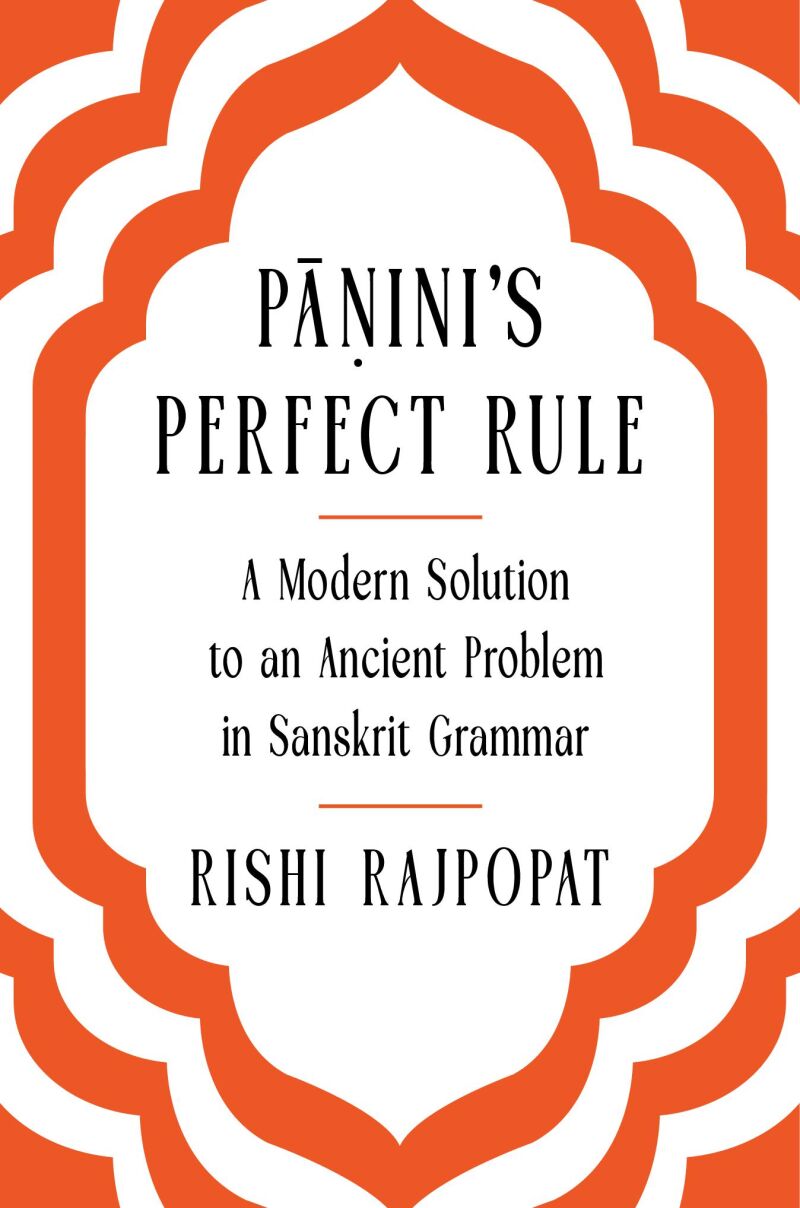
“Pāṇini’s Perfect Rule: A Modern Solution to an Ancient Problem in Sanskrit Grammar” by Rishi Rajpopat
Can grammar function like a machine? Can a set of mechanical procedures, or rules, generate perfectly correct sentences in a given language? This is a question that preoccupies linguists, but not language users. It is natural to assume that language is too sloppy, too idiosyncratic, too human, in the end, to be generated by a machine. When we studied English grammar, we learned there was an exception to every rule. But in India, scholars uphold one monumental grammar as a model of perfect, generative power: that of Panini, who lived in the 4th century BCE. His 4,000 rules in verse are supposed to generate all the required forms of Sanskrit, the classical language of Indian civilization.
The only problem has been that until now, to use Panini to generate correct Sanskrit forms also required mastering Panini’s commentators. Over the last 2,000 years, they generated countless metarules and exceptions. In the face of all these additions, to what extent was Panini’s rule perfect?
It seems extraordinary that hundreds and thousands of grammarians could have gone down the wrong path for so long.
In 2022 press headlines proclaimed of Rishi Rajpopat’s PhD thesis, “Student solves millennia-old mystery,” and that Panini had indeed created the perfect rule. Admirers of Rajpopat appreciated how the mathematician had revalidated the amazing intellectual achievement of Panini. Traditionalists were aghast, as his argument allegedly rendered obsolete the library of commentaries that they had spent their lives mastering. What indeed is the true significance of Rajpopat’s rediscovery?
Let’s look at his approach. Rajpopat started to study the traditional commentaries on Panini, and saw that despite the piling on of rules and rules, they still lead to wrong outputs, that is, incorrectly formed words. The traditions worked a little bit like Ptolemaic astronomy, evoking many rules to explain the path of the sun, based on the problematic assumption that the earth revolved around that star, and not vice versa. The “aha” moment for Rajpopat came when he determined that Panini’s rule “in case of conflict, choose the latter” referred not to a later rule, as assumed by the tradition, but the later of any two conflicting elements. According to Rajpopat, if we follow this rule, then all of Panini’s rules lead to a perfect outcome, without any additional rules and no exceptions. It is as simple as Copernicus deciding to plot the planetary paths with the sun not the earth in the center.
It may help to envisage a computer programmed with all of Panini’s 4,000 rules. You feed into the computer a Sanskrit root, along with any morphological elements you need to add to the root. The computer looks at the rules and comes up with the right changes in the root and the suffixes or affixes, to produce a good Sanskrit form. Sometimes the rules spits out a straightforward answer. But sometimes two rules appear to apply to the same transformation. In this case, if there are two rules for the same operand (the element to be combined), pick the more specific rule. If there are two rules, one governing, for example the root and the other the suffix, pick the latter. This is Rajpopat’s Copernican revolution.
That the proof of the thesis results in a book much longer than the original treatise’s 35 pages is interesting to contemplate.
It seems extraordinary that hundreds and thousands of grammarians could have gone down the wrong path for so long, and that an outsider to the tradition could have cracked the code so abruptly. It is perhaps an argument against Panini’s famous brevity—leading to two millennia of uncertainty about what he really wrote.
But is Panini really a generative grammar? Here the problem is to agree on what exactly is a grammar. Sanskrit, like Latin and Greek, has complex morphology to express grammatical concepts (unlike English or Chinese which use almost entirely word order). So Panini’s rules generate words. Here is an example: If I want to say, “by the gods”, I have to take the root “deva” and add a suffix that indicates the function. This is often “bhis”. But the Panini rule says that “deva” becomes “devā “ in the plural, and that after “ā” we substitute “ais” for “bhis”. By similar phonological changes we find Latin forms like “Divibus” alongside Greek forms like “Theios”, both meaning “by the gods”. So Panini rules seem to be more about allowable morphological changes than correctly formed sentences. But in Sanskrit, correct grammatical forms yield correct sentences.
This is an important distinction because it is easier to imagine that both morphological transformations are regular and so predictable, and also that grammarians can encourage speakers to adhere to certain rules, so that life imitates art, as it were. There are some clues that Panini addresses inherent untidiness in speech. His grammar can generate some forms found in an earlier version of Sanskrit, as used in the Vedas. But he cannot generate all of them, because the Vedas had different phonological transformations. Rajpopat suspects someone interpolated some rules into the Panini corpus to account for common Vedic forms, and this may not have been Panini’s original intent. So perhaps one was encouraged to speak as Panini taught.
Panini’s Perfect Rule is not an easy book to read because Rajpopat uses traditional Sanskrit terminology, like “jhal” for stops and fricatives (think B, D, F..) and “yaÑ” for semi-vowels (think V, Y). This reviewer had to use Google to be able to follow his procedures. Most of the book is taken up by examples of Paninian transformations on different word forms. This is required to prove his approach, against his numerous critics seeking to fault with his thesis. It is of little interest to the general reader, unless they are learning Sanskrit and want to understand why the phrase “one who has sat” is Sadusah, and not “*Sad-vas”. That the proof of the thesis results in a book much longer than the original treatise’s 35 pages is interesting to contemplate. Nevertheless one comes away with a deep appreciation both of Panini’s contribution to linguistic science, and Rajpopat’s revolutionary thesis about its core mechanism.