“Patchwork Dolls” by Ysabelle Cheung
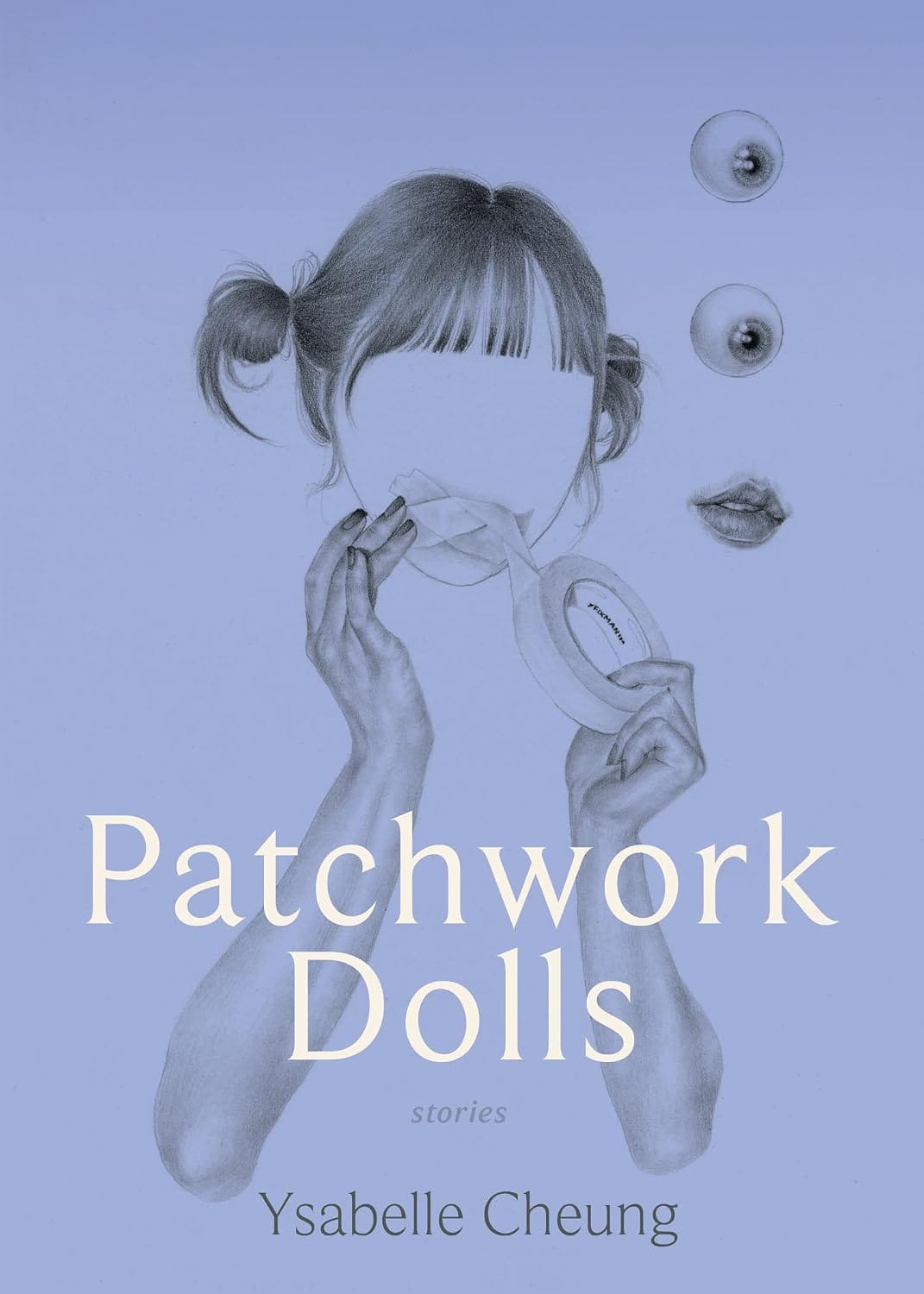
In the title story of Ysabelle Cheung’s debut story collection Patchwork Dolls, the narrator Sophia and her childhood friends sell bits of their bodies so they can pay down their student loans, start businesses and afford luxuries.
Mahika had sold her deep-set eyes, her nose, her dimples, her lips; Jumana her sharp, symmetrical cheekbones; and Rui her high, auspicious forehead and small ears. I was swapping out my entire face. We were known as Patchwork Dolls and in our contracts—each worth thousands of dollars—we agreed to exchange our features with moneyed people seeking an upgrade to newer, trendier faces.
Set for the most part in New York or Hong Kong, these deliciously dark short stories deal with coping with (or not) unease in out-of-balance worlds. One of the sub-themes that runs through the book is the vulnerability of being an Asian female. As “brown girls” in New York, Sophia and her friends suffered because of their faces growing up. Sophia was derided as a “Chinese monkey” as a child. As a woman she fights off an attack from a criminal carrying out anti-Asian hate crimes and is harassed by a male colleague who tells her she has “perfect hentai face potential.”
Sophia thinks, “On a white woman my face was desired, ambiguous, a symbol of power and wealth. But for me, it had been a curse, something I desperately tried to scrub out.” But Sophia’s surgery goes terribly wrong. “In the mornings I felt my flesh melting off my skull: I had to use my palms to push it back in, and when my fingers came away they were coated in a rusty discharge.”
Sophia hesitates but eventually seeks help. “When I realized nothing was clearing up, I called the clinic. In my head I calculated the costs of it all. If I sold something else, like my breasts or my feet, I could get back on track.” When Sophia finally goes to the clinic, the doctor tells her she’s only seen one other case like hers.
The girl had started growing another face under her new one. So, we had two choices: Either we removed the new face, or we had to stop the secondary one from growing. By the time we realized this, it was already too late. The girl died. She was trapped in her own face.
The story, which first appeared in Granta. is a critique of the modern dilemma of late capitalism: we live to consume, even if it means selling parts of ourselves.
Written in shimmering prose that has a slightly hallucinatory effect, the stories are original and surprising. In “Find Your Spirit,” a young woman tracks the ghost of her twin on an app. The second person narrative makes it feel intimate. “The ghost of your dead twin sister visits you late on a Tuesday night when you’re boiling ramen.” Use of second person narration carries into “The Reader,” one of the strongest stories in the collection. It deals with cultural erasure, another theme that runs through the stories. The main character awakens to amnesia and the mysterious disappearance of all her books. Cheung punctuates it with choices, directing the reader to turn to certain pages if they want to navigate the narrative differently.
You wake up one morning and it’s gone. There is a blankness inside of you: carved, scraped, dry. But you cannot name it. Everything looks the same. The unwashed cups on your bedside table, the puddle of clothes on the floor, the way the air conditioner spits a fungal mist. What is missing, you wonder? Is it your memory that has been erased? Or something else? You had heard of this happening: entire timelines wiped clean, people fading, even buildings disappearing.
Cheung, who lives in Hong Kong and owns a gallery there, does not shy away from stories which evoke Hong Kong’s enforced re-shaping of speech and behaviour after the imposition of sweeping national security legislation.
In “Please, Get Out and Dance”, Frankie and her mother and grandmother choose not to go to America or the UK but instead to slide down into a promised new world in the sea to escape a totalitarian society in which things, people, and whole apartment buildings are being erased.
“Back in the city, people danced colorlessly. Music streamed from every speaker. Somewhere in the crowd, a woman with a poster in her hands screamed and screamed, but nobody could hear what she was saying – the orchestra of sound was so loud – and then she was gone. How or where she went nobody knew, although the entire event was filmed live and played back to the dancing masses.”
There are many references in “The Reader” that people familiar with Hong Kong during the pro-democracy protests will recognize. It ends with a showstopper.
Many stories in the collection have the feel of trauma literature, a field that explores the psychological, emotional, and social impacts of extreme disruptive experiences on individuals. Two characters in “The Reader” look at a pamphlet for an art exhibition from a year earlier.
“Trauma fractures all timelines,” it reads. “We live on top of ghosts—the ghosts of our ancestors, the ghosts of violence, the ghosts of ourselves. We exist as palimpsest. If we write, if we paint, we also erase.”
In Cheung’s acknowledgements she reserves a thanks for “the authoritarian figures who dictate what we can, and cannot, write and say. You gave me a reason to write these stories.” Perhaps we can say that writing is also resistance and resilience.
Cheung’s stories are at once enticingly strange and seductively relatable. They resonate precisely because they personify people, mostly women, trying to cope with a world out of balance or in various ways turned hostile. Whether present day Hong Kong or Trump’s New York the world is crazy everywhere.