“Reassembling Knowledge” by Thomas Benfey
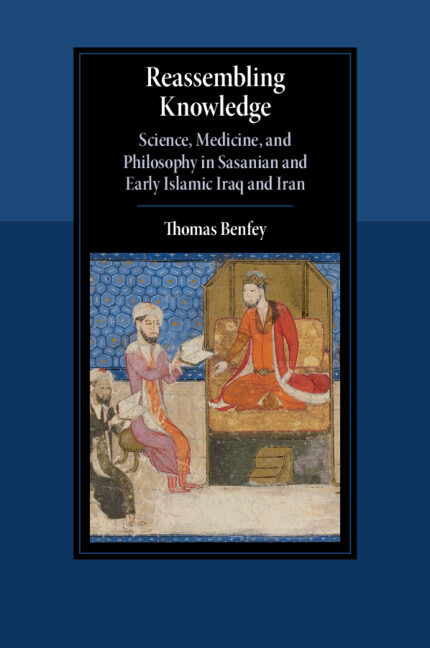
Iranian tradition held that the first, ancient dynasty of kings had mastered all the useful sciences, from astronomy to medicine, and recorded them in books of wisdom. Some claimed the prophet Zoroaster himself to be the ultimate author. These books were well guarded in the great palace we call Persepolis. In one terrible night of destruction, Alexander of Macedon burned down the palace and dispersed the precious books. Some found their way to Greece, while others are said to have traveled to the east with Alexander’s army to India. For centuries the land of Iran remained bereft of learning, while the equivalent of today’s universities and hospitals rose up in Syria and Afghanistan. Iranians had to beg their neighbors to send them doctors, astronomers and sages, in the middle of their constant warring with them—embarrassing to say the least. Finally, the greatest king of the Sassanian dynasty, Khosrow I (reigned 531-579), enticed scholars from abroad and directed them to establish native academies. Perhaps in a nod to local sensibilities, and mindful of the jealousy of the Zoroastrian clergy, Khosrow claimed to be merely repatriating the wisdom that had been stolen by the destructive Macedonian. How this actually unfolded is told in Thomas Benfey’s new book, Reassembling Knowledge.
The story requires considerable unpacking, since it only comes down to us through yet another reassembling of knowledge, by the Abbasid caliphs of Baghdad, three centuries after Khosrow I. As eager as their pre-Islamic predecessors to sponsor scientific activity, rulers like Al-Mansur gathered together scholars from cosmopolitan traditions: Jewish, Christian and Zoroastrian. These writers synthesized and preserved much of the scientific knowledge of late antiquity, making it available in Arabic. The motives of the caliphs and the Sassanian kings were similar, to act as patrons of the sciences.
In both eras the Indians enjoyed a reputation for mathematics and astronomy. Both before and after Islam the government needed Indian maths to reform the calendars, essential for the practical matter of tax collection. Indians also had extensive knowledge of precious medical plants, which abounded in their country. Westerners provided access to fundamental medical texts like Galen, but also offered deep practical knowledge. Jews and Christians often served the old kings as well as the later caliphs as physicians.
In analyzing these 8th and 9th century scientific texts, Benfey highlights a palimpsest of synthesis dating back to Sassanian times. We do not have direct access to much of their scientific literature, so we have to reconstruct it via later texts in Aramaic or Greek, or even later texts in Arabic, which may or may not rely on a Middle Persian original. Because of the imperfect nature of translation and transcription, particularly of proper names, great effort is required to reconstruct the intellectual lineage of a given scientific notion, and to distinguish the original source from later transmission. A good example of the author’s detective work is his attribution of astronomical tables—the “Zij-i Shah”—to a specific Indian school and his demonstration that this knowledge dated to the “reassembling” performed by the Sassanians, and not a later, Abbasid-era source.
The Sassanians asserted that they were recovering the lost science, confident that the ultimate truth unveiled by their research would be consonant with their Zoroastrian faith. People of this age assumed that articles of faith had to be true, but struggled to produce indisputable proofs. For inhabitants of cosmopolitan Iran, in the center of the old-world oikumene, diverse points of view abounded: Jewish, trinitarian and monophysite Christian, Buddhist, and Vedic, making it tempting to conclude that knowledge was inadequate to explain man’s role in this world, or his possible destiny in the next. A tradition of skepticism, nurtured by philosophers like Burzōy, Paul the Persian and Uranius, did not find favor with Khosrow. Resurfacing centuries later under the Abbasid caliphs such beliefs led to the execution of the polymath and translator of Burzōy, Ibn Muqaffa.
The rich legacy of Sassanian and the later Abbasid curiosity then fell victim, in 1258, to the Mongols, who burned down Baghdad and its libraries. To the extent that Iran later experienced a revival under the Safavids, much was again lost during the Afghan sack of Esfahan in 1722. Despite these recurrent disasters, or perhaps because of them, Iranians retain a keen interest in science. One has only to consider the numerous prizes won by its young mathematicians and chess-players. Their curiosity and persistence in the pursuit of knowledge will survive even the current menace to “bomb them back into the stone age.” Benfey’s book is a dense but lucid exploration of Iran’s ancient scientific traditions.