“Slavery and the Jews of Medieval Egypt: a History” by Craig Perry
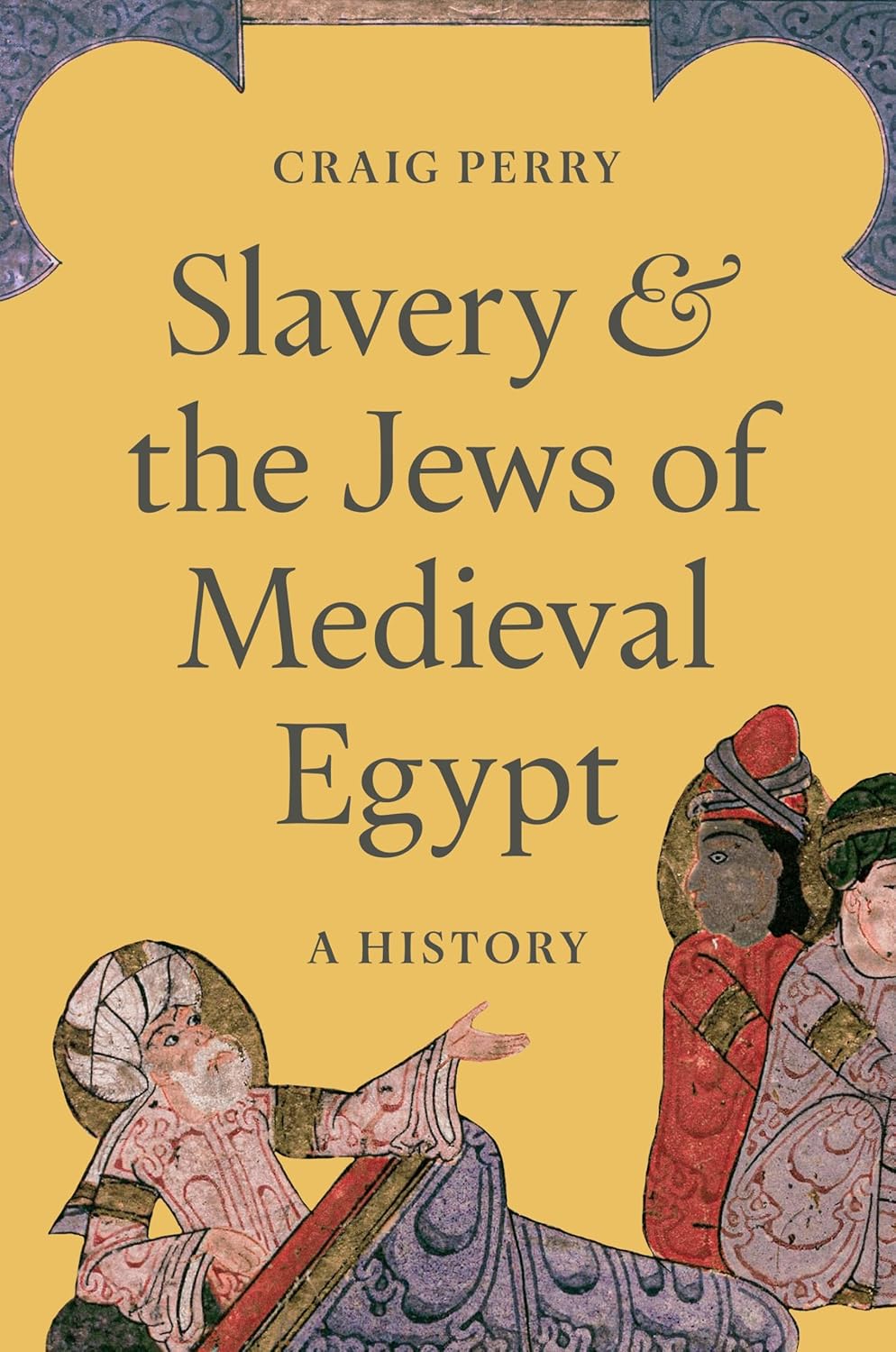
Slavery underpins so much of the pre-modern Islamicate world, with its slave-sultans, eunuchs, elite dancing girls as well as household servants, and yet we don’t know much about this social institution and what we know is probably wrong. Perhaps because contemporary historians considered slavery so natural, we can glean little insight from their texts about how the institution functioned; who became enslaved, how did the slave trade work; how were its victims treated? Craig Perry seeks answers to those questions by delving deeply into the Cairo Geniza, a trash repository which by serendipity preserves for us tens of thousands of private, legal and commercial documents from the 11th-12th centuries. With these, he comes to a number of surprising conclusions about the workings of medieval slavery in the lands of Islam.
The Geniza documents reflect the experiences of Egypt’s Jewish community with slavery. Just as the scribes used both Hebrew and Arabic (written in Hebrew letters) to transact their business, so the underlying legal framework makes use of both Talmudic and Muslim legal precepts. Despite this specificity, these documents bring to life the world of the enslavers and the enslaved. The technical aspects of slavery as “ownership” impacts many life events: inheritance, dowries, and divorce, which leaves an extensive paper trail and many thought-provoking details.Much of what Perry lays out seems like familiar territory to readers of The Thousand and One Nights, or even the Roman comedies of Terrence and Plautus.
In Medieval Cairo enslaved people performed many roles. They worked in the domestic sphere, cooking, cleaning, and nursing infants. Because well-off Jewish women observed a form of purdah (seclusion) similar to their Muslim sisters, they often employed their enslaved maidservants for shopping and errands. Some lucky young women were purchased only to sing and dance, though they could be rented out to perform at circumcisions or weddings by their owners. Unsurprisingly, most of Cairo’s enslaved population consisted of women and girls, since women could not employ male slaves, while men could employ both.
The men, on the other hand, often exploited slave labour in their businesses, as factotums, preparers in a pharmacy, carpenters, even as secretaries. Since Perry’s subjects are Jews, we do not get a look at the use of enslaved people by the ruling elite, who had eunuch and slave soldiers. Indeed the slave soldiers (Mamluks) of Cairo wound up taking over Egypt and ruling it for 250 years, after the period covered here.Men, perhaps inevitably, exploited enslaved women for sexual services, causing a great deal of anxiety both to their own wives but also to society as a whole. This form of exploitation characterized long-distance merchants, who often left them homes for years at a time. Muslim practices in this case differed significantly from Jewish ones. Rabbis tried mightily to discourage such liaisons, but one concludes, on the basis of Perry’s documentation, not very successfully. In the case of offspring, the plot thickened, as noted below.Slavery in this era is primarily an urban phenomenon.
Much of what Perry lays out seems like familiar territory to readers of The Thousand and One Nights, or even the Roman comedies of Terrence and Plautus. At the same time, there are some “aha” moments. Perry clarifies the differences between Medieval Egyptian and early modern American slavery. The older slave trade was not so much massive and long distance, as capillary. A merchant from Cairo went to Gujarat, bought a captive, returned to Cairo and sold her. There is no evidence of large scale enslavement and transportation over great distances—the conditions of travel simply did not allow this. So most of the enslaved peoples came from nearby:Nubia to the south, the Christian lands to the north, or India. Nor did large-scale plantation slavery exist then. In Iraq, earlier slave revolts had given the rulers a run for their money; in Egypt, there was plenty of exploitable farm labor, not did the returns to agriculture justify an investment in enslaved people as capital. So slavery in this era is primarily an urban phenomenon. Finally, despite the high percentage of enslaved persons from Nubia and Ethiopia, race did not correspond to enslaved status as in the new world. Enslaved people included Greeks and Armenians, people of color could be slave owners.
Perhaps because racist concepts did not underlie the institution of slavery, the boundary between enslaved and free people was more fluid than in American slavery. Manumission was consequently frequent. Last wills and testaments often provided freedom for enslaved servants, and sometimes even financial support for them. Muslim law and Jewish law provided different solutions to the situation where the enslaved woman carried her owner’s child. The son of a Muslim man was automatically born free—this ruling alone ensured that slavery would be a misfortune occurring in a single individual’s life, and not a generations-long curse. The son of a Jewish man by his enslaved concubine remained a slave, because the man could not, cannot transmit membership in the Jewish community.This led the rabbis to urge men living in concubinage with enslaved women to manumit their partners, to allow them to convert to Judaism, and to marry them. It is clear that the rabbis understood slavery to be an unavoidable evil, while manumission provided the ideal outcome. The greatest Jewish judge of all times, Moses Maimonides, argued for compassion and gentleness in dealing with the enslaved. Yet, as Perry writes, we can imagine the irony of Jews celebrating Passover, and repeating the words, “our fathers were slaves in the land of Egypt,” while being served at their couches by enslaved people.Dealing with a fraught subject like slavery, Perry navigates between a historian’s dispassion and a 21st-century sense of outrage. Though his prose is precise and readable, Perry nods off from time to time repeating himself and providing over-lengthy recapitulation. The actual text fills only 150 of the 369 pages. The notes are copious and worth reading for those interested in the methodology. It is not an easy matter to turn 11th-century scrap basket into a vivid picture of Cairo’s social life with enslavers and enslaved but Perry’s attempt is noteworthy.