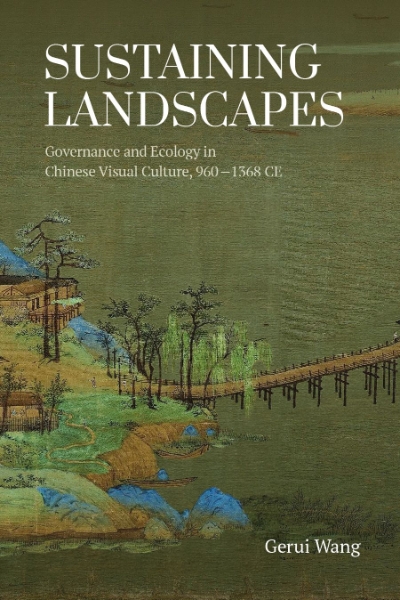
“Sustaining Landscape: Governance and Ecology in Chinese Visual Culture” by Wang Gerui
The art historian Ernst Gombrich once observed that in Chinese landscape painting, the aim is not to reproduce the appearance of things, but to convey the rhythm and spirit of nature. Among genres of traditional Chinese art, landscape painting is widely regarded as a central tradition and admired for its qualities beyond the aesthetics, with the capacity for conveying lofty ideas and cultural meanings. To many artists, Chinese landscape painting is not merely a literal depiction of a specific place but represents an idealized vision of their environments shaped by their imagination and individualized understanding of nature. Chinese landscape paintings thus bear meanings beyond the physical realm, elevating the viewer towards spiritual and intellectual awakenings.
Wang Gerui’s Sustaining Landscape: Governance and Ecology in Chinese Visual Culture not only discusses the symbolism of traditional Chinese landscape paintings but goes further to examine the ways Chinese landscape art reflects ecological thought, linking visual culture to infrastructure governance, resource management and geospatial knowledge. The book examines how nature and the environment are debated and developed alongside the rise of Chinese landscape representations in paintings and mundane paraphernalia such as fans and ceramic pillows, reflecting how the Chinese people perceive and interact with their natural world and environment as shaped by politics, governance and resource management.
Fans with landscape art were portable objects that served as a medium for the expression of personal taste.
By the late 12th century, Chinese landscape painting has extended beyond scholars and officials to lower segments of the society, and by the 13th and 14th centuries, mass-produced objects found among the populace featured landscapes depicting empathetic portrayals of the relationship between humans and the natural environment. For example, fans with landscape art were portable objects that not only helped people cool down in summertime but served as a medium for the expression of personal taste.
The fans depict different human activities in their engagement with the natural world, from thriving landscapes to the plights of people encountering harsh environmental conditions. In Towing a Boat in a Rainstorm (late 12th century), the author underlines how harsh weather endangers communities who depend on rivers for their livelihood. In this fan painting, two labourers struggle to tow their unsteadily moored boat to shore amid a relentless rainstorm, their bodies hunched and straining against seemingly strong winds and water. Dark, menacing clouds are illustrated and misty, churning waves heighten the tension, symbolizing the fishermen’s vulnerability and precarious situation. Representations of people battling extreme weather and scarce resources stirs compassion for disadvantaged social groups such as the rural poor in these representations.
In addition, Wang writes about the ways in which Northern Song landscape paintings reflect concerns in public infrastructure and the natural world, revealing dynamic interactions among people, natural resources and their built environment. Infrastructural projects such as improved roads and waterways enhanced transportation safety and reliability while facilitating travel and the circulation of wealth. Qingming shanghe tu is used as an example to illustrate this emphasis on commerce. The painting depicts bustling riverbanks lined with wine stores and eateries, shops serving diverse social groups, and workers unloading goods from boats, underlining the waterway’s role in enhancing trade. Shops and buildings near the ports serve as inns and hubs that offer accommodation for travellers.
Similarly, bustling waterways with boats of various sizes are also depicted in paintings such as One Thousand Miles of Rivers and Mountains and Summer Mountains. While depicting climatic and environmental conditions, Chinese landscape paintings are often accompanied by poems and inscriptions to convey the artists’ thoughts. Prominent landscape 11-century painter Guo Xi’s son Guo Si collected notes while he painted landscapes. In a poem, Guo Si writes,
… Oranges fill the grove, golden like jade blocks,
Reeds brush the shore, snow-like flowers in flocks.
A tavern flag hangs high by Lotus Harbor’s side,
A fishing boat drifts slantwise where lotus blooms abide …
While some Chinese paintings illustrate an idyllic relationship between humans and nature, other works represent the hardships of poor villagers. In Fisherman’s Evening Song, Xu Daoning (died 1052) presents a stark and depleting landscape characterized by shallow waters and few navigable paths or vessels. Bare forests, slender mountain ranges and limited vegetation further convey a sense of isolation and minimal accessibility. This suggests that the artist consciously emphasizes scarcity and hardship, using the landscape not merely as a backdrop but as a means to convey the challenges of survival and the precarious relationship between the Chinese people and their environment.
Traditional landscape paintings and administrative maps use a common visual language to convey perceptions of the interrelated functions of people, natural resources and governance.
Apart from exploring landscape representation in paintings, the book also considers administrative maps used by Southern Song local gazetteers as an alternative form of representing the landscape in work documentations. Devised by prefects and magistrates, these maps served as tools to gauge the availability and conditions of local resources of the eras. There are documentations by local gazetteers on grievances against land reclamation projects that caused environmental degradation, thus reflecting tensions between agricultural development and environmental sustainability.
While traditional landscape paintings and administrative maps are different forms of representation, they use a common visual language to convey perceptions of the interrelated functions of people, natural resources and governance. A characteristic of maps in local gazetteers is the arrangement of frontal and bird-eye’s views that depict buildings frontally, with inscribed names for easier identification. The use of both frontal and aerial views in administrative maps is clearly demonstrated in literati landscape paintings.
Qiao Zhongchang (12th century) applies this technique in Illustration to the Second Prose Poem on the Red Cliff, where the poet Su Shi is depicted asleep in the house, dreaming of talking to two Daoists. The gate, front yard, and house façade are depicted frontally to reveal the poet reclining inside, while rendering the backyard from the aerial view. This dual perspective enables viewers to observe the rooftops of the side buildings as from above, much like in maps. The dual perspective element not just mirrors cartographic techniques but also reflects the literati painters’ interest in integrating spatial understanding with narrative and intellectual engagements.
Landscape imagery on ceramic pillows reflecting a flourishing commercial culture.
During the Jin and Yuan dynasties, landscape imagery proliferated on ceramics, particularly on Cizhou ceramic pillows produced at various kilns across northern China, reflecting a flourishing commercial culture. Many intact examples of ceramic pillows retrieved from tombs show painted images of landscape scenes reminiscent of the painting styles of the Northern Song court, revealing how artistic styles moved between social elites and vernacular audiences. A group of educated Han Chinese pillow makers who upheld Confucian and Daoist values but were marginalized under Jurchen and Mongol rule worked as craftsmen in northern China. Their ceramic pillows bear inscriptions of their values that reflect Confucian and Daoist ideals with literary skill, reflecting the intellectual depth of their creators.
Many pillow scenes depict scenes from popular plays, connecting the fantastical world of dreams in everyday items. For instance, the 13th-century story of Sima You (fl. late 11th century) dreaming of the celebrated fifth-century courtesan Su Xiaoxiao (479-502) was a popular subject in Yuan plays and was rendered on both ceramic pillows and paintings. The designs on ceramic pillows appealed to viewers of modest means, providing a visual link to the cultural ideals found in theatrical performances. Referencing The Legend of Yingying, a ceramic pillow represents Yingying burning incense at night. a story that served as the basis for Wang Shifu’s (active 1295-1307) celebrated play Romance of the Western Chamber (Xixiangji).
In addition, many serene landscapes on ceramic pillows and reclusive ideals in Yuan drama reflect a desire among common people for retreat and tranquility amid the turmoil of the Yuan period. While landscapes provided an imagined sanctuary, dreams offered as an escape from the fraught realities of war, natural disasters, and social inequities.
Across different mediums of representation, the readers understand Chinese landscape art functions not just as visual expressions of harmony and spiritual reflections, but they also serve as instruments to document and critique infrastructure, resource management and socio-political conditions. The circulation of artistic styles and between elite circles and popular audiences from the 12th to 14th centuries reveal how landscape imagery can mediate social empathy and imaginative engagement with the environment, bridging personal, political and ecological perspectives.