Old post
This post was published before January 2026. Some links, images or other content may no longer display or work as originally intended.
“The House of Awadh: A Hidden Tragedy” by Abhimanyu Kumar and Aletta André
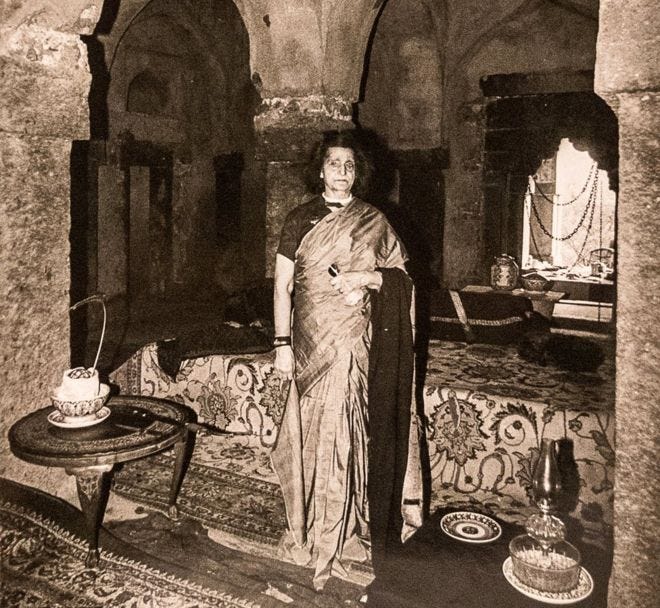
This epic story centres on an irresistible premise: is the main character “Her Royal Highness, The Begum of Oudh, Shehzadi Wilayat Mahal, Heir to the Last King of Oudh Begum Hazrat Mahal and Wajid Ali Shah” … or just plain old “Mrs Butt”? Satisfyingly, even the latter more prosaic option “Mrs Butt”—horse-loving wife of an academic—opens a Pandora’s box linked to the 1951 assassination of Liaquat Ali Khan, the first prime minister of Pakistan.
Whichever it is, the result is a feisty protagonist living for a decade in the VIP lounge of New Delhi Railway Station with her children, dogs, servants, and antique furniture, with dreams of reclaiming a lost kingdom—the once rich and fertile kingdom of Awadh (which occupied roughly the footprint of current-day Uttar Pradesh). In this station waiting room she received international royalty as guests, as well as Indira Gandhi and Prime Minister Nehru. The story, while grounded in archival rigour and on-the-ground investigation, is a tale so unbelievable it could only be true.
The story is a tale so unbelievable it could only be true.
At the story’s heart lies Malcha Mahal, a 700-year-old Tughlaq-era hunting lodge nestled in Delhi’s Ridge Forest. Once private and secluded, the dilapidated mansion now lies amid the ever-encroaching hubbub of modern New Delhi.
The authors put this in context by going back centuries to the collision between the Mughal and British empires, the trauma of the 1857 Lucknow uprising, the forced annexation of Awadh, and the upheavals of Partition. This backdrop adds layers of political, religious and psychological complexity to Wilayat’s claim to royal entitlement.
The central figure is Wilayat Mahal, or perhaps Mrs Butt, depending on which strand of her chameleonic identity one traces. Was she the heir of the last monarchs of Awadh? Or a deluded “mad aunty” clinging to dreams rooted in a dislocated past? This ambiguity fuels the book, and the authors’ framing of her as akin to Tennessee Williams’s Blanche Dubois in A Streetcar Named Desire helps orient the reader through a dense and shifting narrative.
Wilayat presents herself as “a wronged princess, embodying a century-old history of injustice” and emerges as a figure of profound contradictions: proud, eccentric, and often tragic. Her demands for recognition included printed letterheads and silver-platter correspondence, fuelled by her unwavering belief in her lineage. Her instability is suggested through accounts of possession by djinns, shifting origin stories, and time in an asylum—yet even these are nuanced by political context and the unreliability of official narratives. She staged a years-long sit-in against perceived betrayals by both British and Indian governments, seeking restoration of Awadh’s royal estate and legacy. Her protest was, in essence, a symbolic stand against erasure.
The book is shaped by its authors’ investigative zeal.
While critics labeled her a fraud, Kumar and André resist reduction based on tropes and stereotypes. They explore her inconsistencies not as evidence of deception, but as symptoms of trauma—personal and collective. The trauma of Partition looms large: Wilayat’s life, like so many Muslim families caught in the Subcontinent’s violent reshaping, is riddled with loss, exile, and bureaucratic limbo. Her story becomes a microcosm for the displacement experienced by millions.
As for the matter of her Kashmiri husband Inayat being implicated in the assassination plot of Liaquat Ali Khan: the trigger man, Afghani Said Akbar, was shot dead at the scene leaving a swirl of murky conspiracy theories behind, unresolved to this day.
The academic Mr Butt was involved in a circle of activist and politically-agitative groups, and Wilayat herself was no saint, having been institutionalised in 1954 as a result of disrupting Prime Minister Bogra’s speech in Lahore, Pakistan. She was at the time president of the Jammu and Kashmir Muslim Conference and treasurer of the Muslim League Women Wing.
The research is forensic, multilingual, and terrier-like.
One of the most affecting parts of the book concerns her claim of descent from Begum Hazrat Mahal, a formidable elephant-riding resistance figure during the 1857 rebellion. The tenuous nature of that claim—filtered through female lineage and the ambiguity of mut’ah marriages (often a temporary arrangement of moral convenience with minor wives, at worst tantamount to being a kept woman)—highlights the ways in which women’s stories are often excluded from official genealogies. It adds emotional gravity to Wilayat’s struggle.
The book is shaped by its authors’ investigative zeal. Kumar and André—he Indian, she Dutch—live in Delhi, and embark on a cross-country pursuit, chasing whispers down alleyways (often on bicycle or rickshaw), unlocking secret documents in dusty archives, interviewing estranged relatives and one-time servants, and tracing leads that often dissolve into rumour or contradiction. The work is as much a chronicle of their research quest as it is of Wilayat’s life. They are candid about their own uncertainties.
What is true? What is false? What is real? What is imaginary? The search is frustrating at times. At this stage we ask each other why we are pursuing this story.
The research is forensic, multilingual, and terrier-like. The authors’ cultural awareness and sensitivities enrich the narrative. The ability to work in Hindi, Urdu, and English proves invaluable in unpacking the complex web of documents and testimonies. Their transparency—documenting not just what they found, but how they found it, and sometimes how it slipped away—adds a layer of integrity.
The structure of the book—divided into Memory, History, and Identity—helps organise what could otherwise become an overwhelming mosaic. The historical section, particularly on Kashmir and the politics of post-Partition India, provides vital context, though at times it risks slowing the narrative. Nonetheless, the framing reinforces the complexity of identity formation in post-colonial South Asia. The epilogue is restrained and thoughtful, and ties up many loose ends, not with a pretty little bow, but the best that could be pieced together from fractured memory, bureaucracy, and myth.
The resulting portrait is richer for its nuance. The authors’ conclusion, invoking Prof Akhtar—a renowned Indian-American psychoanalyst—brings the story full circle:
The line between delusion and truth, and the line between delusion and lie, is very, very thin.
That insight, as much as any archival discovery, is what this book offers.
This is ultimately a story about the ghosts of empire, and the stubborn echoes of lost grandeur. It will appeal to readers drawn to multi-generational sagas, post-colonial legacies, and human stories that resist easy classification. As one former neighbour of Wilayat in Kashmir reflects: “Sometimes I feel like I knew folks from a mystery novel.” Apart from the authors’ painstaking research to find the “truth”, that’s very much how it reads.
You must be logged in to post a comment.