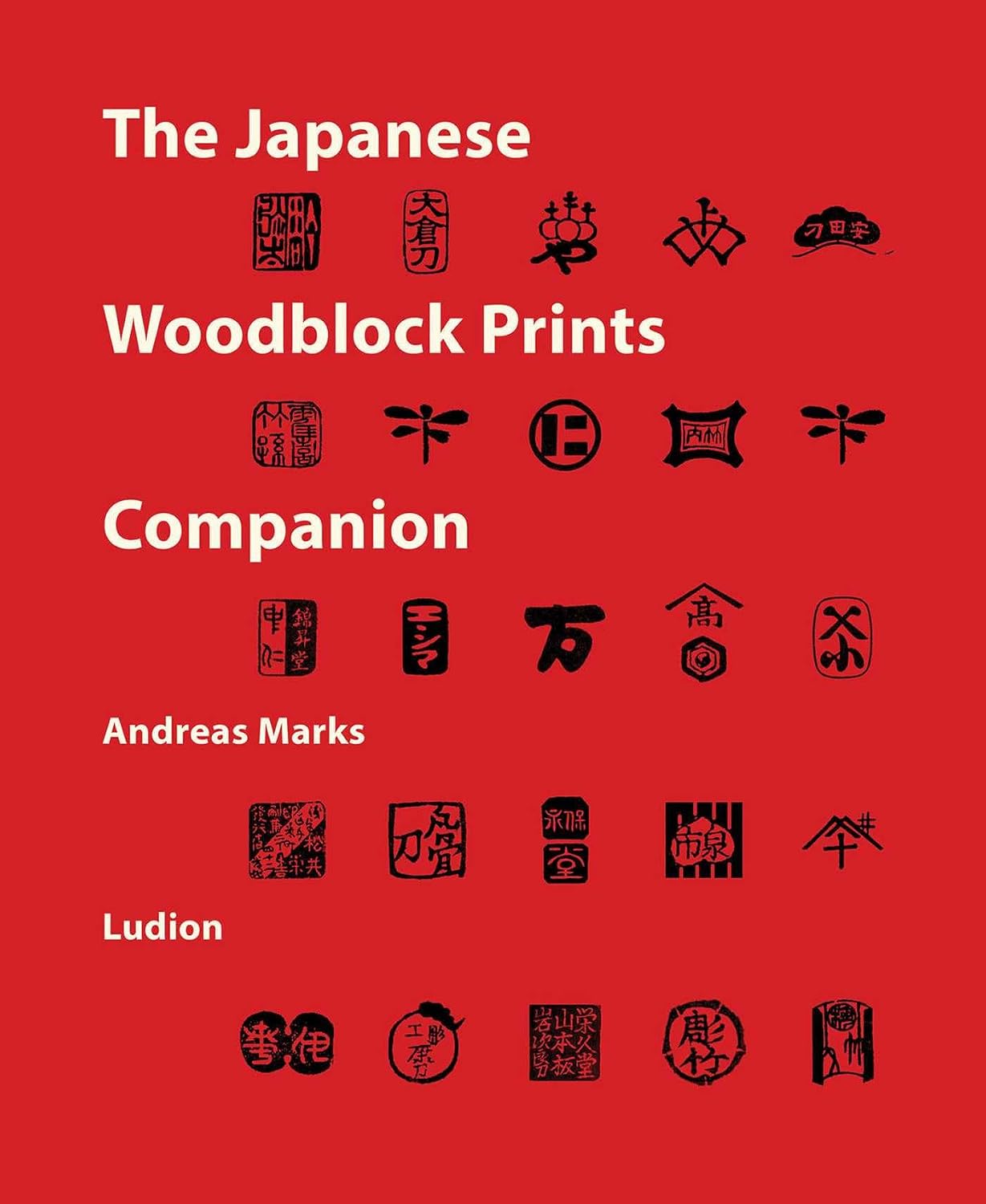
“The Japanese Woodblock Prints Companion” by Andreas Marks
“Under the Wave Off Kanagawa”, popularly known as “The Great Wave”, is without a doubt the most celebrated Japanese woodblock print. It is also the most recognised work of Japanese art tout court. Ask anyone with an interest in the genre and they will tell you that it was made by Katsushika Hokusai (1760-1849) which, of course, is true. But this attribution only tells part of the story. It obscures the fact that the production of ukiyo-e, or images of the floating world, was a collective effort which involved many other actors.
The driving force behind the process was the publisher. He put the financing together, commissioned the design, chose the craftspeople, procured some of the material, sought the censor’s approval and even organised sales and at times distribution, too. He also assumed all the risks, writes Andreas Marks in an instructive essay opening this impressive reference work on ukiyo-e publishers, block carvers, printers and censors. If the venture failed, he “had to be able to withstand the financial loss and conserve enough capital” to remain in business.
This was no simple task. The market for woodblock prints in Tokugawa Japan was extremely competitive. At its peak in the 1840s, more than 250 firms were active in the field. To succeed, Marks explains, publishers needed sharp entrepreneurial skills, but also “a keen sense of fashion and of the mood of the market”.
The production process often began with the publisher pitching an idea to a designer. After agreeing on a composition, the artist, who like all his peers had been trained as a painter, used brush and ink to prepare a drawing. At this stage, no colour was involved; everything was in black and white.
If the publisher was satisfied, the material was passed on to a carver of his choice. In some cases, established artists were able to insist on a particular individual, but this was relatively rare. The selected woodworker then prepared a proof, on which the artist indicated the colours to be used. Based on the palette and complexity of the design, he also assessed the number of blocks necessary to faithfully render the vision of the designer. It was not unusual for a carver to grouse about the intricacy of a particular motif and grumble about the difficulty of transferring it onto woodblocks.
Once completed, the blocks, which were the property of the publisher, were handed over to a printer, who pulled as many impressions as ordered. If asked, the printer could also add luxurious touches, such as embossing or powdered mica to make parts of the woodcut sparkle. A good artisan could turn out between 700 and 800 copies per day.
This production process remained stable for most of the history of ukiyo-e, especially from the advent of full-colour prints in the second half of the 1700s up to the early years of the 20th century. All artists, from early masters such as Utamaro (1753-1806) and Kiyonaga (1752-1815) down to the last generations of Ogata Gekko (1859-1920) and Migita Toshihide (1863-1925), operated within that structure. Ukiyo-e was a business, and this is how it worked.
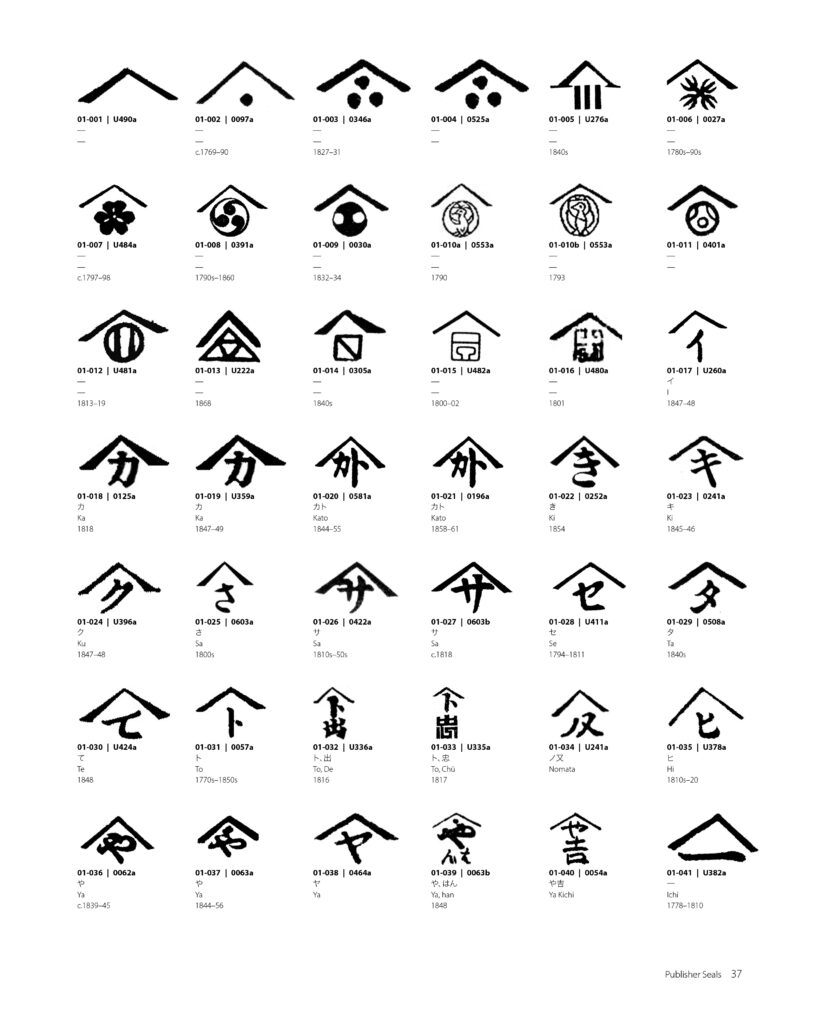
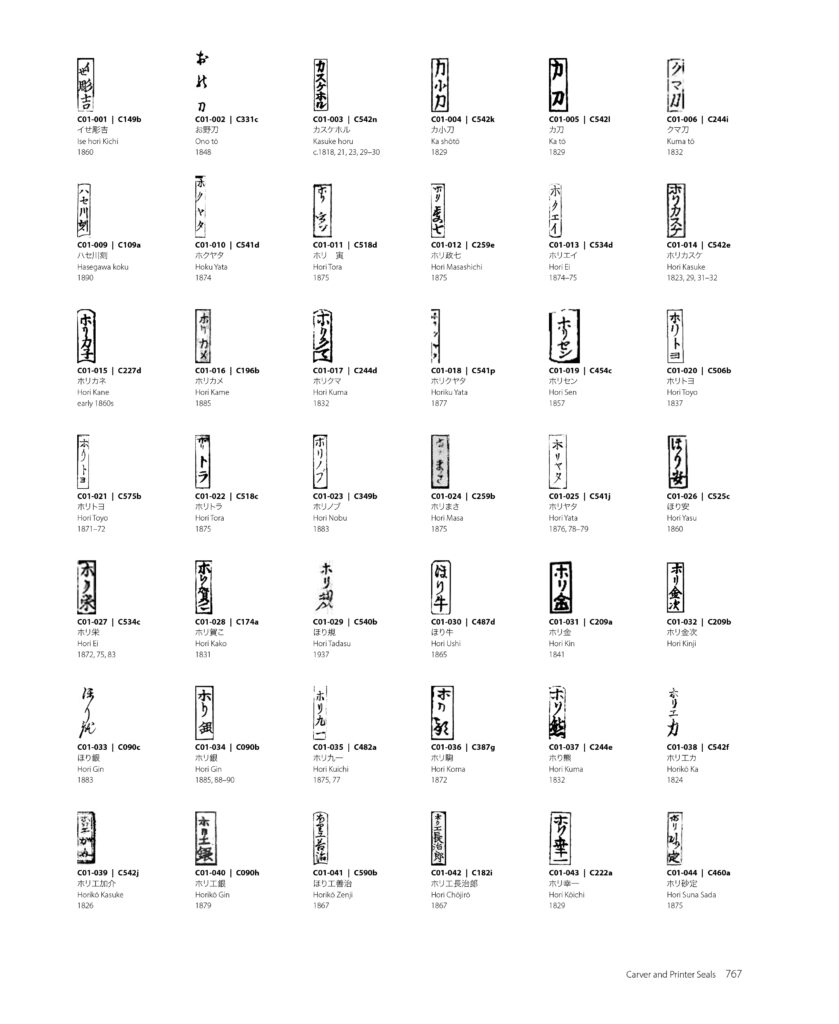
Today, good-quality prints remain relatively easy to find, but dating them precisely can be fiendishly difficult. Neither blocks nor prints displayed a date, and few records about the context in which they were made have been preserved, so we must rely on other clues to establish a chronology. Fortunately, almost all ukiyo-e show the seals of the publisher and censor, and sometimes those of the carver, too. Knowing when these individuals were active thus offers precious evidence on when a woodcut likely hit the market.
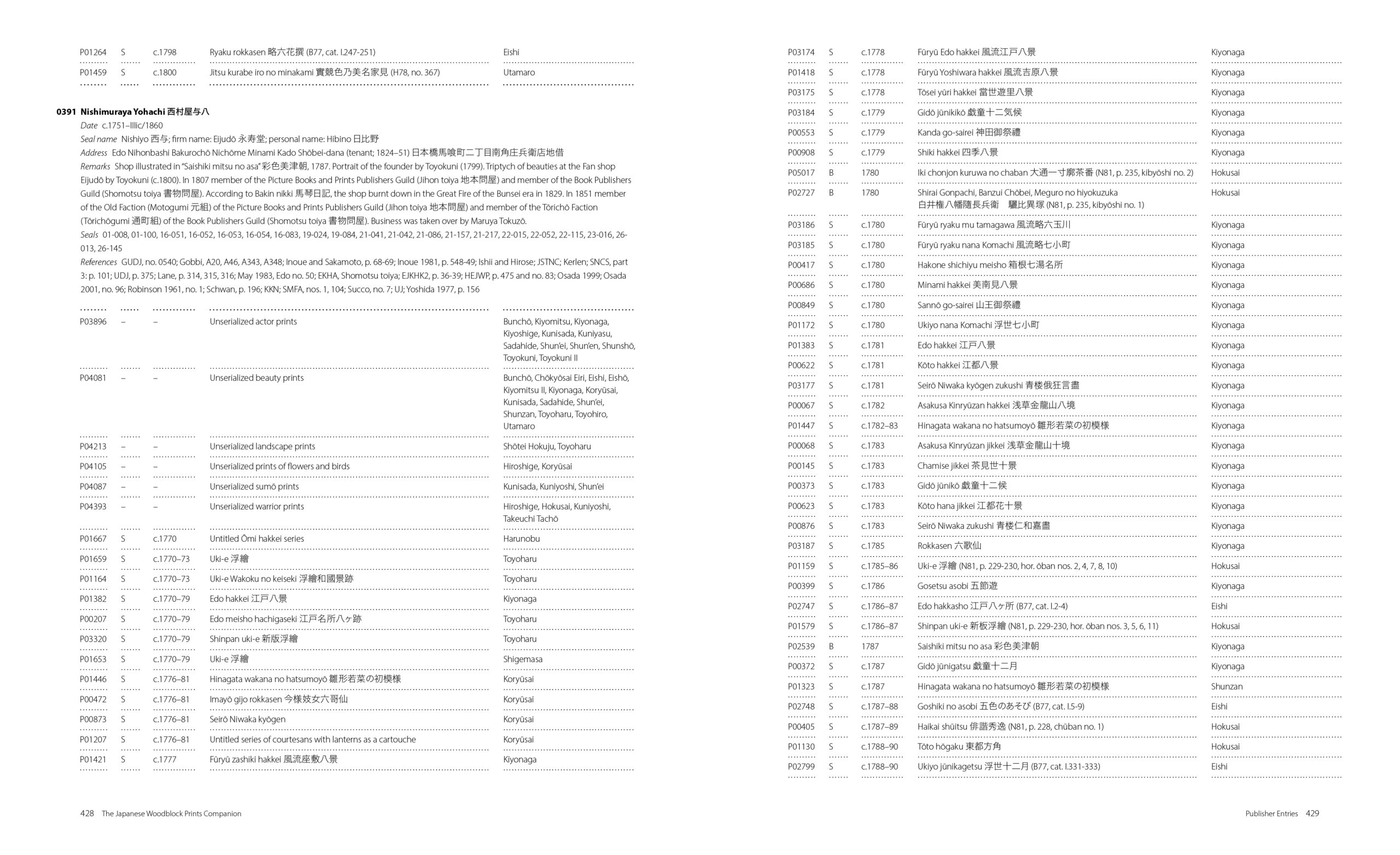
This is where the value of this book comes in. It is, in essence, a voluminous dictionary of 2,086 publishers, along with their seals, the main series of prints they released and other relevant details. Similar information is offered on 585 carvers and 286 printers, while a separate chapter presents seals of poetry clubs, which regularly commissioned surimono, ie prints not for public sale. In total, more than 4,000 seals are reproduced, exactly as they appeared on the artworks.
This edition is an updated and vastly expanded version of a previous work, Publishers of Japanese Woodblock Prints: A Compendium, also by Andreas Marks, which was released by Brill/Hotei in 2011, and has long been out of print. It is a feat of research and synthesis which will likely stand as the reference work for the next generation of scholars, dealers and serious collectors.
Publishers, designers, carvers and printers operated in a symbiotic relationship. Remove any one of them and the entire ukiyo-e edifice collapses. As a result, close—albeit not exclusive—bonds often formed between them. Hokusai began working with publisher Nishimuraya in the mid-1780s and, half a century later, the two were still collaborating, most notably on Thirty-Six Views of Mount Fuji, the series to which “The Great Wave” belongs. Likewise with Egawa Tomekichi, a highly-skilled block cutter, who worked on and off with Hokusai for more than 20 years.
Much of the life and work of the people who created ukiyo-e remains shrouded in mystery. But thanks to Andreas Marks, we can now draw new connections between many of the individuals who breathed life into one of Japan’s most unique art forms.

You must be logged in to post a comment.