“Birds in a Gale: A Novel” by Ata Nahai
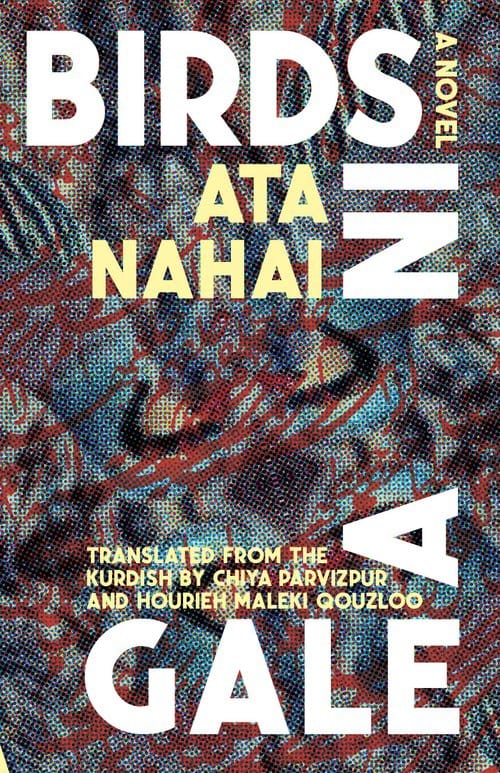
Nahai, who hails from Iranian Kurdistan, is regarded as one of the leading contemporary novelists writing in Kurdish. Birds in a Gale, originally published in 2002 and set in the Iran of the 1990s to consider the aftermath of the Iranian revolution of 1979, is one of his most celebrated novels and demonstrates both his use of post-modern narrative and his extremely lyrical prose.
The prologue presents the horrifying episode of a young, unknown woman’s self- immolation in a back alley, which turns out to be the disturbing nightmare of the protagonist, Mehraban, that haunts him throughout the novel, but whose full significance only appears later.
And where was he when she was a yarn of fire at a small house and courtyard? Smaller than the small world of her forbidden, haram dreams and fantasies; smaller than the whole collection of her wants; smaller than the share she wanted from life; even smaller than that which wraps her fire-woven body.
Nahai has a fine sense of place: he conjures up the unnamed Kurdish city with its numerous alleyways, secret courtyards, brightly painted wooden doors, old tea houses and market stalls.
Some years after fleeing Iran in 1979, Iranian-Kurd, Mehraban, has returned to his unnamed home city. As an exile in Europe, Mehraban has become a celebrated Kurdish novelist and his intention is to write a story about his contemporary and fellow student revolutionary, the painter, Farhad, who chose to stay in Iran and has become an elusive recluse. Though Mehraban is the main protagonist and storyteller, the actual first-person narrator is another writer, who knows both Mehraban and Farhad, and tells this story about Mehraban writing a story, while acting as a liaison between the two figures. The narrator is anonymous and enigmatic and all we really discover about him is that he has “a line of black, dirty, and ugly teeth”.
Nahai has a fine sense of place, and he conjures up the unnamed Kurdish city with its numerous alleyways, secret courtyards, brightly painted wooden doors, old tea houses and market stalls. Mehraban (who is from a once wealthy background), is staying, while he struggles to write, at his old family house; a crumbling, dilapidated and abandoned mansion but which he remembers once had “a goldfish filled swimming pool” and recalls, “behind the rows of roses, tuberoses, hollyhocks, and jasmines, his mother was lighting the coals for his father’s hookah”. But now, “the courtyard looked like a small park in the middle of a war-torn city.” Mehraban’s story about Farhad will also be a journey into his own past and memories while searching for the truth.
As the novel progresses, we learn about the past of both Mehraban and Farhad, their role in 1979 as friends and student protesters and would-be Marxist revolutionaries, and their arrest by the Savak (the Shah’s secret police). However, we also learn that their story is one of melancholic lost love that still haunts them, with a visceral sense of their betrayal of the women that they had once loved with all their hearts. Mehraban loved and lost Afsana, abandoning her when he fled into exile, and she consequently made a disastrous, miserable marriage to a controlling man she didn’t love, which ended in her death. Farhad loved and lost Kaleh, whose tragic story after his arrest and disappearance into prison gradually emerges.
As the novel progresses, Mehraban and Farhad’s stories become increasingly intertwined, and Mehraban tells the narrator he is increasingly unsure if he is writing Farhad’s story or his own. This is foreshadowed by a local newspaper:
A small image of him lingered in the corner of the front page, with the caption beneath: MEHRABAN EMBODIED IN THE CHARACTERS OF HIS STORIES.
His existential quest for Farhad’s truth gives way to the slippery unreliability of narration and identity. As well as regrets, Mehraban and Farhad also share a sense of looming mortality, as both feel they are coming to the end of their lives. On his initial meeting with Farhad, Mehraban finds him more dead than alive.
Farhad wrapped his thin, bony arms around his knee while his head dropped onto his shoulder. His hair and beard were grizzled, his eyes and cheeks sunken. He resembled a thousand-year-old mummified man, freshly extracted from the earth.
Unlike many of his contemporaries, Nahai chose to stay in Iran after 1979.
Unlike many of his contemporaries, Nahai chose to stay in Iran after 1979 to work as a writer and critic but has avoided having his novels censored. Birds in A Gale therefore has no direct criticism of the current Iranian regime, but nevertheless the regime’s presence is manifest everywhere in subtle and often ironic details. Mehraban sees a statue in the town square,
the head of a veiled woman, hands raised. At the base, in bold black letters: HIJAB IS THE BEAUTY OF WOMEN.
Mehraban and Farhad are known only by their surnames, without first names; as if to hide their precise identity from the authorities and we never learn even the surname of the actual narrator. When Mehraban flees abroad, his “father gathered all the books, piled them in the courtyard, and set them on fire” to protect the family. Much like writing from the former USSR and Eastern Bloc, there is an implied sense of self-censorship and the novel stages the internalised fear of what the regime might think of those recalling the past, which is opposed to Mehraban’s potentially dangerous nostalgia. When Mehraban meets his other old revolutionary “comrades”, he finds: “They had forgotten their dreams, their hopes, even how they used to talk. And they had forgotten him too…”
Mehraban’s brother, Balam, wants him to agree to sell the family mansion so that a bank can tear it down and turn it into a new headquarters, while his sister, Mounira, hopes to marry Mehraban to a much younger, beautiful poet, Laila, and for him to start a completely new life. To try to journey into the past is to take the risk of being perceived as an opponent of the current regime and writing the story of Farhad is dangerously close to challenging the Iranian regime’s deliberate forgetting and erasure of those secular forces who were central to the pluralistic 1979 revolution. These non-Islamic revolutionary elements were later expunged from the official history of Iran, as Ayatollah Khomeini created the Islamic Republic, after the adoption of the Velayat-e Faqih (Guardianship of the Islamic Jurist) constitution (officially approved and ratified on 3 December 1979).
Birds in a Gale is a moving elegy for a lost, betrayed generation.
This is a poignant, enthralling novel that explores the enormous personal costs of the Iranian revolution and what followed, for those young, idealistic Leftists and democrats who revolted against the Pahlavi regime, hoping for a better world, but who found themselves instead living in the bitter cruelty of a totalitarian theocratic dictatorship. Revolutionary Iran became a state that valued ideological Islamic “purity” far above its citizens’ lives. It is a moving elegy for a lost, betrayed generation, where the characters in Birds in a Gale, thrown hither and thither by the unrelenting storm of history and their shared trauma, entwine the personal and political in their stories as they attempt as best they can to mourn what was irretrievably lost. Birds In A Gale concludes with the final words of Mehraban’s fictional story about Farhad: