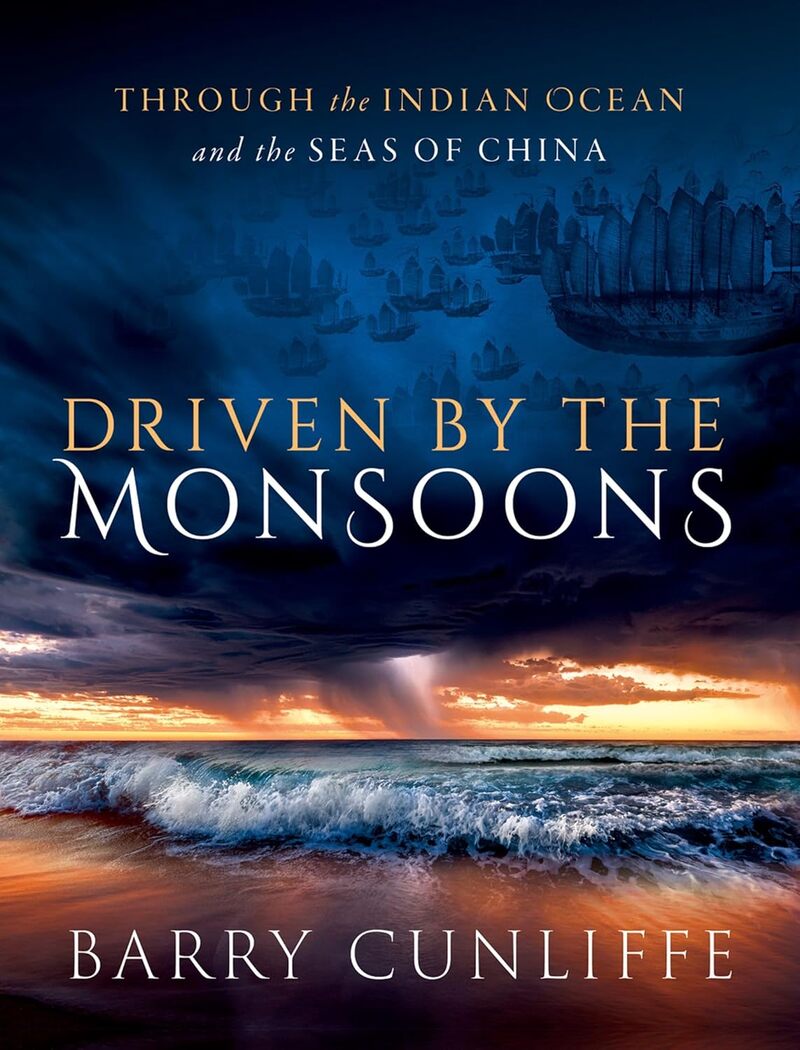
“Driven by the Monsoons: Through the Indian Ocean and the Seas of China” by Barry Cunliffe
History is often told as the story of distinct societies, focusing on the ambitions of kings and the outward march of empires. Yet there is an arguably richer tradition that views the connections between societies as the true engines of human development. Just as Peter Frankopan (The Silk Roads: A New History of the World) reframed antiquity around the Silk Road, and David Chaffetz (Raiders, Rulers, and Traders: The Horse and the Rise of Empires) recently argued that the horse was the definitive connection-technology of the terrestrial world, Barry Cunliffe’s Driven by the Monsoons applies this lens to the sea over the longue durée. Accomplishing for the Indian Ocean what Fernand Braudel did for the Mediterranean, the emeritus professor of archaeology at Oxford argues that the ocean was not merely a backdrop but the fundamental heartbeat of the ancient world, a rhythm dictated by the slow, unchanging geography of the earth and the seasonal back-and-forth of the monsoon winds.
While the Indian Ocean has long been recognized as a zone of connectivity, Driven by the Monsoons sets itself apart through three critical shifts in perspective; extending the timeline back to the Neolithic dawn of seafaring; stretching the map eastward to merge the Arabian Sea’s trade routes with the Austronesian migrations; and abandoning the exhausted Asia-Europe comparison entirely. Instead, he orchestrates his narrative on the structural dichotomy of the resilient sea versus the volatile land.The maritime world was dictated by the unyielding, seasonal reversal of the monsoon winds.
Cunliffe’s narrative begins in deep prehistory. Tracing the maritime impulse back to the sudden cold snap of the Younger Dryas (around 10,800 BC), he shows how coastal hunter-gatherers were forced to adapt to shifting environments. Millennia later, when the great river valleys—Mesopotamia, the Indus, and the Yangtze—produced massive agricultural surpluses and booming populations, they found themselves resource-impoverished. Lacking the basic building blocks of statehood like stone, metals, and timber, these societies were forced to look outward. Long-distance maritime connection, therefore, was not a luxury; it was an ancient, developmental necessity. This reliance on the ocean subjected human history to a biological and meteorological clock entirely different from the rhythms of the land. Terrestrial empires operated on the schedules of the harvest and the marching pace of armies. The maritime world, however, was dictated by the unyielding, seasonal reversal of the monsoon winds. You sailed when the wind allowed, and you stopped when it turned.
This meteorological reality is what gave specific geographies their immense power. Cunliffe identifies “zones of constriction”—places like the Malay Peninsula and Sri Lanka—which functioned as inescapable funnels for global wealth. These straits did not merely direct relationships; they physically trapped them. Because ships had to wait months for the monsoons to reverse direction before they could sail home, these chokepoints evolved into massive, cosmopolitan entrepôts. Merchants from the Arabian Sea and the China Seas were forced to live together, trade, and intermingle while waiting on the weather, creating a profound cross-pollination of culture, religion, and technology.This reality brings Cunliffe to his most compelling argument, one that positions this book as the direct maritime companion to his earlier overland history, By Steppe, Desert, and Ocean. He argues that terrestrial history is defined by violence and fragmentation, while maritime history is defined by stability. On land, territory is both the conduit and the objective of war; armies march through populated areas, subject to the constant disruptions of competing states. The sea, however, has no non-combatant populations. Out of the reach of rampaging armies, the ocean served as a civilizational safety valve where merchant shipping could simply sail around conflicts. It was a network held together not by military supremacy, but by “moral economies of trust,” where Buddhist and Islamic merchants traded securely across thousands of miles. As Cunliffe beautifully observes, “While dynasties came and went, merchants continued to ply their trade, safe in the certain knowledge that there would always be a demand for raw materials and consumer goods, and that the ever-consistent monsoons would be there to serve them.” Cunliffe quotes Bahadur Shah, the sultan of Gujarat: “Wars by sea are merchants’ affairs, and no concern to the prestige of kings.”While the Portuguese certainly utilized nimble, lateen-rigged caravels that allowed them to sail close to the wind, their true game-changer was the introduction of the floating gunship.
This unbroken era of stability lasted until the winter of 1497–98, when Vasco da Gama’s arrival shattered this maritime world. For thousands of years, the open ocean functioned as a stateless, neutral zone that belonged to no one. It was strictly a merchant’s domain; the rulers of the great terrestrial empires viewed the sea as an alien world where they had absolutely no prestige to gain or lose. This ancient era of stability was violently shattered by the arrival of the Europeans, who brought with them a radically different ideology. They viewed the ocean not as a shared, peaceful highway, but as a territory to be conquered, seeking to strangle the traditional networks and replace them with a monopoly of heavily guarded coastal fortresses. Ultimately, this aggressive new attitude was only made a reality through brute technology. While the Portuguese certainly utilized nimble, lateen-rigged caravels that allowed them to sail close to the wind, their true game-changer was the introduction of the floating gunship. By combining robust, iron-fastened European ship construction with heavy gunpowder artillery, they easily overpowered the fragile, stitched-together merchant dhows of the Indian Ocean, permanently transforming the maritime world into a militarized battlefield.
Dealing with a subject as vast as the Indian Ocean over ten millennia, Cunliffe expertly shifts the focus from terrestrial empires to the maritime world. His argument—that the monsoon winds and physical geography dictated the rhythms of Eurasian integration—is deeply compelling. However, by leaning so heavily into environmental determinism, the book occasionally risks flattening human agency, reducing the complex political and economic calculations of Asian maritime societies to mere reactions to the weather. The immense scope also means the narrative must sometimes sacrifice granular, local history for grand structural synthesis. Nevertheless, Driven by the Monsoons ultimately succeeds in its primary goal, providing a rigorous, well-documented reminder that human history has always been both constrained and facilitated by the physical realities of the natural world.