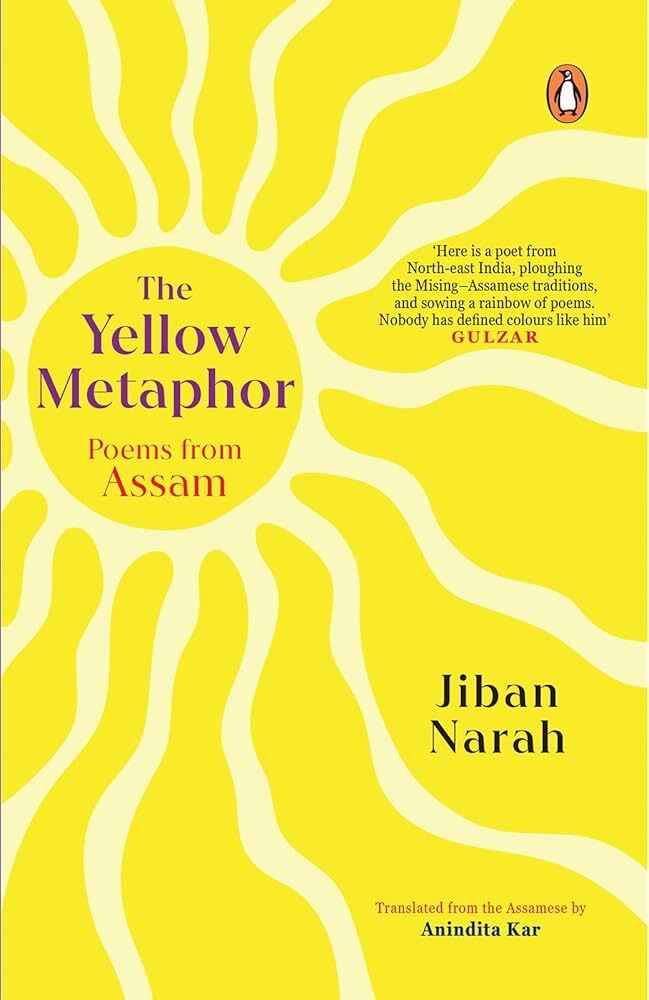
Jiban Narah’s The Yellow Metaphor is an unassuming collection of poetry, written from 1990 to 2023, that draws from the Mising and Assamese traditions of north-east India. Occasionally embedded in the English translation are the original Mising words, a translator’s decision to retain the otherworldliness of the poems. Assamese geography, fauna, and history feature prominently throughout the book. While steeped in regional references, Narah blends his poetry with literary allusions to Virginia Woolf and TS Eliot, as well as spiritual representations of Krishna.
What stays consistent throughout, as the title would suggest, is the treatment of colours as symbolic hues. The poem “Colours” starts the book with points of reference from which these colours can be further interpreted.
Strange how colours flow
Right after birth
my grandmother dipped me in greens
I was lifted from the midst of the yellows
by my mother
Spooling out lengthwise
the harlequin wrap threads
spun my way forward
amongst the blacks
These colours expand in their meaning once associated with images; take these examples plucked from different poems: “Come, let’s carefully turn yellow / like the ripened sun”, “The screams of women are red / the men, blue” or “Your eyes turn green / when the
bogori blooms.” In her translator’s note, Anindita Kar explains how the colours, as motifs, could be navigated.
The first poem of the anthology, “Colours”, is both a map and a manifesto… Colours here are not merely visual but elemental, even ontological. Each colour marks a passage: from the ‘green’ of childhood to the ‘Red’ that is both culmination and annihilation…
Equally helpful, the book contains a glossary, the terms organized by the order in which they appear in the poems. The glossary functions as both a set of definitions and a set of contextual endnotes. For the poem mentioned by the translator, “Colours”, the glossary provides an insight into the cultural object and tradition associated with the color red:
Red: A Mising shawl, known as Ribi Gaseng, is woven in red, white, and black. When an elderly or respected member of their community passes away, a Ribi Gaseng is draped over their grave. The vibrant red of the shawl stands out and can be seen from afar.
If the poem “Colours” serves as a map, then “Guest”—the poem immediately after—reads like a vague set of directions.
Come, this Bihu, but I won’t share my address.
Seek out a smoked-potato village
You can ask my address to anyone carrying a pail of water
Or you can ask the half-naked boys building sand castles on the riverside
If you come across young women giggling at you,
that’s my village, my home
Or else, here’s a clue:
Inquire about me at the first house you see past Gelabeel
If a woman answers in a hesitant voice
from inside the house,
come back,
because that could be Saraipung or Lakhipathar
The first few stanzas offer an immediate sense of home. Natural landmarks of Assam, the Gelabeel river, the Saraipung and Lakhipathar forests, are brought into the poetic landscape. Bihu, a set of harvest festivals unique to the Assamese people, serves as the impetus to and the backdrop of a very warm welcome. However, the idyllic scene of sandcastles and the whiff of earthy smoke is restrained by a secrecy and hesitancy that could be construed as playful, or deciphered as a serious attempt in hiding. As the poem progresses, the refrain “I won’t share my address” becomes increasingly contradictory and almost confrontational.That undercurrent of fear is carried forward in “Missing mother and son”, where a house abandoned by its inhabitants is overwhelmed by flowers. Soldiers later come by, searching for suspects, only to find “a house whose only occupants / were butterflies and flowers”. The soldiers refer to the Indian Army raids in search of cadres from the United Liberation Front of Assam, an organization that demands a sovereign Assam state. “Missing mother and son” and “Guest” expose both sides of Assam—the violent and the pastoral—while remaining deliberately measured and subtle.
The Yellow Metaphor is positioned as an introduction to both Narah’s oeuvre and to Mising and Assam history. The motifs, evolving with each invocation, inform but do not burden the poetry, and lends Narah’s eclectic collection a consistent color scheme by which to follow.
Contributor
Jonathan Han
Jonathan Han is a writer based in Hong Kong, with works published in Essays in Criticism and Hong Kong Review of Books.