“The Nylon Hotel: Buying Rubies and Following the Circus in Myanmar” by Daniel Ehrlich
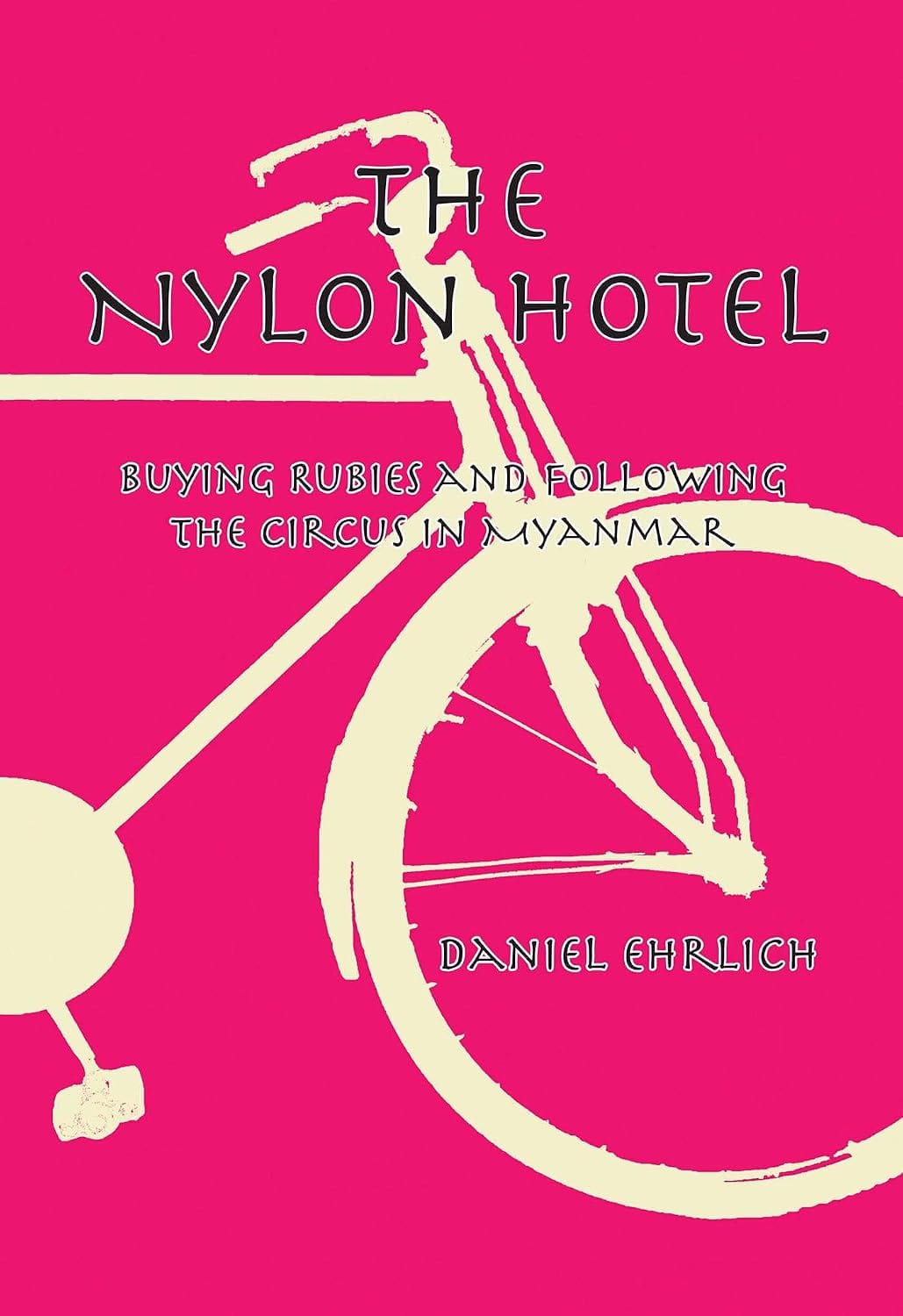
Daniel Ehrlich spent four decades as a laboratory head at MIT, leading national programs in semiconductors and optics. Beginning in 1987 and continuing for the next 32 years, he travelled to Myanmar almost every December, crossing twelve time zones, arriving alone in the dark, and checking into a modest Mandalay hotel called the Nylon Hotel on 83rd Street, eight dollars a night. He kept doing this because Burma, as he insists on calling it, gave him something his brilliant competitive American world conspicuously could not. What that something is turns out to be the real subject of the book.
Burma became Myanmar by military decree in 1988, a change Ehrlich acknowledges but quietly sets aside, preferring the older word for the same reason he prefers the older country, because it is the one the people he knew actually used.
The Nylon Hotel is not structured as a conventional travel memoir. It is forty short vignettes, loosely organized by friendship and theme rather than chronology, so that events from 1987 sit comfortably beside events from 2015, and characters appear, vanish, and reappear years later, aged or diminished or simply gone. The effect is cumulative rather than dramatic. You do not so much read this book as absorb it, the way you absorb a country over repeated visits, each time understanding a little more and finding more questions waiting.
The human core of the book is a group of Mandalay sidecar drivers who become Ehrlich’s guides, companions, and eventually the measure of everything he is trying to understand about Burma. Aung Aung, renamed Mintha by his peers, meaning “the prince”, had wanted to be a classical dancer and trained as a teenager at the government arts school where professionals prepared for the famous Mandalay traveling troupes, but stage careers were short and the work uncertain, so he became a sidecar driver instead. He taught his colleagues English and the art of hospitality, and built a reputation for honesty that the men who learned from him were still boasting about decades later. He died at 31, of depression and an unsupervised Buddhist fast in a graveyard during the April Buddhist lent, the long dead months between tourist seasons when there was no work and no income and nothing to do but wait. Ko Win, his former partner, is the book’s great steady presence, a man of impeccable professional standards and no personal luck at all, who by his late fifties owned nothing and waited for the tourist season the way farmers wait for rain. James Ayeyarwady, a self-taught Anglophile living in a bamboo hut near the source of the Irrawaddy river, with a five-foot mountain of paperback books in the centre of the room and a portrait of Bertrand Russell on the wall, dies of diabetes at the end of a very long dirt road, still young. These are not exotic figures. They are fully rendered human beings, and losing them over the course of the book is genuinely affecting.
Ehrlich also became a serious student of the Mogok ruby mines, and the chapters set among Mandalay gem brokers are unlike anything else in travel writing. The Mogok tract lies in a high valley north of Mandalay, where a geological anomaly has produced rubies and sapphires of a quality found nowhere else on earth. Medieval Europeans knew the mines existed somewhere in a vague country an unimaginable distance away that they called Capelan. Ehrlich visits gem brokers over years, learning the ritual of negotiation, the shout price, the counter, the days of patient marination before a deal is done. He eventually talks his way into the Mogok valley itself, a place closed to almost all Westerners for decades, arriving only because a political shakeup in the military government had left a temporary vacuum in the permit system and he had simply thought to ask. He sits with four ethnic Palaung sisters from one of the most important mine owning families, who bring out twenty matched rubies worth a cool million and a pigeon blood ruby in an antique gold ring whose natural fluorescence overwhelms the reflected light. He asks the price. They smile. It is not for sale.
Then there is the zat pwe, the classical all-night theatrical festival that Ehrlich came to love perhaps more than anything else in Burma. A bamboo stage in a pagoda yard, thousands of people on mats with children and blankets and tea sets, a Burmese classical orchestra on one side of the stage trading sound through the night with a rock band on the other, the repertoire moving backward from Western covers through colonial soap opera toward dances a thousand years old. Ehrlich is not interested in the zat pwe as a colourful spectacle. He argues with quiet conviction that it is civilization talking to itself, a shared repository of history and values doing the work that newspapers, universities, and parliaments never adequately performed in a country that spent most of its modern history under military rule. By the end of the book it is in serious decline, and the loss feels like more than a cultural footnote.
The nat spirit cult runs through the book from beginning to end. A nat is a spirit, typically of someone who died a green death, the Burmese term for a premature and usually violent end, whose unresolved energy is believed to linger in the world and retain power over the living. There are 37 principal nats, some of them real historical figures from as far back as ten centuries ago, and they demand propitiation and are capable of real mischief if ignored. The spirit wives, the natkadaws, go into trance to channel them, spending hours in preparation for minutes of contact, emerging exhausted. The annual pilgrimage to Taungbyone, where a one-ton teak platform carrying the gilded talismans of two wronged princes careers through a crowd packed tight for fifty yards in every direction, is described with the kind of close attention that makes you feel the heat and the noise and the genuine fear running underneath the festivity. Ehrlich is neither credulous nor dismissive about any of it. He simply watches, and in watching makes you understand that these are not quaint survivals from a superstitious past but a living system of belief that has held a society together across a thousand years of invasion, colonisation, and military rule.
Ehrlich has the scientist’s instinct for exact observation and the writer’s instinct for knowing when to stop. Describing the dogs of Thazi railway junction, bred over a hundred generations from stock that dates back to Bagan, he notes that they are tan, of medium build, wide-set eyes, marine-corps crew-cut coats, and that they almost never bark: “And if they do, it will be a single note and it will mean something.” Describing the Nylon Hotel’s stairwell, where a rounding error in the design reduces head clearance with each descending floor, he notes that the lowest threshold has been “solidly re-enforced with a stainless steel angle bracket so as to protect the building.” The building, note, not the guests.
The book was completed before Myanmar’s 2021 military coup but held back while Ehrlich waited for better news. He published it finally without that news arriving. That decision, and the quiet grief underneath it, gives the whole exercise a weight that no amount of craft alone could produce. This is a book written by someone who loved a country and its people across three decades of visits, and who is honest enough to know that love was not enough to protect either. Published out of Thailand, The Nylon Hotel deserves a wider readership than it may receive, and it will repay rereading.