“The Traitor” by Kobo Abe
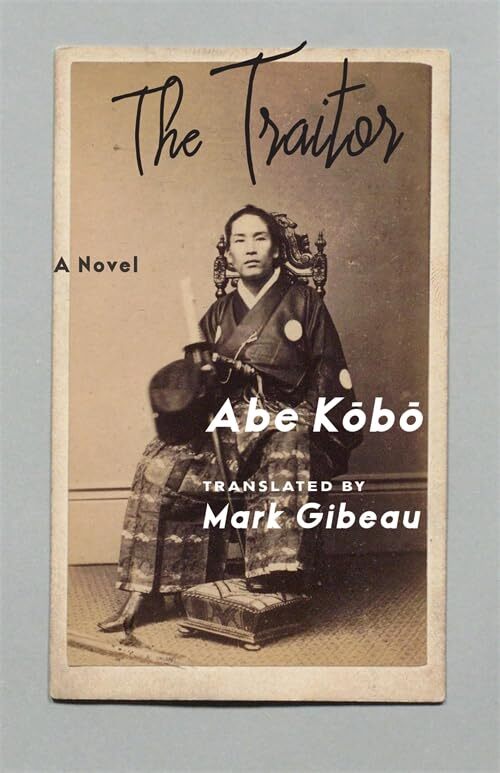
Originally published in Japan in 1964, and now translated for the first time into English, Kobo Abe’s The Traitor starts with a writer’s visit to a country town of Akkeshi. There he learns from an innkeeper, Fukuchi, the story of three hundred convicts who escaped into Hokkaido after the end of the brief Boshin War, a power struggle between the Meiji Emperor and the Tokugawa Shogunate. These men are followed by Enomoto Takeaki, an officer in search of the convicts. While the framing is fictional, Enomoto is a real historical figure: a leader of the Shogunate faction and later a prominent member of the Meiji government.
From this introduction of Enomoto as the central character, the story traces the history of the Boshin War and the establishment of the Republic of Ezo, a separatist state formed in Hokkaido by leaders of the Shogunate. Enomoto’s political fortunes on both sides of the conflict, a fact well known and discussed early in the text, hint at a duplicitous character. Loyalty and betrayal form the core themes that run throughout the text, asking whether it was the person who betrayed the regime, or the regime, having passed into a new one, that brands the loyalist a traitor. That conflict of definitions is best represented by Fukuchi’s obsession with Enomoto, who
understood that just because the times have changed, it doesn’t mean that everyone abandoned by the new age is a criminal. That’s why he helped [the convicts] make a country of their own, deep in the mountains, far beyond the reach of the new age. If the gentleman was merely a traitor, he never would’ve bothered. He never would’ve gone to such lengths to help them, would he?
The nested narrative deftly switches its focus between the aftermath of Boshin War and the aftermath of the Second World War. The parallel between two regime changes, described thoroughly in the first part of the novel, is reinforced by the unravelling of Fukuchi’s identity, who is revealed early on to have been a member of the kempei, the military police of Imperial Japan. In this capacity, he was responsible for the arrest and death of his brother-in-law. With the defeat of Japan in the Second World War, the disbanding of the kempei, the innkeeper too felt abandoned by a new age.
The legend of Enomoto and his own stigma as a former kempei were inextricably connected—the warp and weft of a single piece of cloth. At some point in his story, those two threads had grown hopelessly entangled so that he himself became one with the escaped convicts, even as the convicts became one with those kempei rendered obsolete with Japan’s defeat.
That parallel ruptures once the writer receives a mysterious package from the innkeeper. The package contains an account by Asai Jūsaburō, one of the shinsengumi, the Shogunate’s fanatical enforcers, and a man who accuses Enomoto of betraying the Shogunate cause. Fukuchi is deeply affected by this new account, having associated his past deeds with an Enomoto-like sense of duty. At this point, there are three interwoven narratives—the writer’s, Fukuchi’s, and Jūsaburō’s—each one centered around the life of Enomoto. The construction is complemented by Abe’s deliberate style, as well as how he clearly defines what Enomoto means to each narrator. As part of his package to the writer, the innkeeper includes a letter with a plaintive appeal:
“What does it mean to betray… What does it mean to betray?” Though Fukuchi understood, as an objective fact, that he’d been betrayed, it seems he never managed to grasp why he had to be betrayed, nor the significance of that betrayal.
The purpose behind Enomoto’s purported betrayal, not just to the Shogunate cause, but the ideal of duty itself, expands on the initial theme. Enomoto’s actions, if treacherous, do demand explanation, one not just supplied by the plot, but also by Abe’s own life. Abe had gone to medical school to avoid serving in the Second World War and grew up in Manchuria, never feeling like a full Japanese citizen. From that upbringing grows his philosophy, explained in the translator Mark Gibeau’s informative afterword:
Loyalty, in Abe’s eyes, is a mechanism employed by the state, society, communities, organizations, and so on to control the individual and to delimit the range of individual agency. Abe’s primary interest lies in exploring and dismantling the hierarchical relationship that subordinates the individual to the goals of the communal.
To investigate this mechanism, the writer acts as both the primary narrator and the catalyst for the plot, organizing the tale of Enomoto with that of the innkeeper. His role is highlighted in the second part of the novel, which consists mostly of Asai Jūsaburō’s fragmented account of the Boshin War and his thorough characterization of Enomoto: a bundle of letters, poems, market prices, telegraph reports, newspaper-clippings, even a map. To help navigate the mess, Fukuchi and the writer-protagonist both insert annotations between fragments of the account, corroborating the facts, acknowledging the disorganization, but also building an investigative momentum.
This second part showcases Abe’s ability to add complexity and texture to a narrative without deviating from the plot. The result, however, is a book that requires a diligent reader willing to connect each detail to the accusation—or a relatively detached one, unburdened by those same details, and focused on the general plot. And the plot is generous with political intrigue, military action, and historical references, culminating in the Battle of Hakodate and revealing exactly what happened to those convicts.
Abe is a writer of considerable range. His sole historical novel, The Traitor highlights the momentous question of loyalty as the political ground shifts underneath one’s feet—a question not isolated to Japan alone, nor to the two historical periods themselves. As the translator Gibeau puts it
Abe looks back to history, but he does so primarily to achieve the critical distance necessary to view the present in a new light.
And now, sixty years after the book was first published, this new translation too offers a critical distance—perhaps a premonition of a new age, and a point of reflection for those left behind.