Jainism, an older contemporary of Buddhism, is rooted in the ideals of austerity. While Buddhism spread outside India, very little is known about Jainism worldwide. Similarly, in terms of art, it is subsumed within the larger Hindu and Buddhist traditions of rock-cut architecture. In terms of painting, the Kalpasutra and Uttaradhyaynasutra are two texts thought to date from at least 2000 years ago, have traditionally come with illustrations. However, beyond these examples, post-medieval Jain art has largely remained off the popular and scholarly radar. A recent set of essays looks at the ways in which this tradition developed new expressions.
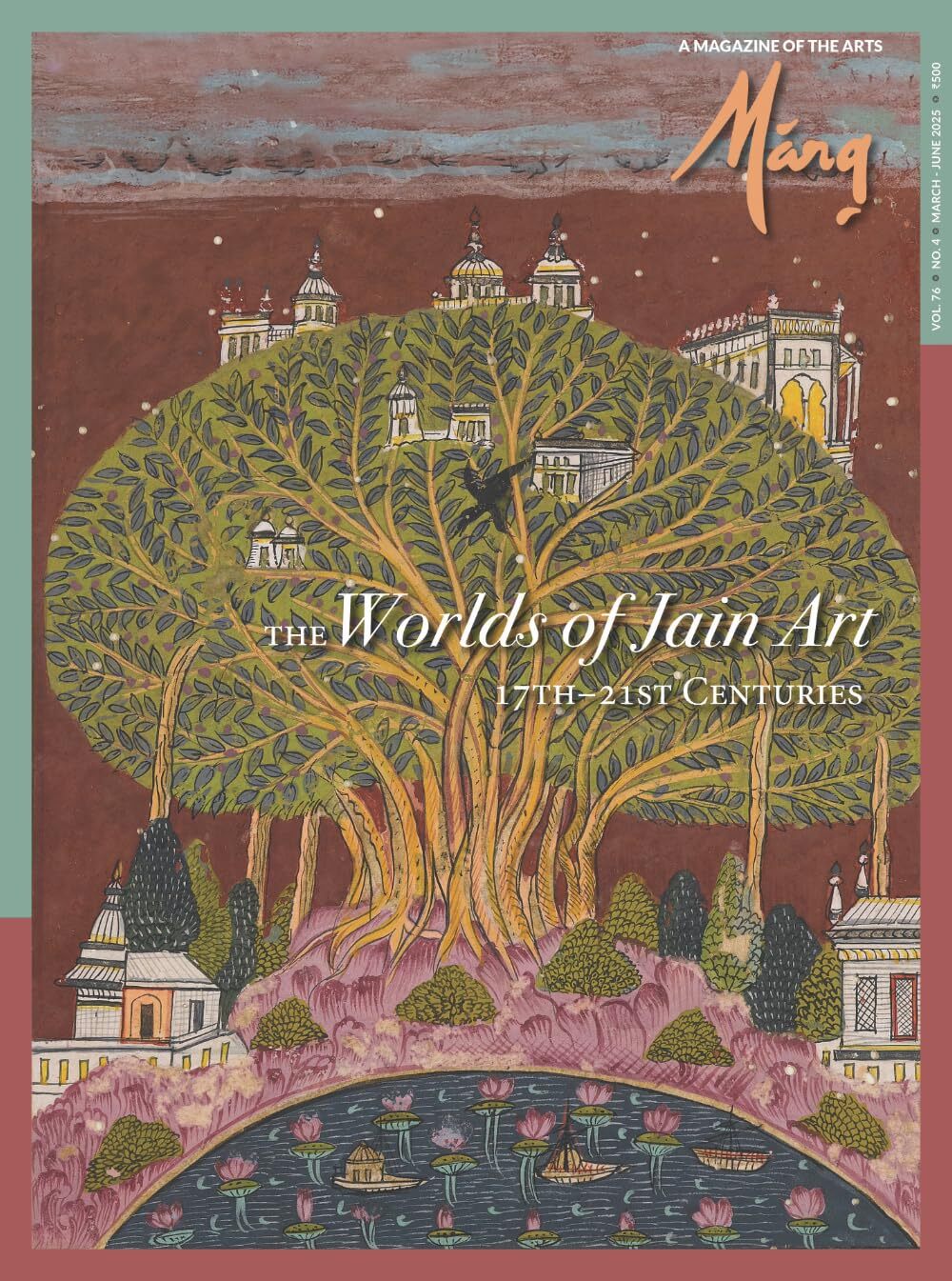
Marg is a leading magazine on visual culture in India and its special issues are not less than edited volumes. Its recent issue titled
The Worlds of Jain Art: 17th-21st Centuries brings together essays on a largely ignored phase on the subject. Insofar as most people know much about Jain art, it dates from the pre-modern period and earlier, and almost always has a distinctively religious character. Work from later centuries is, much like Indian art as a whole, generally considered less interesting or distinctive. This apparent trajectory of older innovation yielding to later stagnation owes much to what interested (and what was “re-discovered” under the aegis of) the European powers. Editors Phyllis Granoff and Nandita Punj invite scholars to explore the works that have begun to be located in private collections. The result is a volume that curates the artistic diversity of Jain visual culture, showing how it adapted to the changing times by expanding its form and content beyond the teachings: the focus was no longer only on mythological figures; there was a greater attention being paid to the social life as lived in these centuries.A striking aspect of this art is that it is diverse in the sense that it adapts to regional practices of art and culture. Rooted in or traditionally associated with the western parts of India such as Rajasthan and Gujarat, Jainism spread to other provinces and kingdoms and borrowed from local customs and literary and political environments. For instance, the 1745 manuscript of
Chandana-malayagiri-barata is a retelling of a poem by 17th-century Jain monk Bhadrasena which is in turn based on a story from the
Ramayana. The 1745 manuscript shows the influence of Vaishnavism, the Hindu sect around Lord Vishnu, from regions as far as Kashmir. The evidence of multiple influences on Jain art is clear. It includes
… a compendium of sights seen in the morning. Representatives of multiple religious groups other than Jain appear in the upper register. A Krishna devotee blows a conch while another sings a raga; a qazi reads from the Quran; and a naked sadhu, with a white beard and long, matted brownlocks, smears ashes on his body … The painting depicts the multiplicity of religious groups and everyday residents the royal family encounter as they leave the city … The Jain elements are de-emphasised, while transregional awareness is foregrounded through the incorporation of Mewar’s royal regalia, the Rama story from Kashmir, high Marwari turbans and the use of the codex format alongside other stylistic features ultimately derived from Persianate prototypes.
The article goes on explain that
The text and images attest to its creation within a Jain milieu that had wealth and access to sophisticated literary circles and Rajput courts across multiple regions of Rajasthan and beyond. The patrons appear to be participants in a new social order that rose to prominence during the mid-18th century – one that crossed boundaries and melded categories encompassing Vaishnava and Jain, kshatriya and vaishya spheres – with emphasis on worship of Jinas alongside lineage goddesses and mother goddesses.
Another example in the same vein of diverse influences is the 18th-century painted manuscript of
Shalibhadra Chaupai, a poem that praises almsgiving. Written in Gujarati and spanning 536 stanzas, in process of preaching austerity and piety, the text is a lot more worldly than its theme:
Situated within complex networks of literary-artistic exchanges that developed in the context of Krishna bhakti in early modern India, the Shalibhadra tale, with its performative and visual aspects, also provided an emotionally charged immersive experience to a receptive audience that appreciated representations in a visual vernacular characterised by the use of bright colours, compartmentalised vignettes, stunted proportions, exaggerated facial features, and mixed perspective often lacking depth and shading.
Once again, the article elucidates the social milieu:
At the same time, these painted manuscripts reflect a historical consciousness and awareness of contemporary courtly traditions, defying all notions of insularity, while offering a window into a unique visual culture of 18th century western India.
Jains in 18th century Bengal, the bankers that played a role in financing the Governor of Bengal’s severing of ties with the Mughal Empire, commissioned the
Ragamala, a set of paintings and poems that evoke the emotions specific
ragas evoke in the listener. The text’s uniqueness is, again, in its cosmopolitan ethos: it has inscriptions and writing in both Persian and Devanagari scripts. A Brahmin was commissioned to “write” the text and it was written in the Brajbhasha rather than in Bengali or Persian. The text is noted in the volume for the multicultural nature of the Jain mercantile community.The early 19th-century poem
Bhupalachauvisikavyabhasartha is an example of Jain narrative art incorporating recent changes in book culture: it is bound as a book in Europe rather than written on loose palm leaves.The most astonishing example of Jain art in the volume relates to ritual art. Jainism in Karnataka has embraced the regional ritual of
kola, a possession ceremony in which spirits are invoked and worshipped as they possess a designated “performer”. These spirits belong to the ordinary men and women glorified as heroes of the land. Kolas usually involve sacrificial customs. However, in the Jain appropriation, these revolve around spirit deities of noble Jain kings that reject such customs. Over a period of time, the Jain rituals have influenced the native traditions with a few ceremonies similarly refraining from sacrifice and alcohol.The takeaway from the volume, not just for Jain art but religious art in general, is that art history needs to be explored a lot more in the Indian context for its influences and interlinkages. Perhaps religious boundaries are not as sacrosanct as they are made to be and that art is more invested in uniting rather than dividing communities.
Contributor
Soni Wadhwa
Soni Wadhwa teaches Literature Studies at SRM University, Andhra Pradesh, India.