“Two Paths to Prosperity: Culture and Institutions in Europe and China, 1000–2000” by Avner Greif, Guido Tabellini and Joel Mokyr
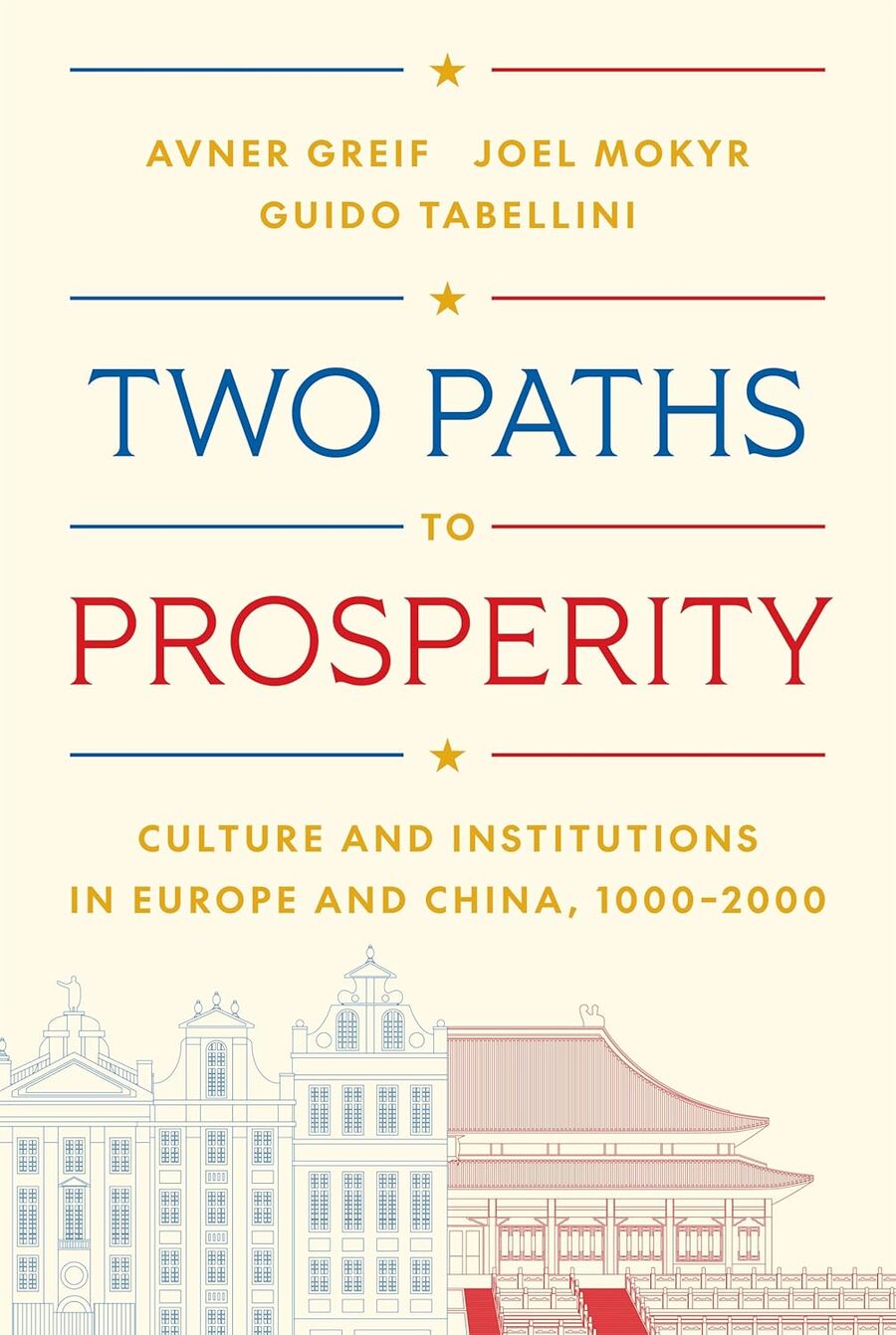
Edmund Burke remarked in 1790 that “… which in the first instance is prejudicial may be excellent in its remoter operation… The reverse also happens: and very plausible schemes, with very pleasing commencements, have often shameful and lamentable conclusions.” The course of the French Revolution soon proved him right. Two Paths to Prosperity reaffirms Burke’s insight on an even grander stage. Avner Greif, Guido Tabellini and Nobel laureate Joel Mokyr bring contemporary social science to bear on the key junctures in European and Chinese history. Along the way, they explore the most fundamental causes of growth, freedom, and innovation that led to the Industrial Revolution and still matter today.
While Two Paths does not attribute the “Great Divergence” to any single cause like geography or genetics, it does trace that process back to the emergence of a distinct Western European style of marriage, one that prohibited infanticide, polygamy, and consanguineous pairing, while requiring the woman’s active consent. Pushing marriages beyond one’s close relatives made nuclear families the salient agents instead of clans. But since that unit was too small to provide the public goods essential to any society, Europeans had to create new organizations outside of their lineal descent groups.That shift in marriage patterns occurred after the fall of Rome, a political catastrophe that kicked off a thousand-year interlude of weak states. The Catholic Church took advantage, carving out a sphere of influence distinct from secular rulers. The resulting separation of church and state implied that both had to respect limits to their action. Feudal lords limited the movement of peasants, but they also asserted their rights before the sovereign. Self-governing cities tended towards oligarchy more than democracy, but their ruling class nonetheless swore allegiance to an organization composed mainly of non-relatives. These voluntary groupings relied on written rules and explicit rights to resolve disputes. That tradition of formalized cooperation set the stage for the emergence of modern business corporations in England and Holland, enabling coordination and resource-pooling on an unprecedented scale.For all their salience, even emperors do not play the decisive role in this book.
In China, on the other hand, dynasties came and went, but the state endured. During the Tang and Song dynasties, China combined effective governance with a penchant for world-leading science and technology. Those capacities faded under the Mongol Yuan, but the pivotal figure was the Hongwu emperor, founder of the Ming dynasty. He centralized power by slaughtering his own bureaucracy, leaving village elders to settle local administrative disputes. In exchange for this new authority, the elders ensured their clans paid taxes and supplied corvee labor. That combination of despotism and decentralization would endure long after the Ming fell in 1644.
For all their salience, even emperors do not play the decisive role in this book. Instead, the authors argue that both societies’ values and institutions evolved in tandem, each supporting and reinforcing the other. While Christian Europe had plenty of hierarchies, over time the notion of a personal saviour steadily undermined the authority of elders. But the freedom to trade, migrate, and worship without the approval of forefathers meant that one had to deal with strangers. Instead of the informal (and perhaps grudging) consensus among a family, they set explicit rules for rights, obligations, and the procedures for the delegation of authority.China took a different path, one guided more by Confucius than Christ. At the very top, emperors derived legitimacy by their Mandate from Heaven. While rebellion would signal its loss, that endorsement never implied a social contract between ruler and ruled. In much the same way, junior members of a clan deferred to their seniors. The keju testing system held this all together: from the Tang to the Qing, China instituted a genuine meritocracy among its civil servants. Only the most diligent and erudite young men could hope to master the Confucian classics at the requisite level. For well over a millennium clans provided public goods such as religious services, insurance for orphans and widows, irrigation, and education, while paying taxes to an impartial and meritocratic government their sons strived to join.This institutional divergence affected everything else. European universities emerged autonomously, each governing their own affairs, setting their own curriculum, and recruiting their own faculty. China’s clan-run schools focused almost entirely on keju exams: looking up to the national government and back to the classical texts. While both civilizations had a body of criminal law, Europeans developed a bottom-up tradition of civil law to resolve commercial disputes. Clan-based societies handled such things in-house, without the need for government intervention. Collective land ownership allowed China to avoid the inequality and feudalism endemic to Europe. But Europe’s aristocratic concentration of wealth generated an alternative power base independent of its kings, something no single clan could achieve in China. Only in western Europe did the inadvertent alignment of free thought, civil law, and limited government create the conditions for the Scientific and Industrial Revolutions.Institutional divergence affected everything else.
While none of the authors specialize in China, all three have spent decades publishing in peer-reviewed journals; this book situates their original research in the larger edifice of contemporary scholarship. Readers without a background in social sciences might prefer to skim the appendix formalizing the book’s main arguments using mathematical notation. Likewise, those unfamiliar with econometrics will need to consult Google to appreciate the casual references to endogeneity, instrumental variables, and regression discontinuity. On the other hand, many of their statistics are straightforward comparisons between Europe and China, such as migration patterns, the distribution of surnames, and trends in urbanization.
The authors had to maintain a delicate balance: explaining how customs and institutions led to the Industrial Revolution without making normative judgments. Often a bit of context or empathy suffices. They attribute Europe’s open intellectual climate more to political fragmentation than progressive ideals. After all, Hobbes and Voltaire both moved abroad to write, but Chinese dissidents had no such exit strategy. Elderly Han and Dutch might age into curmudgeons at the same rate, but the society placing greater emphasis on filial piety will tolerate less disruption. Clever farmers and blacksmiths the world over may craft labor-saving devices and strategies, but such innovations are harder to implement when the displaced workers are all relatives.In many respects, the Chinese Communist Party does not represent a radical break with the past. A single power ruling from Beijing that brooks no opposition, it enforces an orthodox school of thought on its highly trained bureaucrats, rotating them frequently to ensure they represent the centre to the provinces and not vice versa. And while that top-down system lifted hundreds of millions out of poverty after 1978, Two Paths argues that world-leading innovation ultimately demands the freedom for individuals to question shibboleths and challenge vested interests. For the moment, the CCP seems determined to prove them wrong.