“Up the River of Time” by Cheng-hua Wang
Can a painting outlive its authenticity? For art lovers and collectors, an artwork’s value is often inseparable from its status as a singular object. This is why the authenticity of the Mona Lisa is of paramount importance to the Louvre Museum. The painting’s “value” comes not just from its visual qualities, but it carries with it the unique connection as the original work painted by Leonardo da Vinci. It is essential for The Louvre to take extensive measures to preserve and secure the painting, to ensure its authenticity and historical integrity. Yet, dating from the 20th century on, the charm and value of famous paintings like the Mona Lisa have not stopped forgers and some profit-seeking commercial artists from producing replicas.
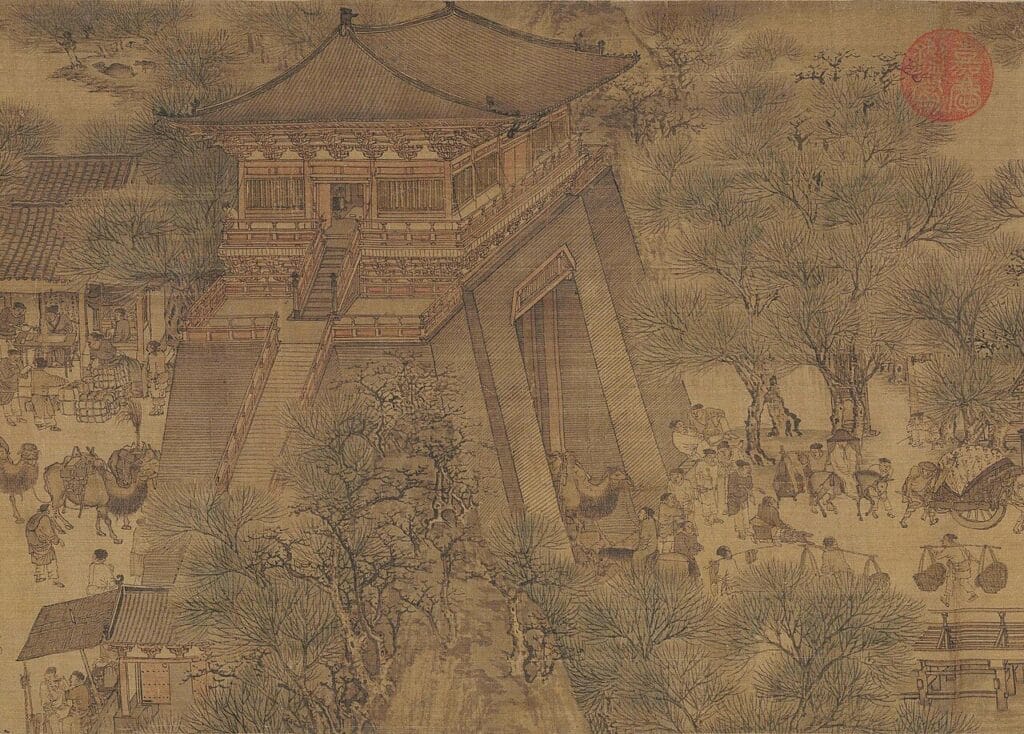
With a status comparable to the Mona Lisa in the history of Chinese painting, the handscroll Qingming Shanghe tu, attributed to the Northern Song painter Zhang Zeduan (1085-1145), provides a striking example of this alternative afterlife of a painting. Zhang Zeduan’s Qingming Shanghe Tu is distinguished by its meticulous depiction of diverse genre details, capturing bustling daily life and economic activities across rural and urban settings and whose richness and complexity underline the painting’s enduring art-historical significance as a canonical work of Chinese art. The title Qingming Shanghe serves as a reference to the activities associated with canals and bridges in the picture, and the public works which are regarded as the embodiment of good governance. The painting depicts a spatial continuum from the rural countryside through the suburban outskirts to the urban center, shown through a horizontally three-fold structure.The scroll unfolds sequentially from misty marshlands and receding trees to familiar countryside scenes filled with farmers’ homes, fields, animals and travellers. The waterway approaches an arched bridge where water and land transport intersect and the activities suggest the approaching city. Boats, laborers, and travelers bring the scene to life, with boatmen steering their vessels and workers carrying heavy cargo from the barges, emphasizing the close connection between activities on land and water.
The lasting influence of Qingming shanghe tu in Chinese painting history has generated a continued tradition of reinterpretation and reproduction. There were many painters across subsequent Chinese dynasties who created adaptations of this genre, produced replicas and in some cases, forgeries. More than one hundred surviving handscrolls bear the title of Qingming shanghe tu, representing a diverse body of works that derive from the tradition established by Zhang Zeduan’s Northern Song Qingming shanghe tu. There are numerous versions produced from the late Ming through the Qing dynasty. While these works generally retain the compositional framework and thematic associations of the original, they vary quite noticeably in their details, techniques, and historical contexts.
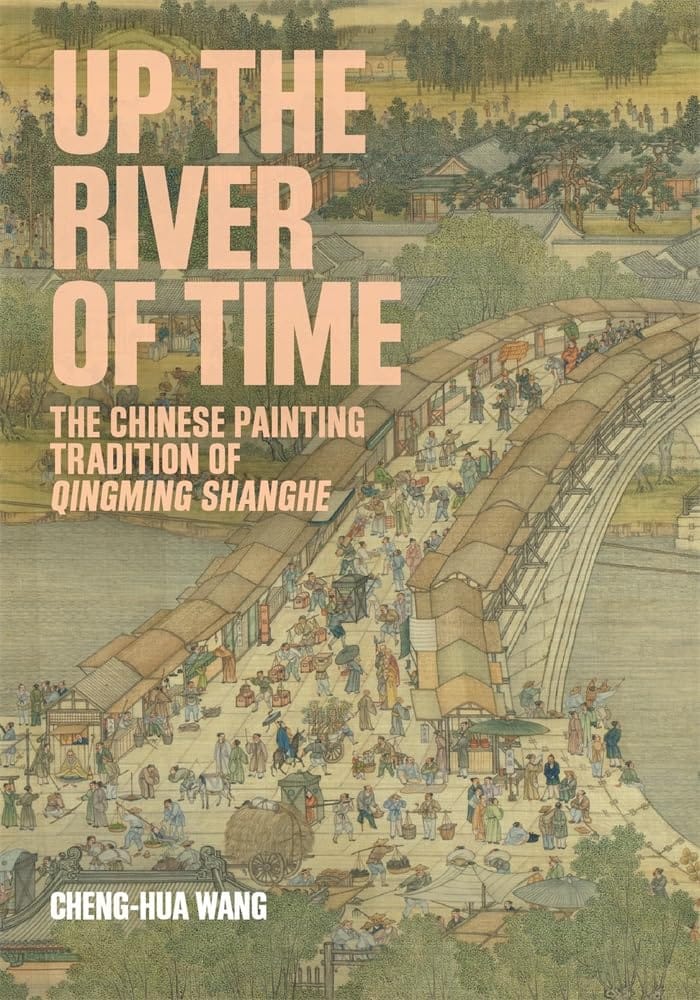
Cheng-Hua Wang’s new book, Up the River of Time: The Chinese Painting Tradition of Qingming Shanghe, examines the cultural imaginaries connected to the paintings bearing the namesake Qingming Shanghe Tu, as well as the artistic, political and sociocultural contexts in which these works circulated. Wang explores how these intersecting dimensions shaped the reception, interpretation, and cultural significance of the tradition, while also tracing the processes through which meaning was constructed around the original Qingming Shanghe Tu. Cheng-Hua Wang draws on the colophons (such as the inscriptions or commentaries) associated with the Song painting to reconstruct its reception history, tracing its changing interpretations from the mid-Jin dynasty (1115-1234) through the late Ming dynasty. The analysis offers a framework for understanding Qingming Shanghe Tu’s cultural significance, evolving meanings, and enduring legacy in Chinese art. Wang highlights that the multiple scenes of the Northern Song’s version of Qingming shanghe tu demonstrate the integration of time-honoured subjects, including wintry forests, water navigation, and city views, pointing to the painting traditions that the artist may have used and repurposed. The later versions of Qingming Shanghe tu emphasizes the commercial and vibrant distinctive features of city life. In the Qinghe Shanghe tu attributed to Qiu Ying, urban views around the bridge and inside the city gates take on greater prominence over countryside views. As a vicarious journey from the countryside to the city, the unfolding of the scroll leads the viewer toward the urban center. There are two correlated themes: “to the city” and “urban delights,” both of which are important features of late Ming cityscapes. The term “urban delights” refers to various forms of consumption and entertainment that highlight the pleasurable and lively aspects of the urban environment painters sought to depict. Street performances form a significant form of entertainment in these paintings, reflecting the activities enjoyed by the urban folks as seen in the puppet theatre featured. The picture also shows a high-end textile shop with benches along the walkway to provide customers with a comfortable space to browse and select merchandise.
From around the late Ming period, there was a rise in paintings with the same title and format, a phenomenon that continued into the Qing dynasty. The proliferation of these works marks a significant development in the reception history of Qingming Shanghe Tu, demonstrating how the painting evolved from a singular pictorial model into an artistic tradition of reinterpretation and replication. Qingming Shanghe Tu might have represented an idealized vision of prosperity and everyday life, and its familiar title might have inspired artists to reinterpret changing cities and social conditions. Because of spurious signatures largely attributed to either Zhang Zeduan or the Ming dynasty painter Qiu Ying, a number of these paintings were perceived as counterfeits for commercial purposes. By the mid-16th century, rumours about the production of replicas and works of reinterpretation in Suzhou arose. Some late Ming-early Qing texts stated that the Suzhou painter Huang Biao was commissioned to produce replicas of Qingming Shanghe. Huang Biao was an established portraitist often commissioned to copy old paintings from wealthy clients and profited from counterfeiting calligraphic works. As the original Qingming Shanghe had been seen by scholar-officials such as Du Mu (1459-1525), some Suzhou workshops produced highly accurate copies.
Zhang Zeduan’s Qingming painting became legendary by the mid-sixteenth century after passing through many collectors. There was a tragic story about Lu Wan who wrote his colophon in 1524 after suffering a major setback in his official career and being banished from his hometown. Another narrative tells how Yang Song and his son desperately wanted the painting, only to discover through an informer that it was actually a direct copy of the original. The painting became highly coveted in the sixteenth century, and fascinating enough to trigger several re-creations. The later versions of the painting depict urban scenes of consumer activities with a sense of urban prosperity, including luxury consumptions associated with courtesans and carnal entertainment. The expressions of material culture and sensual consumption present a society engaged in the aesthetics of excess, which has influenced the creation of the salacious novel The Plum in the Golden Vase.
Beyond referring to Zhang Zeduan’s painting, Qingming shanghe acquired a wider field of signification in Ming-Qing China. It could denote one or more paintings, as well as the painting theme as an overarching category. At the same time, the term encompasses the mental images and abstract ideas that emerged from the viewers’ experiences of and knowledge about these paintings and its thematic tradition. The name Qinghe Shanghe often went beyond referring to the actual paintings themselves. Qingming shanghe acquired an agency beyond connoisseurship and collecting. Thus, the inaccessibility of the original Song version did not hinder but instead fostered the Qingming tradition, whose cultural constellation drew from but was not dependent on the painting’s materiality.
With a detailed discussion on city views produced in late Ming period, the book also covers the scope to encompass three different types of cityscapes and highlights their representational modes, including that of Qingming shanghe. The author highlights the heightened sense of urbanism in the Qingming genre in the Ming cityscapes versions. It posits the emergence of “the city” as a new “pictorial site” in Chinese painting in the late Ming. The portrayals of travellers and city dwellers capture the streets as spaces brimming with movement and action, from street performances to the everyday presence of multitudes of nondescript people seen moving through and around the city. The streetscapes reveal the prosperity and affluence of urban life, particularly in certain sections of Qiu Ying’s Qinghe Shanghe tu. The abstract notion of “consumption” is described through the depiction of commercial spaces and consumer environments.
Suzhou pian (苏州片) were commercially-produced paintings associated with Suzhou workshops, which often imitated, adapted, or recombined established painting traditions. Qingming shanghe tu became a prominent subject within this tradition and is discussed in relation to the forgeries that flourished in Ming-Qing Suzhou, whose extensive production facilitated its wider circulation beyond China. In Japan, historical records indicate that the subject circulated from the mid-17th into the 18th century, influencing representations of urban landscapes. Its influence also extended to Korea, where Korean envoys travelling to Beijing purchased Chinese books and artworks, creating a channel through which Suzhou paintings including Qingming shanghe tu reached Korea and were collected by the elites.
Commissioned in 1728 and completed in 1737, the most famous Qing court rendition of the Qingming painting spans the reigns of the Yongzheng and Qianlong emperors. Qianlong himself added an inscription to the handscroll and composed a poem after viewing the completed painting. Endorsed by the Qianlong emperor for its significance within the Qingming tradition, its distinctive position in the imperial court painting is reflected in its inscriptions, seals, mounting, and pictorial elements. The work is particularly notable for its detailed representation of urban life, in which bustling streets, humorous human interactions, commercial activity, and European architectural features are well integrated in the composition. The composition strengthens the painting’s depiction of the complexity and vitality of urban society. Professional street performances are depicted as more varied, encompassing rope walking, puppet theatre, a mendicant monk, and staged combat. A labourer spilling a foul-smelling bucket prompts passers-by including two literati-looking men to cover their noses, creating a comic mini-drama. Similarly, glimpses of a classroom reveal a mischievous boy climbing out, another boy urinating against the wall, and a punished student kneeling before the teacher. These add to the humorous and sensational moments in the Qingming Shanghe genre. European-style building works exert a fresh visual impact in the representations. The painting’s theatricality and emphasis on spectatorship characterise Yongzheng’s court style. Qingming shanghe reflects the Qing emperors’ artistic and cultural agendas, as Qianlong further built on his father’s vision to reinterpret traditional Chinese painting through time-honoured themes.
Rather than remaining a static artistic practice, the Qingming Shanghe theme has evolved through historical contexts, continually absorbing and reflecting the values and social realities of the generations that sustained it. Its continuity across nearly a millennium attests not only to the vitality and adaptability of the tradition, but also to its important cultural and artistic resonance. The enduring reverberations of the name thus speak to a powerful artistic tradition whose significance extends beyond its historical origins.

You must be logged in to post a comment.