“A Nation Within: North Korean Zainichi in Postimperial Japan” by Sayaka Chatani
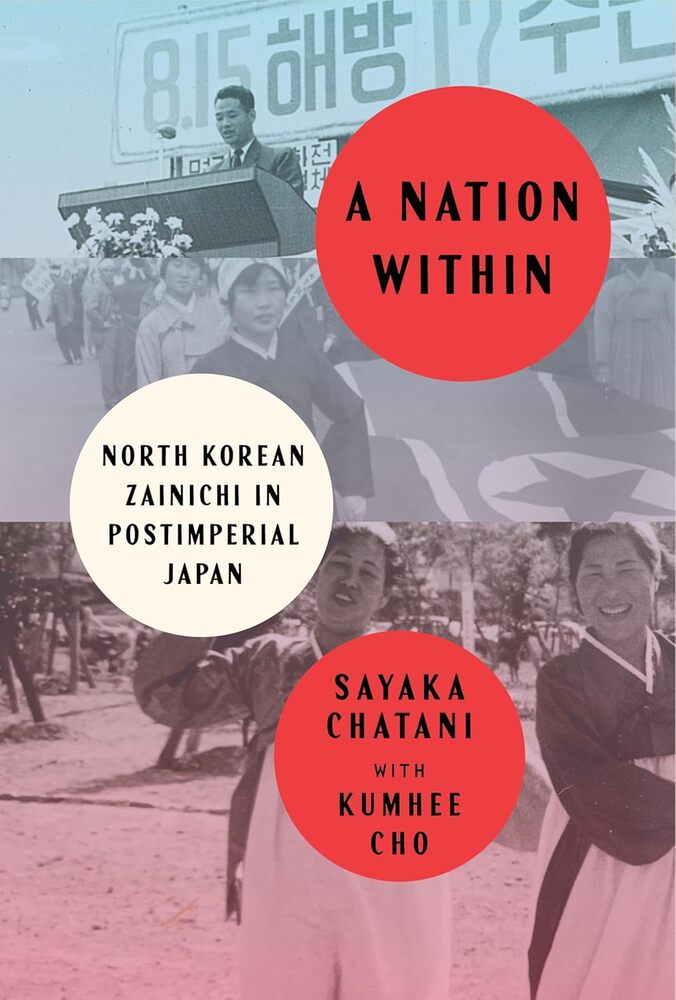
A number of books in English have given us histories of Korean emigration to the United States and Canada, but the story of those who left Korea for Japan in the decades of Japanese imperial rule is relatively unknown. Sayaka Chatani, a professor of history at the National University of Singapore, writes in this book of Korean immigrants and their descendants in Japan who chose after 1948 to support North Korea, despite most of them having roots in South Korea.
Following Imperial Japan’s establishment in 1905 of a protectorate over Imperial Korea and the Japanese absorption of its peninsular neighbor in 1910, Koreans moved in large numbers to the Japanese home islands in search of opportunities. The sons of wealthier Koreans studied at Japanese universities, earning advanced degrees and taking positions within the empire as businessmen, government officials, and military officers. Most of the poorer immigrants flooded into Osaka and other Japanese cities to work in factories or hire themselves out as day laborers. After Japan went to war against the United States, Great Britain, and the Netherlands in December 1941, Japanese mobilized Koreans as laborers in the home islands and elsewhere in the empire and on its far-flung front lines in Asia and the Pacific.
With Imperial Japan’s surrender in 1945 to the Allied Powers at the end of the Second World War, Tokyo lost Korea and the rest of the empire acquired since 1905. Many Koreans rushed in the first few months to depart a defeated and devastated Japan for their liberated, largely unscathed homeland. In 1948, Koreans established in the US and Soviet zones of Occupied Korea two rival regimes: the Republic of Korea (ROK, South Korea), with its capital in Seoul, and the Democratic People’s Republic of Korea (DPRK, North Korea), with its capital in Pyongyang.
Many Koreans who had returned to what became the ROK—for nearly all Koreans in Japan hailed from the south—later returned to Japan. Joining them were new immigrants from southern Korea, as poverty and violence in the US zone of occupation south of the 38th parallel motivated many Koreans in the years before the eruption of the Korean War in 1950 to seek livelihoods and safety in Japan.
Division on the Korean Peninsula soon led to a split among Koreans in Japan. A single League of Koreans in Japan (its abbreviated name in Japanese was Choren) split on such issues as “collaboration” (a term which includes those who might have cohabited or cooperated) with the Japanese in the imperial years. The “collaborators” formed a group that became the Korean Residents Union in Japan (Mindan). Far more Koreans joined what became the General Association of Korean Residents in Japan (Chosen Soren). When the Korean War erupted, Mindan backed Seoul; Chosen Soren, Pyongyang.
Divided by politics, Koreans in Japan shared a common fate. Japanese authorities made the Koreans in Japan, formerly “subjects” of the Japanese Empire, not Japanese citizens but “third-country nationals”, foreigners, once Japan regained its sovereignty by the 1952 Treaty of San Francisco.
Rather than fight for citizenship, Koreans under Chosen Soren’s guidance chose to create a separate society.
The author devotes her attention in this book to those Koreans who cast their lot with the pro-Pyongyang Chosen Soren. Chatani in her first chapter retraces the course of those Koreans: from joining the Japan Communist Party in the early postwar period in support of international communism, engaging in guerrilla actions and other underground activities in Japan in the Korean War, to withdrawing after Stalin’s death into a separate Korean community within Japan.
Rather than fight for citizenship, Koreans under Chosen Soren’s guidance chose to create a separate society. To that end, the organization built schools that served as bases of community activity; organized women via the subordinate Korean Women’s Democratic Union in Japan; and trained functionaries (ilgun in Korean) to staff the Korean schools, with Korea University in Tokyo at the top of its education pyramid, and to run Chosen Soren at its national headquarters and in the prefectures.
Many saw Chosen Soren as an organization to prepare Koreans for repatriation, confident that the DPRK would soon reunite the peninsula. When Pyongyang and Tokyo, with the support of Chosen Soren, launched in December 1959 a “repatriation” program to send Korean residents to the DPRK, approximately 50,000 rushed in the program’s first year to the Soviet ships that took them across the Sea of Japan to the socialist fatherland. After word spread of how the standard of living there was much below that in Japan, the flood subsided to a stream, and then a trickle, before the program ended in July 1984.
The peninsula’s division into rival states laying sole claim to all of Korea was reflected in Japan in a Korean population split between Chosen Soren and Mindan. Seoul’s establishment of diplomatic relations with Tokyo in 1965 tied Mindan even more closely to Seoul. Both the DPRK and ROK used Koreans in Japan as pawns in their struggle. Chosen Soren worked with Pyongyang to recruit Koreans to work as covert agents while studying in South Korea. As a result, Seoul over the years arrested and tortured hundreds of Koreans students from Japan in hunting for spies.
Businessmen sympathetic to Chosen Soren played their part by investing in the Fatherland, building factories and engaging in other ventures. Pyongyang’s modern Kim Man Yu Hospital, a gift from a resident Korean of that name, and the capital’s relatively luxurious Rakwon Department Store are two of the more notable buildings erected in the DPRK with the support of Koreans in Japan.
The Chosen Soren today is a mere shadow of its former self.
The Chosen Soren today is a mere shadow of its former self. The bursting of Japan’s economic bubble in the 1990s hurt Korean businessmen in Japan. The DPRK’s confirmation by the DPRK leader Kim Jong Il at his 1992 summit with Prime Minister Koizumi that Pyongyang had abducted a dozen or more Japanese in previous decades damaged Chosen Soren’s credibility among Korean residents.
Pyongyang’s economic decline in comparison to Seoul must also have played a role. Japan’s Public Security Intelligence Agency estimated nearly 48 percent of Korean residents were members of Chosen Soren in 1968, when the DPRK still boasted a larger economy than the ROK; the figure that year for Mindan was only 14 percent. In 1979, when the ROK economy had taken the lead, Mindan surpassed Chosen Soren in membership, 44 to 42 percent.
Chatani recounts Chosen Soren’s history in relying on information gained from extensive interviews with Korean residents. A former schoolmate from Columbia University, Kumhee Cho, served as her guide. Cho, a Korean resident in Japan (in Japanese, a Zainichi), the granddaughter of Cho Chang-je, still remembered by older Koreans with respect for his efforts as a top official for Chosen Soren in Hyogo Prefecture, gave Chatani a level of access otherwise unavailable to a Japanese outsider.
Also impressive is Chatani’s bibliography of Zainichi literature, from memoirs such as that of Yun Kon-cha, emeritus professor of Kanagawa University and former intelligence recruit for North Korea, to the fictional works of Korean authors writing in Japanese.
What if Chosen Soren, primarily an organization of the second generation of Korean residents, born in Japan and speaking Japanese as their primary language, had demanded citizenship and full participation in Japanese society
The book, written by a university professor and published by a university press for an academic audience, may prove a dense read for those outside the ivy-covered walls of academia. Still, even readers somewhat aware of the history of the Korean diaspora in Japan will learn much from this book.
The photographs alone are fascinating, including one of Hyogo Prefectural Chairman Cho Chang-je, standing at the podium before a bust of DPRK leader Kim Il Sung on the occasion of the Ninth Congress of the Chosen Soren Central Committee. A photograph of students in white uniforms marching around the running track of a Korean school in Japan on Sports Day in 1971 resembles countless others taken at Japanese schools that day, except for the DPRK flags and the placards they hold aloft, on which are written “Democratic People’s Republic of Korea” and “Kim Il Sung” in Korean.
The author ends her book by posing an intriguing question. What if Chosen Soren, primarily an organization of the second generation of Korean residents, born in Japan and speaking Japanese as their primary language, had demanded citizenship and full participation in Japanese society? What if they had joined in solidarity with progressive Japanese in opposition to the conservative Liberal Democratic Party, which ruled without interruption from its creation in 1955 to the end of the Cold War, and is in power today? Such questions are indeed worth considering.