Old post
This post was published before January 2026. Some links, images or other content may no longer display or work as originally intended.
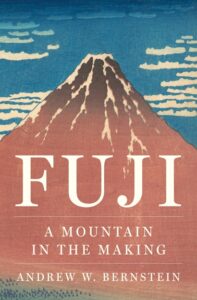
“Fuji: A Mountain In The Making” by Andrew Bernstein
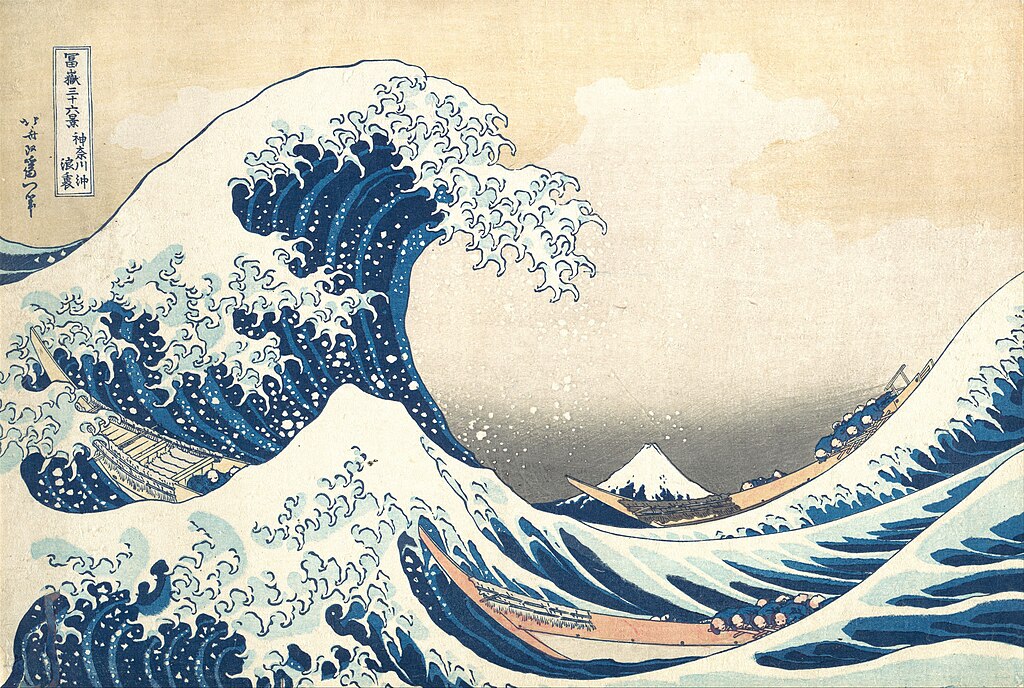
Of all the examples of Cool Japan’s global reach—from sushi to Hello Kitty to anime and manga—perhaps the most iconic of all is Hokusai’s print, The Great Wave. The huge curving wave has taken on a life of its own, reproduced and recreated on coffee mugs and tea towels and across the internet in the myriad ways that mark 21st-century creativity. However, as is well known, the woodblock print was one of a collection of 36 studies not of the sea, but of Mount Fuji. Andrew Bernstein follows Hokusai by placing the mountain right at the center of his new book, surrounded this time by all of Japan: religion, literature, culture, hunting, gathering, politics and even diplomacy.
Fuji: A Mountain In The Making follows a number of “biographies” of rivers and mountains, charting the relationship between humans and their environment and showing the shifting ways in which we project meaning and significance onto parts of the physical world around us. The book stretches back not only beyond the written record into the period where archaeology is our only source of knowledge but further still, beyond any human evidence at all, to where layers of solidified magma and ash reveal to scientists Fuji’s history of eruptions. Bernstein shows how historical and geological timelines overlap one another: the last great eruption took place in 1707, dumping ash hundreds of miles downwind and over a meter deep in local fields. Lava flows during an earlier period of activity in the 800s changed the landscape and split up surrounding lakes and waterways. Even today, the Osawa failure on Fuji’s western slope is unstable, with landslides and rockfalls that have necessitated its closure to climbers.
A Mountain In The Making reminds us that although, at least for now, Fuji lies dormant, we continue to find new ways of interacting with it.
As with other great volcanoes, humans have lived and farmed in the shadow of Fuji for as long as we can demonstrate humans have lived and farmed. Excavations have revealed early settlements surrounding the mountain, and tools fashioned from the stone and glass expelled from its eruptions. However, although it is the tallest peak in Japan and indeed stands alone, Fuji’s location to the east means that it was not visible from the Kansai plain where the first major capitals, most notably Nara and Kyoto, were sited. As a result, its presence in many of the earliest collections of writing was as one of a number of notable mountains rather than one in a class of its own.
The characters used to spell out Fuji in these early years of literate Japan covered a range of different meanings, including 布時 or timeless; 不死 undying; and 不盡, inexhaustible. These readings refer both to its size and to the presence of snow on its peak long into the warmer months. In the poetry collection, the Manyōshū, Fuji was used to symbolize romance in two ways: its periodic outpourings of smoke served as a symbol of a lover’s passion, while the persistent snow evoked unending love.
However, Bernstein demonstrates that it was in the 1600s, when Japan’s capital moved to Edo, now Tokyo, when the volcano became seen as more than just one mountain among many. Fuji was (and indeed, from the right vantage point on the right day, still is) visible from the city. It regularly featured in woodblock prints such as Hokusai’s in this era. Prints were a commoners’ art form, designed to be sold in bulk, so Fuji’s appearance demonstrates how the volcano was growing in significance in the minds of the inhabitants of the capital. At the same time, the mountain took pride of place at the center of a set of screens in the Tokugawa shogun’s own private quarters, showing how it could symbolize the nation and power.
Even today, the Osawa failure on Fuji’s western slope is unstable, with landslides and rockfalls that have necessitated its closure to climbers.
The shogun was not the only one to see the volcano as more than just a meisho, a famous site. In the same period, it became a destination for pilgrimage. Networks grew up across the country connecting local guides to adherents of a new heterodox religion. The faithful sought to raise the money necessary to visit and climb a mountain they believed to be the birthplace of the whole world. At the same time, across Edo, shrines built their own miniature mountains, often incorporating rocks brought from Fuji itself, providing a local substitute for those who could not afford to travel. A couple of these remain, able to be visited in Tokyo today.
In the 20th and early 21st centuries, Fuji’s stature as a symbol of Japan has grown at home and abroad. In 2013 it was awarded the status of a UNESCO World Heritage site, recognition of its position not as an item of physical geography (strato-volcanoes are not particularly rare) but as a location of historic and ongoing cultural significance.
Even today, Fuji carries different meanings: its northern slopes are used for military exercises, atmospheric measurements are taken on its peak, and the mass of tourists climbing it every summer is placing it under ongoing ecological pressure.
Once, a thousand years ago, aristocrats from Kyoto wrote poems about the snow covered peak as they made their way east. Later, the merchants of Edo would collect Hokusai’s prints of the mountain. Now, tourists from across the world queue up to take an iconic photo of it towering behind a convenience store or passing bullet train. A Mountain In The Making reminds us that although, at least for now, Fuji lies dormant, we continue to find new ways of interacting with it.

You must be logged in to post a comment.