“Approaching the Buddha” by Hao Sheng
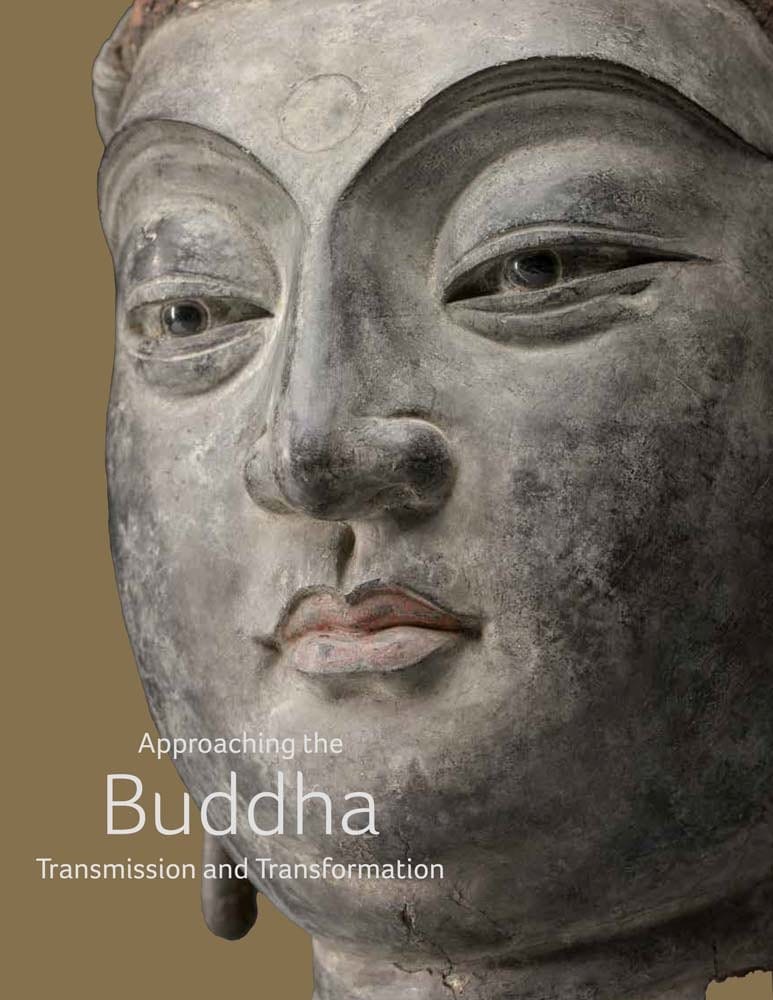
Approaching the Buddha: Transmission and Transformation, is based on the Xuzhou Collection, a dazzling array of ceremonial objects assembled by an anonymous collector and housed at the Museum of Fine Arts in Houston. For students of the dharma, these images are alive, living transmissions rather than decorative relics.
That collector, whose identity is withheld throughout, explains his anonymity in his own collector’s statement with disarming directness. He named the collection Xuzhou—Chinese for “empty raft”—after one of Buddhism’s oldest teaching metaphors. The raft, the Buddha said, is what carries you across the river of ignorance toward enlightenment. Once you reach the other shore, you set it down. You do not carry it on your back. Buddhist art, the collector suggests, works the same way: it is a vehicle, a means of conveyance, and the moment you mistake it for the destination you have lost the thread. He chose the name Xuzhou rather than his own, he writes, so that viewers might focus on the purpose of the collection rather than the identity of the collector. The logic is elegant and entirely Buddhist: the self that collects, curates, and seeks credit is precisely the construction the practice is designed to loosen.
What these objects point toward begins, as everything in Buddhism begins, with a prince.
Siddhartha Gautama grew up insulated from suffering by a father determined to keep his son on a throne. Then, on four excursions beyond the palace walls, he saw an old man, a sick man, a corpse, and a wandering ascetic. The first three revealed what existence actually is. The fourth suggested someone had found a way to confront it without despair. The Gandharan relief reproduced in this catalogue captures that rupture with psychological precision. In ‘The Renunciation of Prince Siddhartha’, carved in schist during the second or third century CE, the future Buddha appears in his father’s harem surrounded by sleeping women whose sensual abundance has suddenly become grotesque to him. Siddhartha does not leave because the world is ugly. He leaves because it is insufficient.
What he found, after years of extreme asceticism he ultimately rejected, was a middle path. The Upanishads had already destabilized the ordinary sense of self. Earlier thinkers had already proposed that the ego, the small acquisitive self, clinging to its continuity, was in some sense illusory. The Buddha inherited this contemplative world and stripped it of metaphysical excess, refusing to speculate about ultimate reality or answer questions about eternity and the afterlife. He was interested in suffering, its causes, and its cessation—radically empirical, offering method rather than revelation.
The Xuzhou Collection traces the subsequent spread of Buddhism across an extraordinary sweep of geography and culture. From the Gandharan workshops of what is now northwestern Pakistan (1st-5th century CE), where Greek artistic traditions blended with Indian religious thinking to produce the first human images of the Buddha, to the refined classicism of Gupta-period India (4th-6th century CE), where the ideal Buddhist figure reached perhaps its most serene expression; from the U Thong bronzes of early Thailand (13th-15th century CE), with their synthesis of Khmer, Mon, and Sri Lankan influences, to the psychological intensity of Kamakura-period Japan (1185-1333 CE), where sculptors pushed toward an almost unsettling human realism—the collection makes visible how a single contemplative vision was endlessly reinterpreted without losing its essential coherence. Each culture expresses Buddhism through its own artistic vocabulary, and what emerges across these objects is less a single style than a shared quality of presence, recognisable across centuries and civilisations.
The 8th-century CE Chinese lacquer Buddha head that appears to be the centrepiece of the catalogue may be the single most haunting object in the collection. Originally part of a seated figure more than seven feet high, it was constructed from hollow-core dry lacquer: hardened resin layered over an armature so sophisticated the enormous figure could be carried in ritual procession. The eyes, made from solid glass spheres, still catch the light with uncanny vitality. The lips retain faint traces of red pigment. Seen frontally, it acquires something unsettling, an intelligence that seems to look through the viewer rather than at him.
Such images were carried through Tang dynasty (618-907 CE) streets during festivals, crowds burning incense and throwing flowers before them, hoping not merely to see the Buddha image but to be seen by it. That distinction is the heart of darshan, a concept shared across Hindu and Buddhist practice that quietly undermines the idea that these two traditions are as separate as commonly believed. Darshan simply means sacred seeing, but the seeing goes both ways. The devotee comes to behold the sacred image, which beholds the devotee in return, and that exchange, that moment of mutual recognition, is itself the point. In Hindu temple culture this is literal: you come to meet the god’s gaze. Mahayana Buddhism carried the same understanding into its own devotional life. The bodhisattva is present in the image, capable of seeing, of responding, of extending compassion to whoever stands before it. This is why, across much of South and Southeast Asian history, ordinary people moved fluidly between Hindu and Buddhist sacred spaces, offering flowers to Shiva one morning and to Avalokiteshvara the next, understanding both as expressions of the same underlying reality.
But the catalogue does not rest there, and neither should any honest account of it. One of its most arresting sections involves the tantric female deities: the dakinis, the Varahi, the Matrikas. Their presence forces a reckoning with how Buddhism is most commonly imagined in the West.
The centrepiece is a small Tibetan bronze: Anucara Varahi, a Boar-Head Goddess, dated to the 15th or 16th century CE. She sits on a lotus pedestal, knees raised, wearing beaded necklaces over her naked torso. Her head is that of a wild boar, silver tusks curving from her jaw. In her right hand she holds the kartri, a vajra-handled flaying knife. In her left, a skull cup, the kapala, filled with blood: a reminder that nothing in this world is solid, nothing can be held onto, and no ground beneath us is guaranteed.
Nothing in the catalogue’s more familiar images prepares you for this.
Varahi belongs to a pentad of female deities attending Green Tara, alongside Marici, goddess of the dawn; Pratisara, embodiment of early Buddhist texts; and Ekajata, wrathful protectress of Tibetan Buddhism. Her Hindu counterpart is one of the Matrikas, the seven mother goddesses, shakti of the boar-headed avatar Varaha. The catalogue makes clear that female animal-headed dakinis predate both Hinduism and Buddhism in their current forms, their individual manifestations linked to twenty-four sacred power places across the Indian Himalayas. The sow-headed dakini is associated specifically with Mount Kailash, axis of the Buddhist and Hindu universe alike.
The word dakini translates roughly as sky-dancer: a female being who moves through space, unbound by terrestrial order. In Tantric Buddhism, which flourished across the Indian subcontinent and Himalayan world roughly between the 7th and 12th centuries CE before finding its most enduring home in Tibet, dakinis are the very embodiment of wisdom energy, the feminine face of enlightenment, depicted dancing, wielding implements of destruction that simultaneously function as tools of liberation. Their ferocity is compassion operating at a frequency ordinary perception cannot tolerate.
The Western image of Buddhism, shaped by 19th-century scholarship and mid-20th-century popularization, tends toward the philosophical and the serene: the breath, the cushion, the gentle smile. That picture is radically incomplete. Alongside it exists a tradition that regards the fierce, the naked, the animal-headed, and the skull-bearing as equally valid vehicles of awakening. Tantric practice moves through the body, through desire, through death. The dakini holding the skull cup is the tradition reminding itself that enlightenment is not comfort.
Approaching the Buddha is, in the end, a book about attention: attention as discipline, as contemplative act. The lacquer Buddha head still looks outward with its glass eyes. The Gandharan prince still turns away from the palace. The bronze Varahi still raises her flaying knife, still stares out from her boar’s face with an expression that is neither benign nor malevolent but simply awake. Across centuries and collapsed civilizations, these images ask the same question Buddhism has always asked: what remains when the self loosens its grip on itself? Śūnyatā—emptiness —is not absence or void. It is the recognition that nothing exists as a fixed, self-contained thing, and that loosening that illusion opens rather than diminishes experience.
The book calls what remains presence. These objects have been saying so for centuries.