The Architect’s Apprentice by Elif Shafak
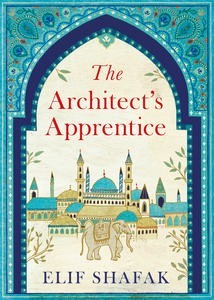
Elif Shafak can be a difficult author to categorize: one of Turkey’s best-known and controversial writers and, perhaps consequently, political and social commentators, she was born in Strasbourg, spent many of her formative years outside Turkey and writes her novels in English first before reworking them in Turkish.[1]
In addition, those familiar with her previous work may find her latest novel, The Architect’s Apprentice, something of a surprise, for it is a relatively straightforward historical saga set in 16th-century Ottoman Istanbul, very different from the modern-day, multi-cultural, multi-continental and, literarily, multi-layered Bastard of Istanbul with which she made her international name. Those coming to Shafak for the first time will find in The Architect’s Apprentice the elements—good storytelling, attractive characters, evocative and historically-grounded settings and personages—that appeal in writers like Amitav Ghosh.
Jahan comes to Istanbul as a twelve-year-old orphan in charge of a white elephant by the name of Chota, who is meant as a gift for Ottoman Sultan Suleiman. He lives in the palace menagerie and serendipitously comes to the eye of Mimar Sinan, the Empire’s premier architect and builder. While taking care of Chota and apprenticing for Sinan, he falls in love with the Sultan’s daughter Mihrimah.
In a story that covers a lifetime at the height of the Ottoman Empire’s political, military and cultural power and influence. Instead, Shafak allows several different threads to develop and intertwine: the story of Jahan and Chota, Jahan’s lifelong voyage of discovery—of himself, of the nature of the world of people and politics, of the wonders of architecture—and of the entirely unconsummated love that Jahan has for the princess.
It is also the story of Sinan and the building of the architectural monuments for which he is still renowned, set at a time when the architects of St. Peter’s and the Suleimaniye mosque were well aware of each other’s work. Woven into this saga are the struggles between engineering and religion, science and superstition, innovation and tradition.
The result is very much a tapestry rich in characters—sultans, viziers, sufis, gypsies, animals, Venetians and other foreigners, artists, prostitutes, dwarves, sailors and soldiers, even Michelangelo—engaged in war, building, debating, competing, stealing and just trying to get by in settings as varied as the brightest palaces, the most spacious mosques, the bloodiest battlefields and the most forbidding dungeons.
Straightforward action-rich narration, somewhat old-fashioned in tone and infused with a sense of innocence, a protagonist who is always learning, always somewhat naive and who never quite grows up until the very end of the book and Chota’s elephantine presence throughout give The Architect’s Apprentice—the odd visit to a brothel apart—something of the feel of a children’s story or at least a novel from a different time.
Those so inclined can pick holes in the narrative: Jahan is rescued by a gypsy chieftain a few times too many to be entirely credible while some characters and events add color but seem superfluous to the plot. But these things only matter if one decides to let them: they tend to be washed away by the passages that tug at the heartstrings.
It is difficult to read The Architect’s Apprentice without seeing—out of the corner of the mind’s eye—that other great Turkish novel set in a similar epoch on a not dissimilar theme: Orhan Pamuk’s My Name is Red. The latter, set immediately after the period of Shafak’s novel, could almost be a sequel with artists rather than architects tracing the downward trend as the period of artistic innovation and brilliance decays to one emphasizing tradition and stasis.
They are similar, as well, in the wealth of detail in sights, sounds and smells that resemble the naturalism of Western painting rather than the inanimate geometry of Islamic art—which is, at least in part, the point. Both books deal with the artistic influences that flowed between West and East but which ultimately succumbed to Ottoman conservatism in the 17th century.
But while both books comment on the nature of artistic expression and freedom, Pamuk’s is—to my mind—more explicitly political, drawing clear parallels to contemporary developments in Turkey. My Name is Red novel is also structurally adventurous with each chapters told in the first person from the perspective of a different character, some of whom are inanimate objects.
Shafak, in contrast, seems to have concentrated this time on storytelling rather than structure and commentary—and not so much one story as many stories and fables one after and sometimes within the other. If telling a good story, one that wraps her readers up with the characters, were her intent, she has succeeded and spun a touching and lustrous tale about a boy, his elephant and their adventures. Sometimes, stories are best told as stories.