Hunters in the Dark by Lawrence Osborne
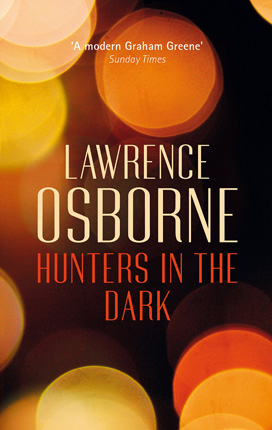
A blurb on the cover of Lawrence Osborne’s new novel, Hunters in the Dark, declares him to be “a modern Graham Greene”. Readers might be inclined to react with scepticism to such claims; after all, they rarely match the reality. And what’s more, in the context of a book set in 21st-century Cambodia, a Greene comparison might well be a worrying signal, warning of all sorts of tawdry anachronisms and generic “white man in the tropics” clichés.
Happily, however, Osborne overturns virtually all such skeptical expectations in this taut, unsettling, and richly atmospheric book.
The story begins as the central character, Robert Grieve, a 28-year-old schoolteacher from England, crosses the Cambodian frontier from Thailand towards the end of his summer trip to Southeast Asia. Strangely detached from the mainstream backpacker scene, consumed by a rootless sense of ennui, and running low on cash, he chances his last travel funds on a few spins of the roulette wheel in a border town casino, and ends up $2000 better off. An encounter with an enigmatic American, Simon Beauchamp, and a little late-night opium, then sees Robert stripped of his winnings and deposited in Phnom Penh, minus his passport and dressed in a suit of the other man’s clothes.
In synopsis, what unfolds from this point on is essentially a thriller: Robert adopts Simon’s identity, sets himself up as a freelance English tutor, and becomes emotionally entangled with a local family, unaware of the nature of the threat, rapidly bearing down on him from the countryside west of the city.
With its unworldly protagonist stumbling off the beaten track and into trouble in a foreign land, the book is actually rather more reminiscent of Paul Theroux’s fiction than that of Graham Greene, while the climactic river journey towards crisis is surely a nod to Conrad, the ultimate reference point for all authors writing about troubled Western men at large in the tropics. But what really makes Hunters in the Dark interesting is the way it confounds clichés, and knowingly subverts the conventions of its own literary antecedents.
The anachronistic American in the tropical suit is slyly acknowledged as such
he suggested a man of another age, an anachronism that was appealing for all the affectation it implied
before being revealed as nothing more than another trust fund kid turned lost junkie soul.
The main protagonist, meanwhile, may well be an innocent abroad, but it is his home in Sussex—portrayed in a series of dreamy flashbacks—rather than Phnom Penh that is “like a posting on a colonial frontier.” The Westerners in Osborne’s Cambodia are not journalists, diplomats or colonial administrators, surrounded by an indelible aura of authority no matter how tormented they might be; instead they are shabby backpackers and sad, middle-aged dropouts, refugees from a dying world:
Once upon a time the Khmers had been in awe of them. But now their dirtiness and scruffiness and unruliness had dimmed their image at the very moment the Chinese and Thais had come into considerable amounts of money.
Even the book’s title, ultimately, seems to refer more to Robert’s blind fumbling for a proper sense of self, than to the exotic threat emerging from the Cambodian night that first assumptions might suggest.
There is, inevitably, a beautiful Asian love interest named Sophal. But she turns out to be a French-educated medical doctor, with a thoroughly convincing inner voice of her own—a world away from, say, Phuong in Graham Greene’s The Quiet American. When Sophal looks at Robert and at his fellow travelling Westerners, she does not see figures of authority:
One didn’t know what to say about them. It wasn’t pity exactly, it was more like maternal anxiety. One wanted to save them, to put them right. She wondered if she had a sad propensity to be attracted to the exotic.
The corrupt policeman, Davuth— the villain of the piece in its function as a thriller—also has a convincingly nuanced voice, and even a bit player, the taxi driver Ouksa, gets a meaningful internal dialogue. During one of the brief sections focusing on Ouksa’s point of view he furiously declares, “I exist all right … I exist a lot…” And that he does—which is more than can be said of most of the locals in the older books by the authors to whom Osborne is sometimes compared.
As a thriller, Hunters in the Dark works very well indeed, despite a couple of plot holes that an editor might have been expected to spot, and one forced coincidence that briefly drags the book down to the level of pulp airport fiction. But the novel is marked out from the ranks of ordinary thrillers by its prose. It is lush and sensuous, bearing scant resemblance to that of Graham Greene, but powerfully conveying a sense of atmosphere, particularly in the early chapters:
The verges were filmed red with sticky and wettened dust and in the dark were rolling green hills dotted with primeval-looking, isolate trees. Fields of mung and shaggy sugar cane. It was windy, the sky jagged with storm clouds and a peeping-Tom moon. The site of a disaster, or of a disaster about to happen.
This rich style helps forge the book’s fine balance of high tension and dazed lethargy (though it is notable, and appropriate, that the prose always snaps tighter when the book shifts from Robert’s perspective to that of the Cambodian characters).
Hunters in the Dark is a very fine novel—modern, self-aware without ever being arch, beautifully written, and as intelligent as it is thrilling. Lawrence Osborne isn’t really “a modern Graham Greene”—but that’s no bad thing at all.