“The Fifth Crusade” by Thomas Smith
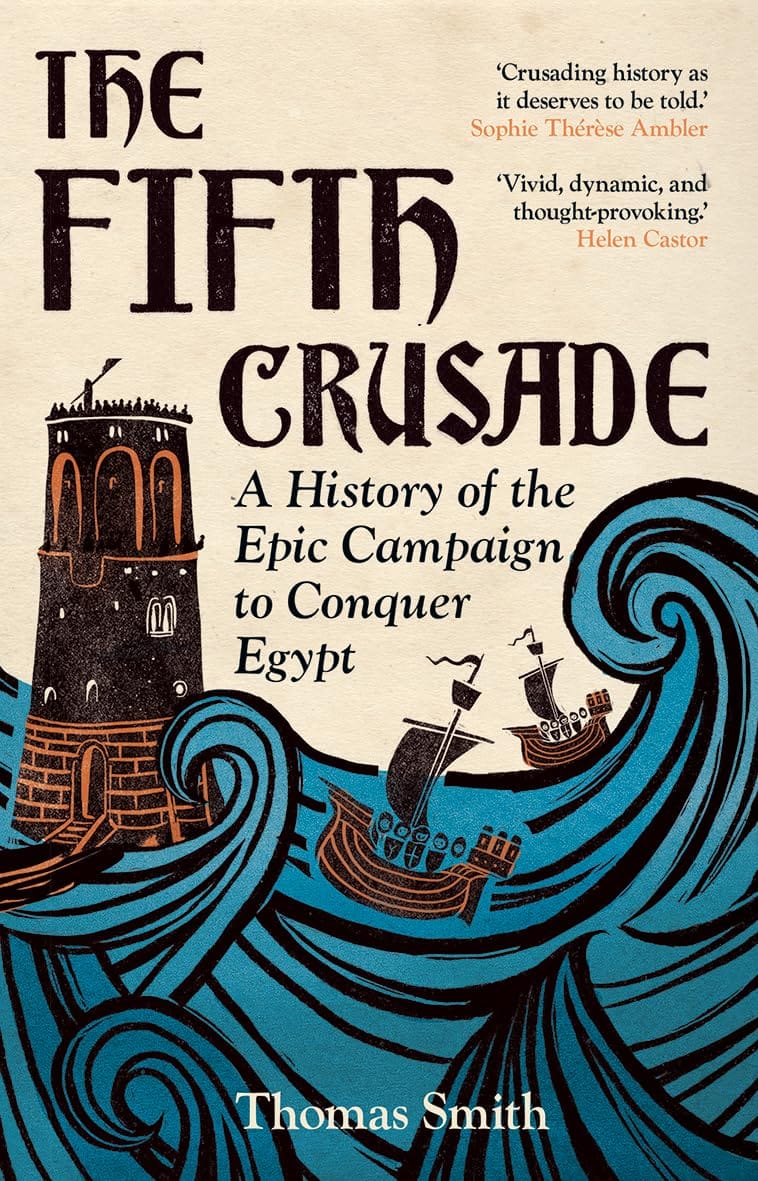
This century’s “forever wars” have nothing on the Crusades, which lasted some three centuries and had to be numbered. Lay interest in the Crusades seems to diminish after the clash of heavy hitters Richard the Lionheart and Saladin in the Third and the disrepute engendered by the Fourth, in which the Franks turned on their fellow Christians in the Eastern Roman Empire, sacking and occupying Constantinople.
The Fifth Crusade is relatively less-known, perhaps because it targeted Egypt rather than the Holy Land, perhaps because it fizzled out in disaster. Thomas Smith tells the story with considerable bravura in his new book, a story which has (he says elsewhere):
crocodiles, amphibious warfare on the Nile, nunchucks, medieval napalm, or ‘Greek Fire’, a floating siege engine, and landing craft – the medieval version of the Higgins boats used on D-Day in 1944.
It kicked off in 1271, when John of Brienne was King of Jerusalem, but since Jerusalem had been in Muslim hands for a generation, he was instead ruling a diminished territory from Acre. To further complicate matters, he was only King by virtue of his marriage to Maria of Montferrat, the hereditary Queen, who had died in 1212 leaving a daughter; technically, John was regent.
John was nevertheless, Smith argues, a competent military commander and after King Andrew II of Hungary returned home in an apparent huff after the Crusade’s desultory early stage in the Levant, John was (unusually) left in charge, the first local Latin ruler to be so recognised. Attention switched to Egypt.
The crusade leaders, with King John at their head, held a general council to decide upon the next phase of the campaign. An assault on Jerusalem was discussed, but a siege of the city during the summer was considered unviable on account of the lack of water. Instead, the council of war agreed on Egypt as the target. They cited that it was the ‘richest and most fertile land in the East’ and that it was the source of the Muslims’ power, and, by extension, their ability to control the Holy Land. According to Jacques de Vitry, the thinking was, that if Egypt could be taken, ‘we would easily be able to recapture the entire kingdom of Jerusalem’.
Smith sees the strategic rationale in this decision. At first, things went reasonably well. The Crusader coalition launched an amphibious assault in May 1218 and captured Damietta after a long siege. The Egyptian Ayyubid Sultan al-Kamil offered terms, including ceding Jerusalem. John was inclined to accept, but the papal legate Cardinal Pelagius insisted on pushing on to Cairo; the Crusaders ended up being trapped by a flooded Nile (with some help from al-Kamil, who opened the sluice gates) and forced into an ignominious surrender.
The somewhat unedifying tale is enlivened by Smith’s breezy storytelling. He opens each chapter with a creative “vignette” which is closer to historical fiction than history per se. The cast of characters includes not just John of Brienne and Pelagius but also the ever-absent Emperor Frederick II (whose lack of arrival lends a “Waiting for Godot” feel to the narrative), such chroniclers as Oliver of Cologne and a couple of Popes; even St Francis of Assisi (who extraordinarily paid a visit to Egypt) has a cameo. The pages are, as promised, populated with crocodiles, “Greek fire” (doused, we are told, with copious quantities of vinegar and stale urine), new amphibious landing craft, siege engines, mysterious prophetic Arabic manuscripts as well as the geopolitical and marital machinations of 13th-century Europe.
The rambunctious result is something of a “Boy’s own” retelling, one in which the conquest of Egypt is presented as a worthy goal and the campaign’s failure due to the Crusaders getting slightly ahead of their skis.
What is remarkable about the crusade on the Nile, then, is not that it failed, but that, despite all the challenges it faced, it came so close to succeeding and completely remaking the Near East in the thirteenth century.
Smith takes particular interest in rehabilitating Pelagius:
Later sources painted Pelagius as an arrogant and pig-headed leader who exceeded his mandate by taking a major role in the military campaign. Historians relying on these sources therefore interpreted him as a negative agitator within the crusader camp. But a more careful reading of the sources directly contemporary with the crusade – which are universally positive – suggests that he should be reinterpreted as one of the most successful leaders of the expedition.
Yet he comes across, even in Smith’s account, as arrogant, over-confident and militarily ignorant.
It is hard to read The Fifth Crusade without hearing echoes of the follies of more recent conflicts. Smith never asks the admittedly anachronistic but nevertheless relevant question as to whether everyone might have been better off had the Crusaders stayed home. Perhaps he doesn’t need to.