“Hong Kong Art Deco Architecture: Unveiling the Hidden Heritage”
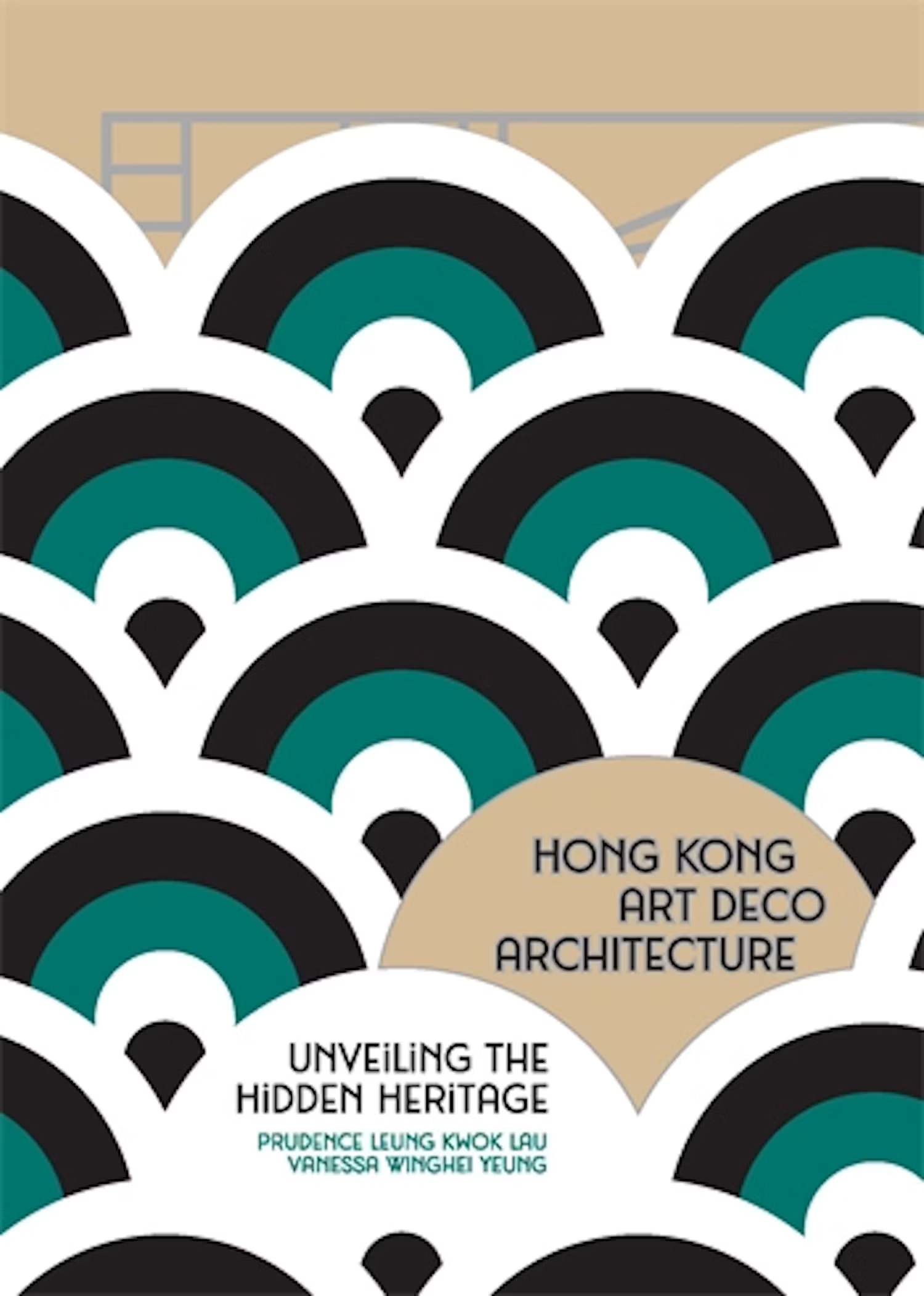
In Moliere’s play Le Bourgeois Gentilhomme, the wannabe aesthete Monsieur Jourdain learns with delight that “for more than forty years I have been speaking prose without knowing it!” A similar sentiment arises when reading Prudence Leung Kwok Lau and Vanessa Winghei Yeung’s Hong Kong Art Deco Architecture: it seems that—except for the very few Hong Kong buildings that are more than a century old—just about every Hong Kong colonial edifice dating from the 1960s and earlier is art deco in one way or another. It helps, as the book notes, that “Art Deco is a sublimely intangible construct…”
Unlike its somewhat older cousin Art Nouveau, so called since the 1880s, the term Art Deco was not in fact coined until the 1960s; it derives from the French “Arts décoratifs”, itself first used in 1925 in Exposition internationale des arts décoratifs et industriels modernes held in Paris, although it and its various elements date from somewhat earlier. Art Deco, like many such designations, is easier to recognise than describe—the style is often characterised as sleek and modern—but chevrons, sunbursts, and fan shapes (often in tones of gold, ebony and silver) are dead give-aways. No “Great Gatsby”-themed party would pass muster without them. In Asia, it is a style often associated with Pre-War Shanghai.
Although much has been redeveloped, there is still much Art Deco in Hong Kong, some obvious, some only visible if one knows where to look. If Hong Kong Art Deco Architecture hasn’t captured all of it, it must have come close. The entries are ordered by building type, ie Public and Institutional Sites, Residential Properties and Commercial, Industrial, and Utility Buildings. As a taxonomy that makes sense, but is not perhaps the way the lay reader would organise them. The Peninsula Hotel’s “Cafeteria” (now known as the Lobby)—perhaps the most well-known (and most-visited) example of Art Deco in Hong Kong—does not appear until page 168.
Other well-known buildings include King George V (KGV) School and Maryknoll Convent School (Primary Section), from 1936 and ’37, the Kowloon Cricket Club (1932), The Wan Chai and Central Markets (1937 and ’38) , and—since Art Deco continued after the War—the Bank of China building (1950). The book also shows how easily Art Deco accommodated Chinese elements and iconography, with St. Mary’s Church (1937) being the most flamboyant example.
But the charm of the book is contained in the buildings that even the diligent flâneur might have missed: not just the houses in Happy Valley and the abandoned Cheung Chau Theatre (1931), but also the 1930s-era Hongkong Electric Company Substation on Broom Road and the Public Toilet on Oil Street (whose date of construction remains a mystery). They detail grills, staircases, moldings and external ornamentation, all recognisable once pointed out.
Some of the buildings included are no longer with us: the old, and once iconic, Hong Kong and Shanghai Bank building from 1935 (two of Art Deco lions remain preserved), the Lee Theatre (1927) and the Star Ferry Pier near Edinburgh Place on Hong Kong Island from 1957 in the Streamline Moderne style.
It would appear that almost every Hong Kong building in the half-century or so from WWI to the 1960s is to a great or lesser extent Art Deco. That isn’t quite all vintage Hong Kong buildings, but few (from St John’s Cathedral and the relocated Murray House to the Hong Kong University Main Building and what is now the Foreign Correspondent’s Club) pre-date this.
The richly-illustrated catalogue of buildings is bookended by essays which cover Arts Deco itself, the local socioeconomic and political contexts, details on the methodology and where Art Deco sits in Hong Kong today. Given the book’s provenance, there is some mention of theory, but those not so inclined can instead revel in the photographs.