In the Rose Garden of the Martyrs by Christopher de Ballaigue
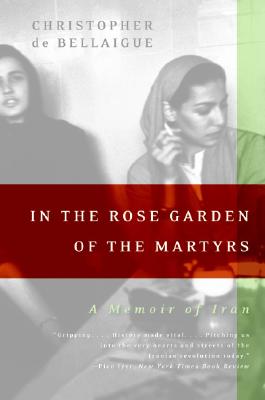
For most people outside the Middle East, mention of “Iran” conjures up pictures of bearded men threatening either the Iranian population or the West with dire consequences. For the West, these currently include terrorism and nuclear weapons. As is invariably the case with such one-dimensional images, the real world is always considerably less black and white, and much more complex.
In his first book, In the Rose Garden of the Martyrs, Christopher de Ballaigue entertainingly paints a realistic, three dimensional view of this complex country and its history. The author is well-qualified for the task. He studied Persian and Indian Studies at Cambridge University and now lives with his son and Iranian wife in Tehran where he is correspondent for the Economist.
The book comprises an interesting mix of styles, at one moment a history book recounting the history of Iran between the two world wars, the next a travel guide to modern Iran, then a personal memoir, and then a journalist’s account of political events. de Bellaigue makes it work, and result is a compelling description of life in a troubled country three times the size of France with a population of nearly 70 million.
For example, in one chapter de Bellaigue starts by discussing the unacceptable level of pollution in Teheran, caused largely by traffic and poor urban planning, he then digresses to discuss the number of street names changed to honour the memories of individuals killed in the Iran/Iraq war, before describing a visit to the Nest of Spies, as the former US embassy is called.
In the same chapter he then describes how he was able to arrange to share a taxi to Isfahan, a major city south of Teheran, and survive the trip, despite the best efforts of the maniacal driver. Once safely in Isfahan he visits the Rose Garden of the Martyrs of the book’s title, in the company of a veteran of the Iran/Iraq War of 1980-88. The Rose Garden is a cemetery with 7,000 war dead from Isfahan and surrounding districts and de Bellaigue’s guide recounts many detailed stories of individuals buried there, as well as his own personal war experiences.
In fact, the war is a central theme of the book and de Bellaigue returns to different aspects of it as he explores its enormous impact on modern Iran. In the course of this exploration, he reports not just what others have written on the subject but also interviews many war veterans and families, Iranian politicians and clerics.
He describes the fatal enthusiasm of the young, inexperienced soldiers—particularly those of the Revolutionary Guard for whom commitment to the cause was much more valued than military training: many thousands of these soldiers prepared to die for their country in the belief they would go straight to heaven. The resulting mass attacks of Iranians against strongly fortified positions held by the Iraqis meant terrible loss of life by the Iranians and over time saw the Iraqi war machine worn down and finally ejected from Iran. In describing these dreadful times de Bellaigue compares the Iranian military’s tactical lack of concern for the lives of its soldiers with the similar lack of concern shown on the Western Front in 1916.
However after, the expulsion of the Iraqis from Iran in 1982 the Iranian government failed to seek a peace. Instead they chose to invade Iraq, a decision that saw them bogged down in another six years of fruitless but lethal fighting. Despite some research de Bellaigue has been unable to pinpoint the logic behind the government’s decision to continue fighting. For fairly obvious reasons now no one is prepared to acknowledge responsibility for the decision which saw the war continue for so long and produce so much misery.
According to the author, a key cause of an ongoing resentment felt by Iranians towards much of the rest of the world is that despite having started the war, and having used poison gas on Iranians, the Iraqis were, in time, supported by most of the West against Iran. Thus while the Iraqis were using modern French and American weaponry, the Iranians were using outdated equipment and suffering because of it.
One can but speculate toady over how much of an impact this feeling of being an innocent victim, ignored by the rest of the world has on the apparent current efforts to obtain a nuclear capability.
In summary, this is an excellent book for those interested in understanding a country with a key role to play in a troubled part of the world.