“Babylon, South Dakota” by Tom Lin
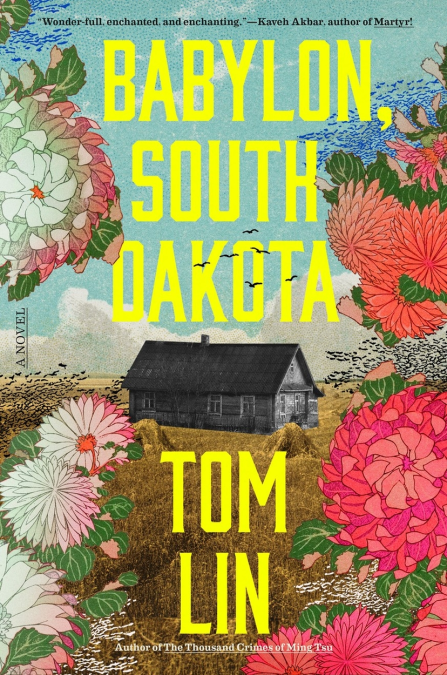
Tom Lin’s debut novel, The Thousand Crimes of Ming Tsu, paid homage to the American Western, with a Chinese twist, and his lyrical writing style is well suited to the cowboy culture of the American Wild West. He’s back with Babylon, South Dakota, a novel just as colourful as his first.
Where his first novel changed the landscape of the traditional cowboy story, his new book is a tribute to the American frontier. In the 1970s, a Chinese couple moves into a ranch on 160 acres of land in South Dakota. Newly-arrived immigrants, they start going by the American names of Saul Keng Hsiu and Mei Lee. They each have different ideas as to how to use their new land.
During the deepening fall of their first year, she and Saul had arguments that rattled the windows and scattered the rats, for there was only enough money to commit to flowers or to ranching. The land was cryptic and bashful and refused to confirm to either her or Saul’s reading of its true purpose. At last they compromised, deciding to pursue both options halfway despite their both agreeing that only cowards took pride in compromise.
The novel references biblical themes, beginning with its title. There is no Babylon in South Dakota, but Saul and Mei live near a military base of that name. They also come face to face with the US government, which cons Saul into allowing a missile silo—called Project Methuselah—to be built on part of his family’s land. When the government representatives first try to speak with Saul and Mei, they realize there’s a language issue and bring in the only Chinese speaker in the area, a man named Abram Song. Abram becomes a close friend of Saul and Mei’s.
During the construction of the silo, Saul’s chrysanthemums are upended. He replants them and brings them indoors until he can build a greenhouse to keep them. Abram helps and sources the glass from broken stained glass windows of a local church.
It was precise, painstaking work, this suturing of holy limbs with molten metal by firelight. The hand of St. John the Baptist, which at one time hovered over the low pipes of the organ, came to be joined with a stand of date palms that once stood sentinel at the gates of Bethlehem. The bowed and shattered heads of penitent were squared for the corners of the greenhouse frame by the addition of many small blue-green shards, which came from the window depicting Jonas being thrown overboard into a churning sea. With the addition of the fresh solder, the panes they created were surprisingly robust and heavy as sin and it took both men half an hour of careful coordination to place a single panel, with Abram manning the winch on the truck while Saul sat astride a ladder and made fine adjustments to the pulley ropes.
During their second winter in South Dakota, Mei gives birth to their daughter, Mara. Sometime after Mara starts school, the government announces it’s going to expand its construction of the silo on the Hsiu family’s property and that their drinking water and air quality may be affected, but there’s nothing to worry about. As one can expect, there’s everything to worry about. Abram knows more about the government’s plan and their interception of intelligence from China and how the silo will counter this threat, but there’s only so much he can do to help the Hsiu family.
Lin infuses his story with magical realism. A herbal doctor named Malachi Owens uses potions and tinctures to heal his patients. Saul falls asleep for five months after taking a cure from Dr Owens, a period of time that could be interpreted as a coma or as a magical healing spell. Mara speaks to the animals on the family farm and Mei can predict events based on the patterns of birds in the area. But when the US government builds a replica of the Hsiu house on the silo, another world opens, so to speak.
By the end of the story, even though Saul and Mei are grandparents, many aspects from their earlier years in South Dakota remain familiar, including Saul’s beloved flowers.