“China’s Aristocratic Age” by Yuri Pines
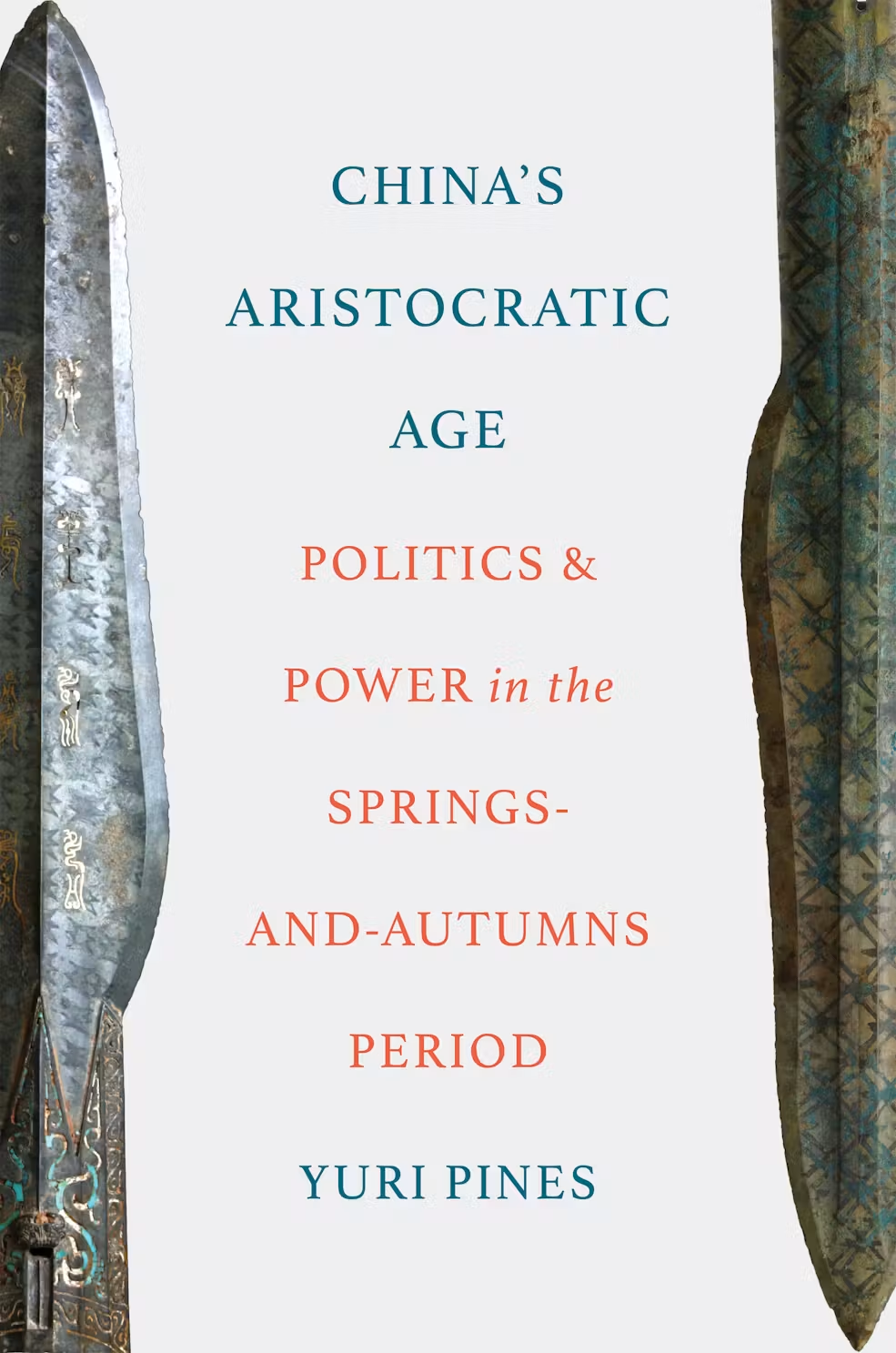
The norm in Chinese political thought for two thousand years has been, to quote Mencius, that “there cannot be two suns in the sky, nor two kings on earth.” Since only one faction can claim the Mandate of Heaven, there is no tolerance for rival claimants, nor for the notion that Chinese territory could be permanently divided into multiple polities. This way of thinking has been nearly constant since the triumph of the First Emperor in 221 BC, and is recognisable today. But it was not always so, argues Yuri Pines in this dense but crisply-written, impressively-researched book, pointing to the Spring-and-Autumns Period (ca 770-480 BCE). It is an unusual part of Chinese history: China’s only “open-ended”, relatively stable multipolar period, and “its longest experiment with polycentrism”. Predating the centralising impulse, the Spring-and-Autumns is the last time China looked more “European”: a cockpit of small, competing states rather than a massive, unitary empire.
At the tail end of the Chinese Bronze Age, around the same time as the rise of Athens, the states of the North China Plain formed a loose union, all under the nominal suzerainty of the Zhou kings but operating as de facto independent units. Confucius, who lived through the Springs-and-Autumns, attributed this diffusion of power to a lack of virtue in the ruling class, but modern historians suspect it had more to do with grain supplies, control of canals and roads, and the slow transition from bronze to iron. Pines entertains both possibilities, skilfully blending exegesis of the principal written sources—many newly translated into English—with new material from inscriptions, fragments, as well as recent archaeological research and a masterful command of “an avalanche of recent publications” in Chinese and Japanese, to draw a fuller picture of an era in flux.
Though fighting and conquest were commonplace during the Spring-and-Autumns, as the strong gobbled up the weak—dozens of minor statelets were annexed—a general war of all against all was carefully avoided. Eventually, power coalesced around the major states of Jin, Qi, Qin, Chu, Wu and Yue. None were quite strong enough to dominate the plain or displace the Zhou, but crucially, none seemed to want to anyway. Based on what can be gleaned from the sources, the major players of the Spring-and-Autumns appear to have been happy with their status quo.
This delicate balance of power had much to do with the men in charge. For four hundred years, a warrior class ruled the Yellow River valley. Bound together by marriage, blood oaths, and a collective ritual culture based on individual honour, martial glory and mass sacrifice (both human and animal), they were the “aristocrats” of Pines’ title. As a ruling class, they are unusual in Chinese history. Powerful offices were assigned on the basis of breeding and lineage, rather than through the meritocratic exam system for which China’s mandarinate would later become famous. But these aristocrats were hardly foppish aesthetes: contemporary accounts and inscriptions attest to their love of chariot-racing, archery, hunting, and war. When not on campaign, they filled their time with brawling, drinking, feasting and concubines. In many ways, they were typical Bronze Age big men: reading Pines’s meticulous reconstructions of their sacrificial rites, squabbles, games and wars, one imagines the heroes of the Iliad would have found themselves quite at home in Qi or Jin.
But it was not all blue-bloods drinking, fighting and carousing; the Spring-and-Autumns was also one of the golden ages of Chinese philosophy. Scholar-bureaucrats had a place at the edge of the aristocrats’ courts, handling the paperwork and overseeing sacrificial rites: most famously Confucius, who was scandalised by the impropriety of his ruler, the Duke of Lu. Leaving the duke’s service, he wandered from state to state looking for a virtuous man to help him re-establish the old ways of the Zhou, but met only defeat, discouraged by the moral laxity of the aristocrats and the ominous totalitarianism of Qin, the rough frontier state that would later triumph and reshape China in its own image after the subsequent Warring States Period. Meanwhile, Lao Tzu preached the way of the Tao as an escape from the harsh realities of life, and mercenary captains like Sun Tzu taught a kind of war based on the use of chariots and calculated deception. The common culture of modern China was beginning to form, yet in this multipolar order lay the seeds of its destruction.
“The Zhou Commonwealth”, as Pines calls it, was only stable as long as its leading states obeyed vague traditions about self-restraint. However, the transition to iron favoured Jin, an economic giant with an army of thousands of chariots (the tanks of their day), and Qin, known for its “Legalism”, a harsh but efficient system of government that excelled at dull bureaucratic work, and slowly but surely outperformed and outcompeted the aristocratic caste, regardless of their dash and flair. A system based on promises had no way to restrain ambitious expansionist powers, and the Springs-and-Autumns gave way to the bloodletting of the Warring States Period as the old alliances collapsed. The picturesque chariot-armies were displaced by massed infantry with iron weapons, and ritual combat designed to maximise the chances for individual heroic deeds (particularly daredevil charioteering) gave way to anonymous slaughter and the burning of cities. Eventually, the ruler of Qin would claw his way to power as the First Emperor in 221 BCE, uniting China under Legalist rule. His totalitarian tendencies were a direct reaction to the uncertainty and instability of the Spring-and-Autumns, and following dynasties all shared his horror of anarchy. Later chaotic periods were closed as quickly as possible by contenders who all aimed to unite the Middle Kingdom under one emperor. The experiment in sustained multipolarity that the Spring-and-Autumns represents has never been repeated.
