“Earth, Water & Fire” by Eiji Yoshikawa
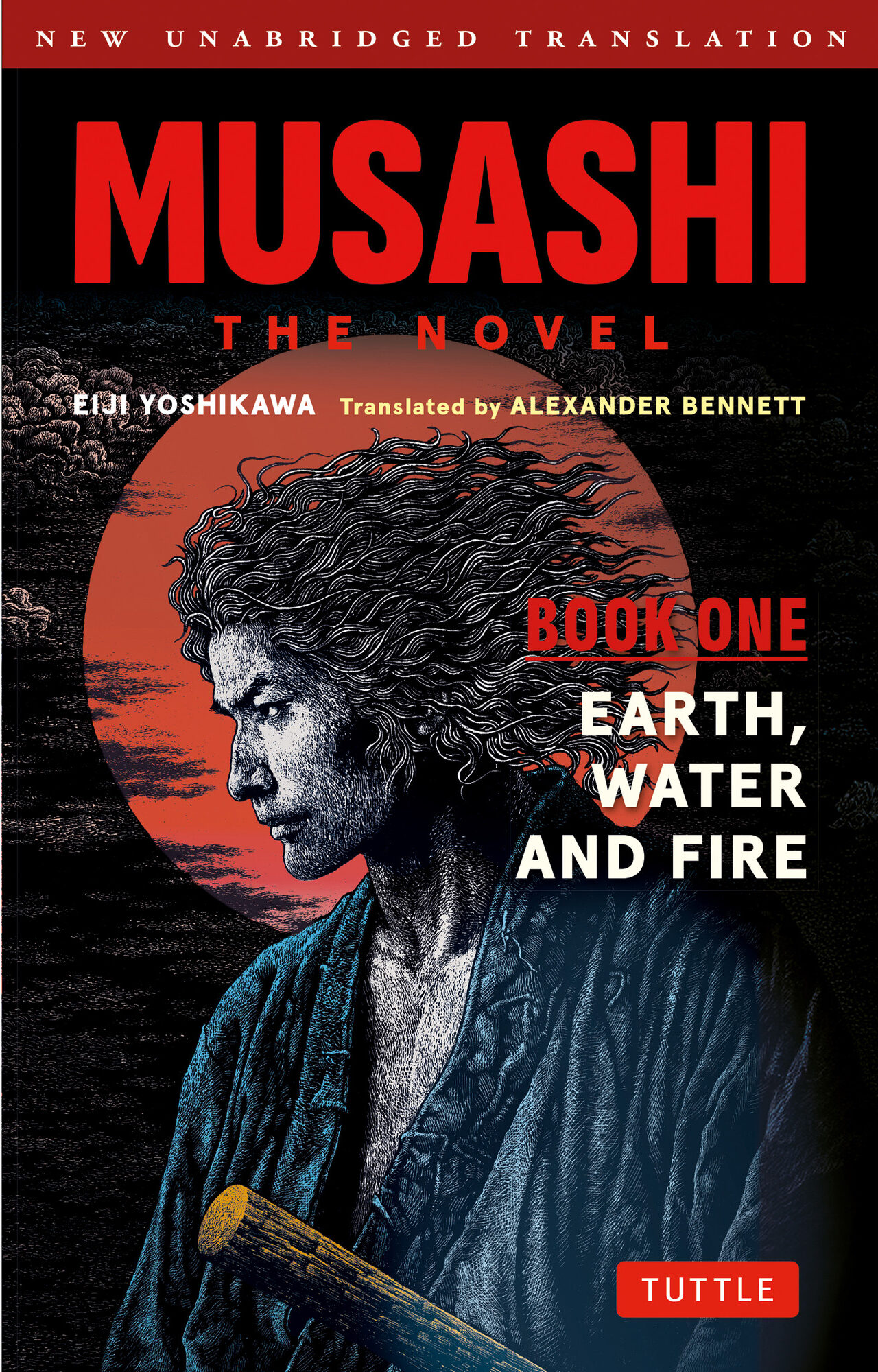
Miyamoto Musashi (ca 1583–1645) was a heroic figure of Japanese history, a master swordsman revered as a kensei, or “sword saint.” Although he was certainly a real person renowned for his swordsmanship and self-cultivation through the martial arts, little is known about his life. His work A Book of Five Rings offers insights into his personal ideas and martial philosophy, but scant biographical information. Therefore, much of the modern understanding of Musashi was born not from historical information but rather from subsequent legend and especially Eiji Yoshikawa’s novel Musashi, which weaves what little data is available about the man’s life with the author’s creative imagination and strong sense of the Edo Period.
First published serially in the newspaper Asahi Shimbun from August 1935 to July 1939, Musashi was initially meant to defend the swordsman’s legendary status, which was being attacked as exaggerated and unhistorical by the novelist Naoki Sanjūgo in debates among the Japanese literati in 1933. The novel emerged when Yoshikawa was drawn into the conversation and ultimately sided with those defending Musashi. What began as a rebuttal in an argument, however, soon swelled to become one of the most popular and influential novels in recent Japanese history, inspiring numerous film adaptations and a litany of manga. Mushashi’s legacy as Japan’s greatest swordsman arguably owes more to Yoshikawa’s novel than to the real historical figure, who is overshadowed by the book’s larger-than-life warrior-philosopher intent on enlightenment through the sword.
Given Musashi’s fame and influence, it is surprising that until now it has appeared in English only in abridged form (though still nearly 1,000 pages), in a 1981 translation by Charles Terry. Thankfully, Tuttle has recently released the full work in a translation by Alexander Bennett—split into three volumes of some 500 pages each.
Musashi is a book that takes its historical context seriously.
This first volume traces Musashi’s beginnings as a troubled youth on the losing side of the Battle of Sekigahara, the decisive battle that established the centuries-long rule of the Tokugawa shogunate. Finding himself a fugitive, Musashi quickly becomes violent in his attempts to evade the authorities, living in the mountains more as a beast than a man. He is ultimately turned from his wildness by the intercession of the Buddhist monk Takuan, and he spends a year reading in solitary confinement. He emerges from this ordeal burning with ambition to pursue the sword. This he promptly does—displaying a virtuosic skill whose immediacy is at times difficult to believe—and the rest of the novel finds him scampering across the landscape of early shogunate Japan honing skills, breaking hearts, and refining his spirit.
Musashi is accompanied by a large cast of characters, many interesting and admirable, some deplorable or obnoxious. He finds himself entangled in rivalries and feuds and becomes the love interest of more than one devoted woman, though he naturally cannot return their affections given his martial devotion. These subplots are often enjoyable, but they give the novel a tendency to read like a soap opera. The central interest of the story is the determination of Musashi to master the sword and become a “real human being,” that is, to achieve the wisdom, clarity, and detachment of figures such as the Zen monk Takuan. At the beginning of his journey, Musashi is an admirable swordsman, but he is vicious and steeped in violence, a fact the book does not shy away from:
Musashi was drenched in blood from head to toe… his own humanity had yet to fully reawaken from the savage, blood-soaked frenzy… he felt dazed by the sheer brutality of this reckless slaughter.
To truly perfect himself, he must learn more than mere strength; he must cultivate humility, discipline, and insight.
More than Musashi’s capacities as a fighter, then, the main plot is his progression toward wisdom, the taming of his violent spirit. This quest is, at least partially, in keeping with the philosophy of the real Musashi, who wrote about the need for personal cultivation beyond the sword, through poetry and art, for instance. In the first volume, the reader sees only the beginnings of this transformation, and more often than not, it is achieved through incredible ambition and self-discipline, sometimes to a point of becoming a mythology of individualism, though an enjoyable one. Yet there is a trajectory toward peace, toward wisdom and the overcoming of worldly ambition that is much more admirable than a mere series of conquests.
Musashi is vital to understanding the legacy of the historical swordsman.
The book is also filled with fascinating historical detail. As the opening reference to the Battle of Sekigahara makes clear, Musashi is a book that takes its historical context seriously. The political changes of the moment are always in the background, and many of the situations the characters encounter arise because of the political instability. Rōnin wander the countryside after their master’s defeat, castles are built by the new government, merchants vie with samurai for authority. The text is likewise replete with references to religious customs, literary traditions, and the fashion of the times. Whether or not these are all entirely accurate, they make for a richer world.
Unfortunately, Musashi is let down by an apparent lack of editorial oversight resulting in a host of typos, missing line breaks, and even alternative translations of the same passages. Bennett, an otherwise largely capable translator, has meanwhile chosen to render the rustic idioms of some characters into a wide-ranging, culturally specific vernacular. Characters mouth phrases such as “wee tot” and “bollocks” and the occasional bilingual pun like “what the fugu.”
Tuttle and Bennett deserve to be commended for bringing to English a work of such cultural significance. While the book has its faults—some owed to Yoshikawa, some to Bennett and Tuttle—Musashi is vital to understanding the legacy of the historical swordsman. And it is, more importantly, great fun to read.