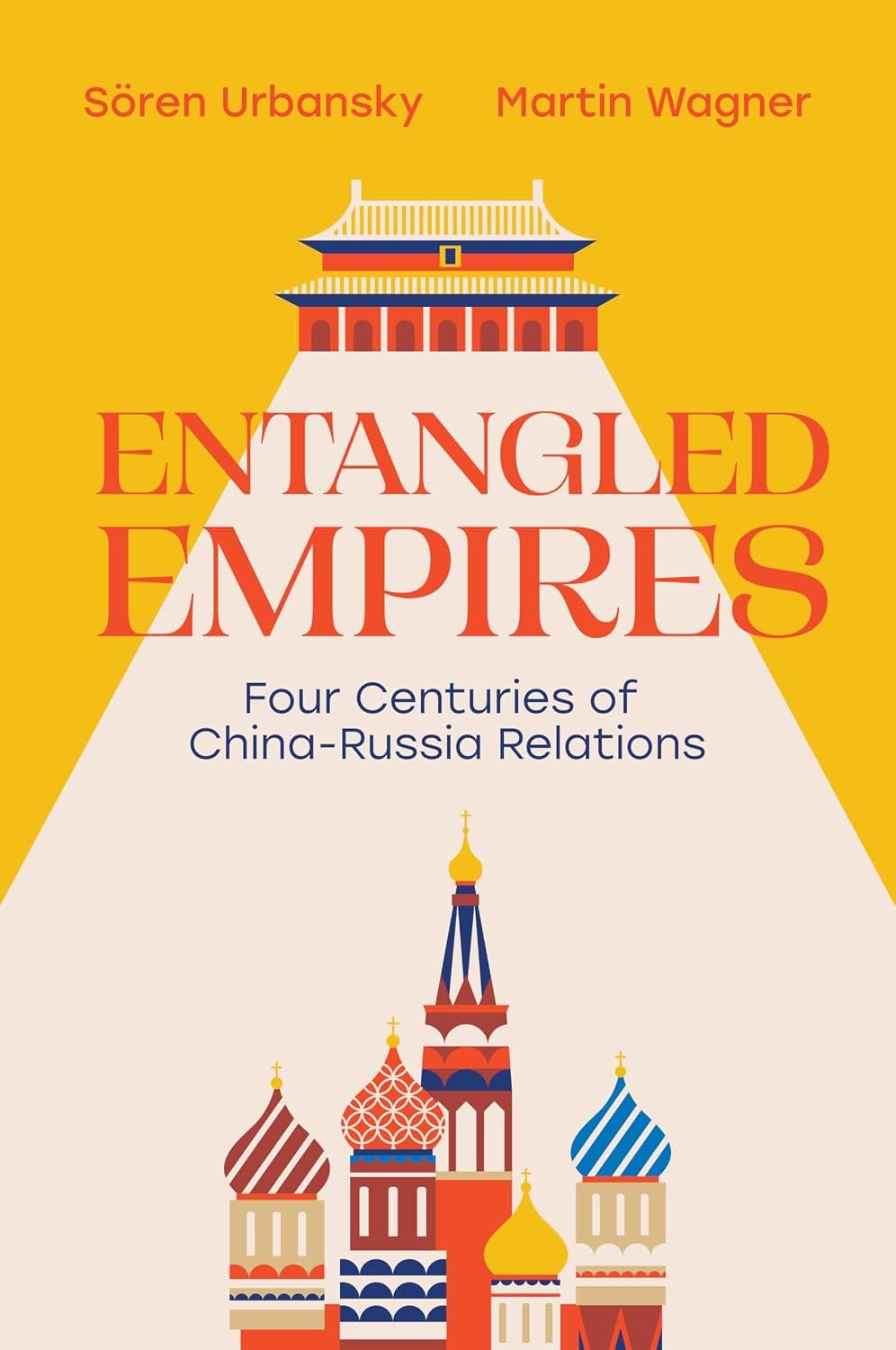
“Entangled Empires: Four Centuries of China-Russia Relations”
Xi Jinping and Vladimir Putin know each other well. Since 2013, when Xi completed his ascent to the top of the People’s Republic of China, they have met more than 40 times. Perhaps no other two heads of state currently in office have conferred as often. This, the pair maintains, has fostered an unusually close bond between their countries. When Putin visited Beijing in February 2022, less than three weeks before his ill-fated invasion of Ukraine, the two autocrats proudly proclaimed that China-Russia “friendship has no limits, cooperation has no forbidden areas.”
Putin and Xi indeed look rather chummy. But how broad, deep and lasting are the ties that bind their two nations? According to Sören Urbansky and Martin Wagner, two historians of Eastern Europe, the answer is not as much as many might think. To their mind, “florid proclamations of friendship are undoubtedly a façade behind which historic rivalries persist.”
In Entangled Empires, which was originally published in German in 2025, the authors strip the veneer of official pronouncements and document the various points of tension, current and historical. The book is organised around 12 chapters, each of which examines what the duo considers a revealing or significant period of Sino-Russian history. One strand that vividly emerges is that the relationship between the two giants has rarely been equal. When they first encountered each other in the early 1600s, China held the whip hand, but by the middle of the 19th century, Moscow had become the dominant partner, and brazenly used its position to extract concessions from its beleaguered neighbour. Today, the roles have flipped once again, and it is Beijing who holds most of the cards.
Initial exchanges—sporadic, inconclusive and often hampered by language barriers—began in the early 17th century. The first Russian envoy, Ivan Petlin, showed up in 1618, when the Ming empire was in decline. Poorly prepared, he achieved little beyond securing a letter from the emperor expressing an openness to some form of tributary trade. Alas, no one in Russia could read Chinese, so the missive “languished in a drawer for more than half a century.”
Meanwhile, Russian expansion across the Eurasian landmass proceeded apace. By 1640, cossack adventurers had reached the Pacific. A dozen years later, they collided for the first time with troops of the Qing dynasty, China’s new ruling house. One cause was the vague and poorly understood border, so in 1689, envoys met in Siberia to delineate it. Neither side had interpreters speaking the other’s language, however, so negotiations were conducted in Latin, with the help of Jesuits from the Qing court. The result was the Treaty of Nerchinsk, the first between China and a European country, which placed the frontier far to the north of the current one. It was also one of those rare instances when the interests of both parties, admittedly still taking shape, neatly aligned.
A century and a half later, the situation had dramatically changed. At the end of the first Opium war in 1842, Britain forced the Qing into humiliating concessions. Then, starting in 1850, the Taiping rebellion ravaged central China. To deal with the uprising, which lasted until 1864, Beijing was forced to redeploy troops from the empire’s periphery. Suddenly, the northern border was vulnerable.
Nikolai Muravyov, a swashbuckler, spotted an opportunity. In 1854, he sailed down the Amur river with a 1000 men and over the following three years, laid claim to much of the area in the name of the Tsar. It was a stunning feat of chutzpah: a Russian geographer later recalled that “hardly any Russian acquisition has ever been so cheap.”
When representatives of the two governments met in 1858 to settle the matter, China was in no position to push back. Making matters worse, its intelligence about Russia was poor, and it vastly overestimated the strength of its northern neighbour. In 1860, Russia wrestled another large tract of land east of the Ussuri river. In a mere two years, Moscow had snatched more than one million square kilometers of territory that the Qing considered to be theirs. No country ever amputated China of such a vast expanse and been able to retain it to this day.
The book also offers several examples of Russian duplicity. After the 1917 revolution, for instance, the Bolsheviks professed to respect China’s claim over Mongolia, but schemed to transform it into the first Soviet satellite in 1921. At Yalta in 1945, Stalin successfully petitioned Roosevelt and Churchill to allow him to restore some of the privileges Russia had enjoyed in the Middle Kingdom prior to its defeat against Japan in 1905. Uncle Joe never asked the Chinese for their thoughts.
By and large, the authors depict Russia as the main historical villain, but at times they pursue their evidence with more zeal than caution. For instance, they claim, without explaining how, that Russia used the Shanghai Cooperation Organization (SCO), a China-led security grouping established in 2001, “to legitimize its breaches of international law” in Abkhazia and South Ossetia, two statelets in the Caucasus which broke away from Georgia in 2008 with the support of the Kremlin, and then in Crimea, which Putin annexed in 2014. However, there is nothing in the press release of the SCO’s annual summit held immediately after each incident that can be construed as unambiguous support for Russia. Since the authors offer no further evidence, the reader is left wondering.
On occasion, they also push too hard trying to demonstrate long-standing bilateral tension. When describing the context of the 1689 negotiations at Nerchinsk, they write that already “the interests of the empires had clashed for centuries.” This is not accurate: the authors themselves point out that the first Russian envoy, Petlin, arrived in Beijing only in 1618 and neither side had much awareness of the other prior to that point.
These missteps aside, the core argument of this engaging book is correct: the Sino-Russian relationship has historically been rocky and mistrust remains. There are plenty of signs if one knows where to look: at a museum in Heihe, in China’s far north, which refuses to forget Russia’s imperial land grabs; in the statistics of their highly unbalanced trade relationship, which Beijing dominates and many in Russia resent; in the dearth of infrastructure connecting the two nations across the Amur, where only two bridges span the 2,000 km waterway; and in China’s reluctance to expand energy imports from Russia for fear, among other things, of becoming dependent. In recent years, there have also been reports of Russian concerns about Chinese spies. All these suggest a bond that is more fragile than the public display of friendship between Xi and Putin indicates.
Still, for now, the relationship is holding up and even expanding in many areas. But one wonders: what will happen when the geopolitical forces pushing Russia into China’s arms no longer hold? When antagonism towards the US and the West wanes? When the war in Ukraine concludes, and Russia comes out of its international isolation? When either Putin or Xi, both in their 70s, die or somehow leave power? Any of these could significantly change the calculation in the Kremlin or Zhongnanhai. What happens then is anyone’s guess, but if the interests of both nations once again begin to diverge, underlying tensions may well return to the fore.