“Island at the Edge of the World” by Mike Pitts
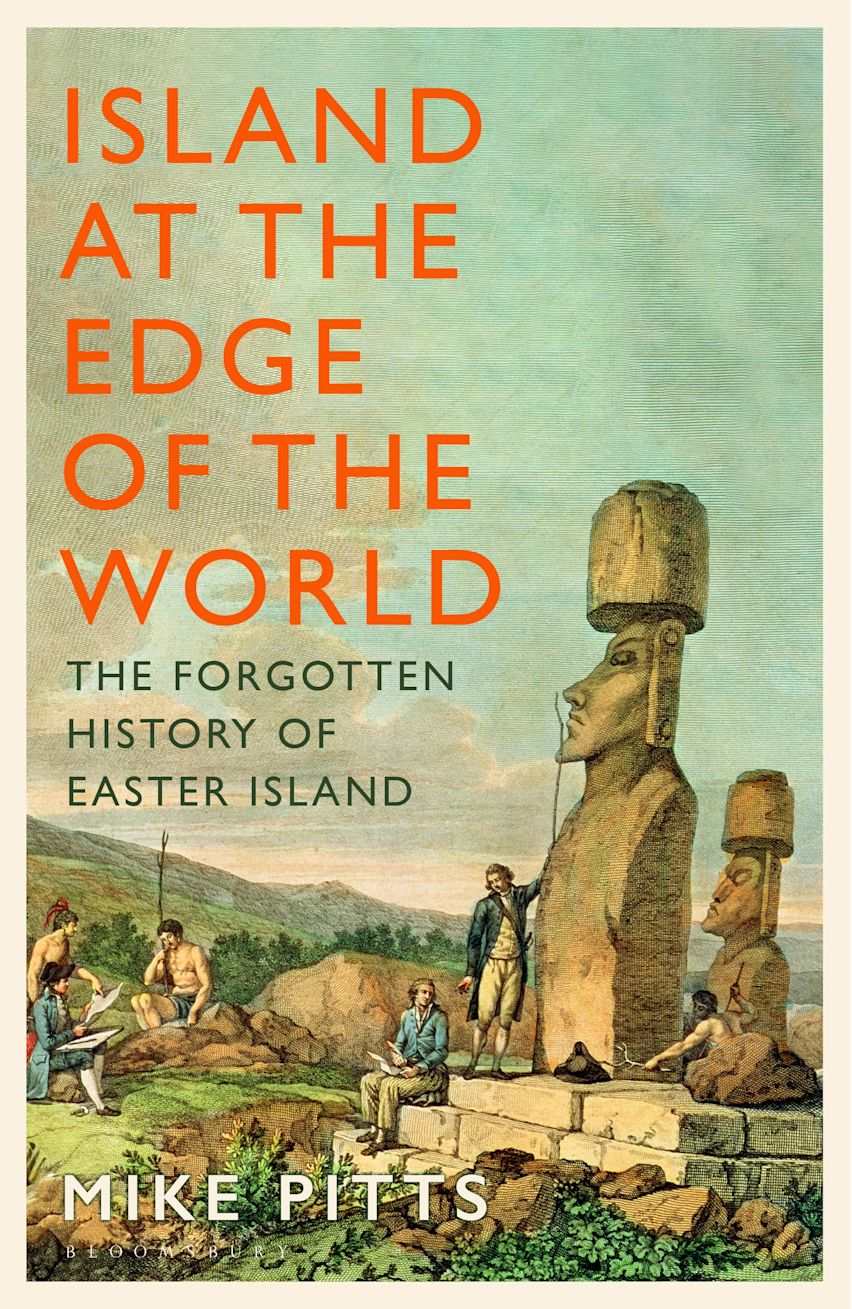
The story of Rapa Nui, better known as Easter Island, contains all the irresistibly exotic ingredients of a compelling story: Thor Heyerdahl’s daring voyages, mystical origin myths, Spanish conquistadores, scholarly rivalries, rumours of ritualised sexuality, and the brooding presence of monumental stone statues. For two centuries these ingredients have fed an extraordinary range of theories, speculations, and fantasies about one of the world’s most isolated islands.
In Island at the Edge of the World, archaeologist Mike Pitts approaches this well-worn terrain with a very different objective: to examine how the island’s history has repeatedly been misunderstood, mythologised, and appropriated. The result is a thoughtful and often quietly corrective work that replaces dramatic speculation with patient archaeological reasoning.Pitts’s fascination with this subject began early.
My interest in Rapa Nui began at school, where I was introduced to archaeology by the late Chris Potter. There I read Thor Heyerdahl’s Aku-Aku and was inspired by his evocation of the island—and puzzled by some of the things he said.
That early curiosity informs the book’s tone. Pitts writes less like a storyteller chasing revelations than a field archaeologist guiding readers through layers of accumulated evidence, and carefully brushing aside disproven theories.The book reads like a tour through the island’s intellectual history. Each chapter revisits a set of claims about Rapa Nui’s past, from early European encounters through 20th-century expeditions and modern scientific research. At the end of each stage, Pitts pauses to review the trail of ideas just examined, weighing what holds up and what collapses under scrutiny.Over time, the island has become a canvas on which outsiders projected their own fears and obsessions.
Central to the book is Pitts’s powerful observation that “Easter Island has never lacked explanations; what it has lacked is evidence.” Over time, the island has become a canvas on which outsiders projected their own fears and obsessions, be it the dangers of cultural decline, environmental catastrophe, proof of vanished continents, ancient super-civilisations, even extraterrestrial visitors.
Pitts patiently dismantles these narratives. The real story, he argues, lies not in sensational mysteries but in the slow accumulation of data.Archaeology does not solve mysteries with a single discovery. It advances slowly, piece by piece, replacing speculation with evidence.
Throughout the book Pitts demonstrates how new techniques such as radiocarbon dating, satellite mapping, geophysical survey, DNA analysis, and landscape archaeology have—and can still further—transform true understanding of the island.Those methods reveal a complex and inventive society rather than a doomed civilisation that destroyed itself. Rapa Nui’s inhabitants were highly-skilled Polynesian navigators and engineers who developed a remarkable monumental culture in extreme isolation. The scale of their achievement is striking: the island contains more than 300 stone cairns, around 1000 statues, of which 600 still stand upright today. (And, yes, he deals with why and how many of these colossi came to be lying flat.)Possibly most powerful are his portraits of the researchers who shaped the island’s scholarly reputation, such as the early 20th-century investigators Katherine and William Routledge. Their work was pioneering but chaotic, shadowed by immense private wealth, personal tensions, and eventual mental illness and dispersion of their valuable research. Pitts suggests that the history of Easter Island research resembles a strange intellectual drama: “Today it seems less musical theatre than a cross between a Tom Stoppard play and a David Lynch film.”Such moments illustrate another of Pitts’ central concerns—the persistent tendency for outsiders to hijack the island’s narrative. Again and again colourful theories have flourished despite little empirical support. The author’s response shows how scientific archaeology gradually filters fantasy from fact.That process has already clarified several key questions. The island was almost certainly settled by Polynesian voyagers around 1200-1300 CE, probably from eastern Polynesia, possibly the Marquesas or Mangareva. Pitts rejects earlier fringe ideas involving South American colonists, lost continents, advanced prehistoric civilisations or extraterrestrial visitors. In this sense the settlement of Rapa Nui itself is no longer mysterious.The book reads like a tour through the island’s intellectual history.
Yet the book is careful not to claim more certainty than the evidence allows. Pitts concedes that archaeology alone cannot provide every answer, and emphasises that many important questions remain open: How exactly did a small population create and sustain the massive moai statue tradition? By what methods were the enormous figures transported and erected across difficult terrain? What social or environmental changes reshaped Rapa Nui society over time?
Among the most intriguing unsolved puzzles is rongorongo, the undeciphered script carved into wooden tablets found on the island. Despite decades of study, its meaning remains elusive, making it one of the few surviving writing systems in the world that scholars still cannot read.Environmental history also continues to provoke debate. Evidence suggests episodes of deforestation, agricultural innovation, and shifting resource management. Understanding these patterns may help determine whether the island experienced genuine societal collapse or whether later observers exaggerated the scale of decline.Pitts points toward three research directions that may bring greater clarity: more careful archaeological excavation, improved environmental reconstruction, and expanded linguistic and genetic analysis.The book therefore does not solve all the mysteries of Rapa Nui. Instead it leaves no stone unturned in dismantling the sensational mysteries and shows where the genuine questions still lie.Island at the Edge of the World is not a conventional narrative history. Readers expecting a fast-moving adventure through Pacific exploration may find its methodical approach demanding. Yet the intellectual rewards are considerable. By sweeping aside two centuries of speculation, Pitts reframes Easter Island not as a stage for extravagant theories but as a rich archaeological landscape whose real story is still emerging.