“Foreigners” by EL Shen
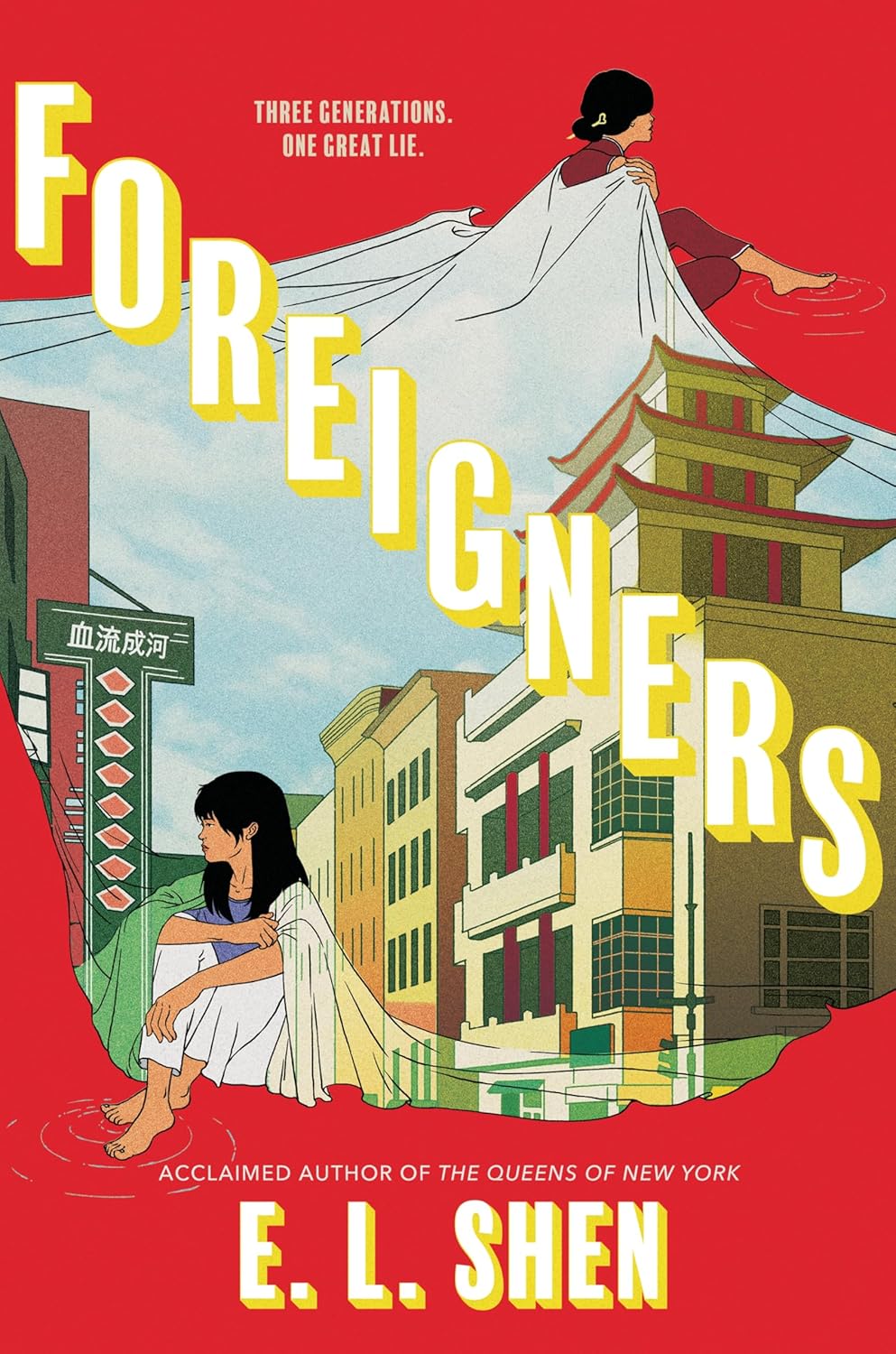
When Dawn Chin is assigned a high school history project to interview a family member, she picks her paternal grandmother and learns more about her family history than she expected, including a couple of life-altering secrets.
All the lies, all the secrets, the masks her family wears, the ones she puts on too, like a good show will erase the past. How can you call yourself a family when you don’t know the first thing about each other? How can you call yourself anything at all?
EL Shen’s latest book, Foreigners, is a multigenerational young adult saga of Chinese women, mainly set on the east coast of the United States. These generations stretch from imperial China to a present-day boarding school in Vermont. The secrets include lies and deceptions that began with Duanfang, a late-Qing reformer who believed in girls’ education and campaigned against foot-binding. He pretended to be a Manchu and wholeheartedly supported the Qing dynasty, but he was from a Han family and ended up losing his life when he supported Emperor Puyi during the 1911 Xinhai revolution. Although brief, the sections about Duanfang offer some of Shen’s most evocative writing.
Born under hazy skies in Tangshan, China, he always knew he would be great. After all, his father had been great, and so had his father, and now he, on the precipice of young adulthood, would learn to be magnificent. Standing on the balcony, flanked by pillars and sheltered by a ribbed pagoda roof, Duanfang dreams of all the ways he would rip open the seams of China and reshaped the country, thread by thread.
Dawn’s grandmother’s English name is Audrey, a name she took after leaving her home in Taipei in 1965 to attend her last year of high school in New York City with plans to attend university in the US. Dawn and her grandmother have never been close.
All her grandparents are dead except Nai Nai—her dad’s mother—and Dawn only sees her on Christmas. When she was a kid, they used to go on cruises together, and Nai Nai would play cards on the sky deck or read by the pool. She wouldn’t go on excursions and sometimes she wouldn’t even leave the ship. For reasons Dawn didn’t try to understand, Nai Nai was never interested in her granddaughter, like children were foreign to her despite birthing and raising one for decades.
As Dawn finally gets her grandmother to open up, she discovers that little about her family is as she had thought. When Audrey immigrated to the US, her parents had already picked out a future husband for her, the son of old friends who happens to attend the same school in New York. At first Calvin is friendly and saves Audrey from lonely lunch periods. But as the two get to know each other, Calvin becomes possessive. Audrey hears that another Chinese teen named Samuel is a patient tutor and can help her with English, but Calvin won’t hear of it and claims that Samuel is dangerous. A love triangle forms and Audrey feels pushed in many directions.
Dawn has her own relationship issues, although they’re not as complicated as her grandmother’s. She becomes close to another student at her boarding school, Penelope Patel, who goes by Pen, and for a long time the two aren’t quite sure if they’re just friends or if there’s more to their relationship.
Shen writes in her author’s note that Duanfang was her great-great-great grandfather and gave her the inspiration to write this story. He was also a collector of bronze artifacts, some of which are now housed at New York’s Metropolitan Museum of Art.