Old post
This post was published before January 2026. Some links, images or other content may no longer display or work as originally intended.
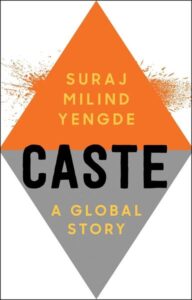
“Caste: A Global Story” by Suraj Milind Yengde
Embedded within Indian ethos, caste is the idea that people (defined by their social positions) are of four types—scholarly-priestly (Brahmins), warriorhood (Kshatriyas), trade and commerce (Vaishyas), and menial jobs (Shudras)—and these are fixed by birth, with no class and social mobility available, especially to the last group. This is no abstract concept; it takes very real form in actual practices and institutions that continue to persist in present times. The so-called lower castes live a life of humiliation normalized with practices of bonded labour and untouchability.
Until recently, the caste system was seen as unique to India. In Caste: A Global Story, Suraj Milind Yengde documents the presence of caste in the West (the UK, the USA, and Australia), the Caribbean (Trinidad and Tobago) and the Middle East to show that caste has reached wherever South Asians are present. Yengde begins his account with historical sources of foreign travellers to India, goes on to discuss the history of anti-caste struggles in India and its leaders’ attempts to connect with Black leaders struggling against racism in the USA, and concludes with a summary of findings from his field work conducted around the globe.
Until recently, the caste system was seen as unique to India.
The chapters pertaining to Yengde’s field work substantiate his point about caste being a global phenomenon due to immigration. Dalits (the commonly used expression to refer to the lower castes in general) live in different parts of the world and experience caste differently.
The story of caste cannot be understood by focusing on the South Asian landscape: one has to extend the study to other places where caste was interpreted, embraced and rejected. Caste reveals how localized institutions provided a basis for imaginative impulses of caste to survive amidst amorphous forms. Caste, therefore, is a journey, an itinerary of global identities and demographics.
Yengde notes that there are at least three ways in which caste materializes in host societies. Because caste is not necessarily visible to those outside the community, Yengde goes closer to Indian diaspora communities through interviews to understand the similarities and differences among the various diaspora groups.
First, the Indian population in Trinidad and Tobago is constituted by the descendants of the indentured labourers taken to these islands in the 19th century, a significant majority of whom belonged to the lower castes. Their descendants seem to have done away with caste because there were hardly any higher castes to enforce the system:
One of the distinctive aspects of Hinduism in Trindiadian life is the dominance of Brahmanism and brahmanical rituals. But who is a pandit and what their traits consist of is hotly debated. This is what makes the story of caste in present-day Trinidad so interesting in a global study. The descendants of dalits and shudras now occupy important positions in Trinidadian society. They identify as Hindus and Indo-Trinidadians, while the caste badge their ancestors had to carry with their emigration pass is no longer mentioned in conversation or everyday discussions.
In contrast, caste is very much alive among the Indian diaspora in the West. Yengde brings up examples from the UK and the USA. Immigrant Indians (most of whom are upper caste) are seen as model citizens in the West, which makes Dalit organizing in these countries very difficult. Yengde points to certain incidents in the UK and the USA to illustrate the influence upper castes hold in these host societies. The Equality and Human Rights Commission (EHRC) in the UK published a report establishing the existence of castes in the UK, the upper castes mobilised the Hindu temples in the country to protest against the report. It is very common to hear stories of in-fighting within groups such as trade unionists. Yengde narrates the story of Bishan Dass Bains, a member of Indian Workers’ Association and belonging to a lower caste, an old and active group of Indian immigrants in the UK, became a victim of casteism: he could not get elected to the leadership of the Association because upper caste men controlled the workings of the group. In the US, caste made headlines with the California textbook controversy in 2005 and again a decade later. Among the things included in the curriculum about Hinduism that the Hindu Education Foundation objected to was the word “caste”. The Foundation wanted to neutralize the term by calling it “varnas” or “class”. Even in the United Nations, any attempt at including caste discrimination as part of any descent-based discrimination has been opposed by India.
“Often, any attempt by the host society to intervene was met with accusations of racism.”
It is very easy for the upper castes to resist their host societies because they make allegations of racism in their discourse:
Often, any attempt by the host society to intervene was met with accusations of racism. As a result, the right practices of caste were eventually harmonized with cultural practices.
Christian Dalits in the West, the US, for instance, attempt to challenge the state of affairs by turning to Christian institutions that have access to government bodies. Things might change though:
Caste will eventually become a primary concern for host societies. As I write this, cases of caste discrimination have been filed in the courts in the United States, Canada, UK, Austria and Australia. In Australia a comprehensive study of caste discrimination has been undertaken.
Anti-caste legislation has been voted for in Seattle and California. Rutgers University has a Task Force on Caste Discrimination and has produced a report on how to define caste, practices of caste based discrimination, and interventions needed to address these discriminations. In 2020, dominant caste employees at a technology company were taken to court for discriminating against a Dalit engineer. More success stories are likely to follow.
Finally, in the Middle East, anti-caste organizing works differently, given the surveillance around the labour camps. In spite of the difficult situations people live in, caste is being “rejected” in the Middle East. There, leaders and workers of Dalit organisations focus on extending help by funding coaching centres so that young students from their communities can pursue higher education.
In summary:
The version of the caste system that exists in Trinidad involves compulsive adherence to shastric norms and a localized struggle between conservative brahmanical orthodoxy and educated subaltern resistance. All the while, the Ati-shudra body is not mentioned in the debate on caste. The reason for this is that untouchable groups have overcome the disadvantage of their caste location, and the general Hindu society is also aware of the imperative of not reproducing Indian standards of untouchability … Many Dalits, like other Indians in the finance and technology sectors, occupy an upper-middle-class status in the West. Their lifestyle is surrounded by white power structures, and in view of the lack of community activism in coordination with movements of locally oppressed people, active solidarities, with some exceptions, are barely existent. However, the movement against caste is being shepherded by working-class labourers in the Middle East. They are more focused and aware of the immediate political necessities that concern people of their backgrounds. The difference in Dalit activism abroad has to do with strategy and approach. Strategies are decided according one’ location, immigration status, job security, and career progress. American Dalits often practise measured caution in their activism. They are overly concerned about the response they may receive from their employers should they participate in any events or protests. In contrast, workers in the Middle East, who are subject to extreme surveillance, boldly and smartly continue the work of recruiting more members and applying their energy to political change in India.
The wider view that Yengde takes of caste is necessary to understand how marginalized groups live and organize themselves. He refers to the history of how some kind of gestures have been made to share concerns: Indian social reformer Jyotiba Phule was the first to draw a parallel between race and caste in his 1873 essay on slavery. Dr BR Ambedkar, the 20th-century champion of the Dalits who later embraced Buddhism, corresponded with the American Black intellectual WB DuBois but nothing much came of it. Much later, the Black Panthers inspired the foundation of Dalit Panthers in India but the group did not survive for long. The poetry of Black writers was translated by Indians, especially in Marathi, an Indian language spoken in the western state of Maharashtra in India. Because casteism has not been able to draw attention to itself in terms that racism has, it continues to remain invisible.
The irony in Yengde’s global story of caste is that casteism is akin to racism in several ways but upper castes have successfully deployed racism to deflate any international pressure or response to the practice of caste. The book needs to be seen as a call for deeper studies of caste in other countries and in comparative contexts exploring what discrimination of all kinds can learn from each other.


You must be logged in to post a comment.