“Good-Bye” by Osamu Dazai
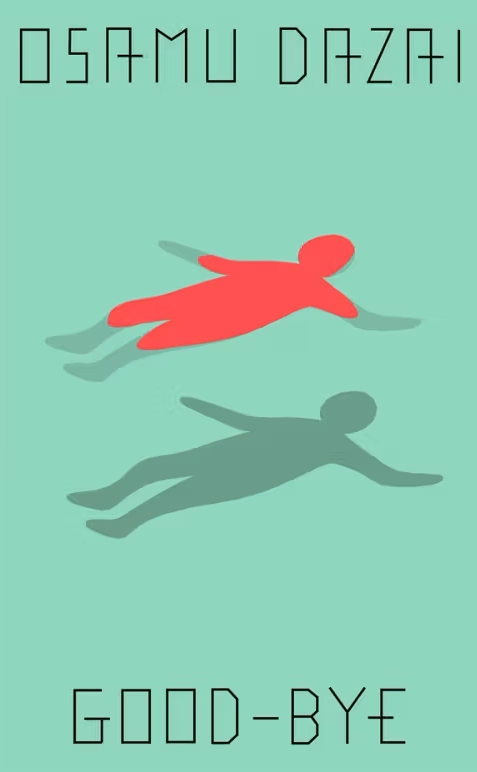
Osamu Dazai’s Good-Bye is a collection of short stories picked from different stages of his career, most of which have been translated into English for the first time. The final story, which shares the title of the book, was Dazai’s last work before he committed suicide, and remained an unfinished novella at the time of his passing. Another story was written under a pseudonym. The result is a collection that is simultaneously familiar for readers of Dazai’s work, and distinct in its miscellaneous nature.
The first story, “Memories”, follows a protagonist recounting his youth, a bildungsroman based on the events of Dazai’s upbringing that also inspired his later novel, No Longer Human, and his other work, The Flowers of Buffoonery. The detached prose in the short story is also reminiscent of Dazai’s other works that fall under the I-novel genre. The slightly-aloof style is matched by his subtle and dry humour, with which the protagonist approaches his adolescence and family life, highlighted by the passages about his relationship with his mother:
One night as I lay in my futon beside hers, practicing a certain stress-relieving technique two of the man-servants had taught me, my mother noticed the covers moving and asked what I was doing. Extremely flustered, I told her my hip hurt and I was trying to massage it. “Just rub, then,” she said sleepily. “You don’t have to pound on it like that.”
There is a whimsical quality that sustains the coming-of-age story. One vignette follows another, without a clear indication of where the story might go. The protagonist later mentions his school life, which Dazai writes about with a similar sardonic attitude:
Later on I would be struck by a number of different teachers. They offered various reasons for meting out such punishment — that I was smirking, for example, or yawning. I was told that the size of my yawns during class was the talk of the teacher’s room. A teacher’s room where they discussed such asinine things struck me as laughable.
The first story sets the expectations for subsequent stories: the egoistic narrator, the economic prose, the dismissal of all things sacred. The second story, “Down with Decadence”, begins with a philosophical defence against the story to come, and a reference to buraiha school of decadence that Dazai is often assigned to:
The fact that a certain work of fiction depicts a rather dissipated young man does not, in my opinion, justify categorizing it as “decadent” literature. I have always written stories that might best be described as idealistic.
The preemptive defence, it turns out, is justified by the plot of a young man in search of a geisha he has fallen in love with. Assuming the “romantic” role of a poor working student, he first tracks her to the seaside town of Aomori:
Bathed in a blue spotlight, the waterfall was visible from the entrance as if at the end of a tunnel, beyond a long, wood-paneled corridor that shone with the cold, dark luster of temple floors. The cherry trees were in leaf, and the waterfall thundering away in the shade of those glittering green leaves was, to me at eighteen, like something out of a dream.
The clear and exquisite prose, partly attributable to the translator Ralph McCarthy, is sustained throughout the collection, even when the work takes a quick turn towards the macabre. In the next story, “An Illusory Bluff”, a man pretends to be an author, and a harmless prank meant to impress a maid devolves into a terrible murder. In a similar bloody fashion, “Criminal” portrays a brother hacking at his sister with a butcher’s knife. “Narcissus” recounts the story of a painter unable to recognize her own genius and her subsequent demise.
Other stories are less tragic, but more experimental. “Tengu” is written from the perspective of someone who is supposedly a haiku aficionado, whose comments of the poet Bashō and his disciples can be read as dismissive and self-aggrandizing. “A: Autumn” is a drastically different piece, consisting of epigrams found in the author’s drawer.
“Good-bye”, the final story, follows the life of Tajima Shuji, the editor-in-chief of Obelisk magazine, now in his second marriage. Facing the responsibilities of middle age, he is determined to “skillfully extricate himself from his affairs with a number of women.” At one point he asks an older writer for advice, who returns wisely with the idea to feign madness, or even better:
Find yourself a breathtakingly beautiful woman somewhere, a world-class beauty, explain the situation to her, ask her to pose as your wife, and take her around to meet all your women, one by one. The effect will be instantaneous. They’ll all withdraw without so much as a whimper…
The humour here, framed by the perspective of a side character, is Dazai’s most unreserved. The joke continues once Tajima decides to follow the advice and goes in search of a beautiful woman. He finds one in a peddler named Kinuko, and begins to feed and dress her at his own expense. However, it is impossible to tell whether the comedy delivers in the end, or what exactly becomes of the man, as the story was interrupted by Dazai’s death.
An eclectic collection by an eccentric writer, Good-bye is a generous representation of Dazai’s entire career. The final story, an appropriate title for the writer’s last unfinished work, poses an impossible hypothetical—how would Dazai end his story? Although the answer would never be realized, the rest of the collection offers enough of Dazai’s voice and style to tease the imagination.