Old post
This post was published before January 2026. Some links, images or other content may no longer display or work as originally intended.
“I Guess All We Have Is Freedom” by Genpei Akasegawa
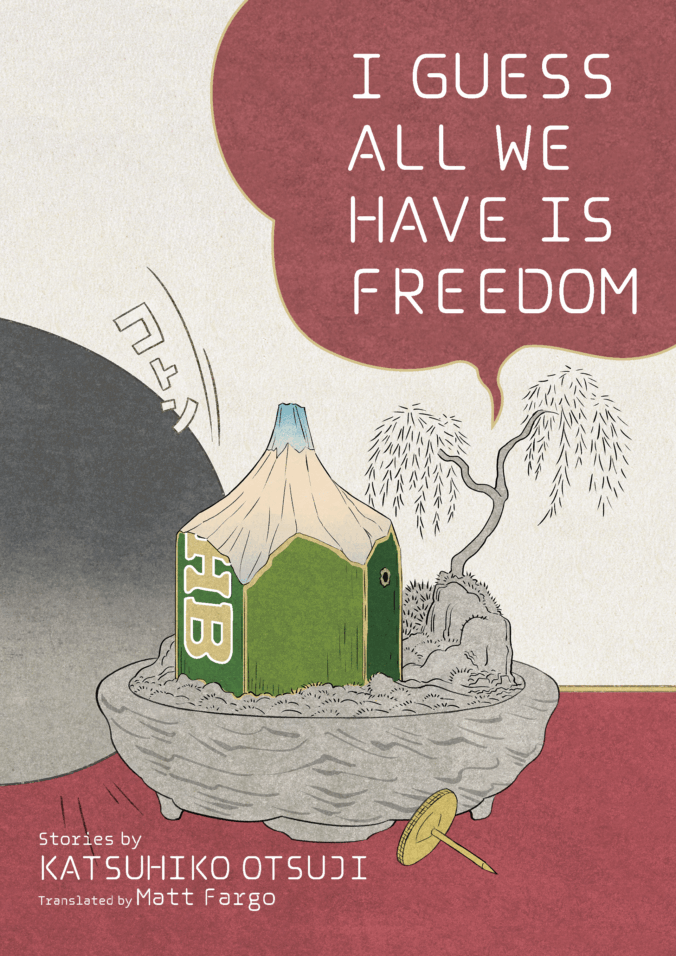
Genpei Akasegawa (whose given name was Katsuhiko Akasegawa) was already famous as Neo-Dadaist artist when he began writing under the name of Katsuhiko Otsuji, and he soon proved himself able to work fruitfully in both domains, earning numerous awards. I Guess All We Have Is Freedom, beautifully translated by Matt Fargo, brings together five of Akasegawa’s short stories, some of them award winners, and all of which follow a narrator (presumably modeled on the author himself) through seemingly banal adventures as a father, professor, and denizen of Tokyo.
Yet the quotidian nature of the stories’ events belies the incredible creativity of the narrator’s mind; even the most ordinary objects and circumstances become opportunities for far-reaching adventures of the imagination. The tone of the book is similarly wide ranging, and Akasegawa shows himself adept at mixing humour with personal tenderness and tragedy in a way that never feels incongruous.The first story of the book, “And Dad Vanished”, which won Akasegawa the prestigious Akutagawa prize, admirably displays the virtues of the collection as a whole. The narrator travels by train with a former student turned friend—all of the narrator’s friends are apparently former students—to visit his father’s grave. The narrator reflects on his father’s death and other near-random associations that arise in the course of their journey. While that is the extent of the plot, the story brims with grippingly creative and often hilarious observations on everything from “buck-naked horseshit” to death to capitalism. Painful memories of a father’s financial failures and physical decline are juxtaposed with lines such as “Oh man, he’s been doing a lot of dying. He had simply stared back at me as if to say, ‘I’m getting pretty dead these days.’” Once the protagonists arrive at the grave plot, the differences between two neighboring cemeteries tell a story about material attachments and the consequences of capitalism: while the more affordable cemetery, with its sparse graves, suggests a death of “relative ease” by working class people without attachments to wealth, the affluent cemetery, filled with decorated graves, “teems with ghosts.” The high quality of the prose (and Fargo’s skill as a translator) is also notable: “At last the engine came barreling into the station like an iron lion, slowing to a hefty halt before heaving its own steamy sigh.”As an artist, Akasegawa is known for his playful and thought-provoking approach to objects, such as moving tin can labels to the inside, thus suggesting the can has been inverted and contains the whole universe. It is thus no surprise that some of the best passages of I Guess All We Have Is Freedom concern ordinary objects and their associations, such as the symbolic nature of graves. “The Throes of Home” is particularly concerned with these kinds of reflections, and the narrator laments his excess of possessions, likening them to “barnacles on the hull of a ship.” In the same story, gutters are described as “radical,” and the replacement of a doorknob prompts meditations on the door’s history and the bravery of a spider occupying a miniscule hole in the frame.Other stories are more character-driven, such as “To the Touch,” which introduces us to the narrator’s daughter, Walnut, and a possibly psychotic and certainly incompetent barber. The father-daughter dynamic, which reappears in later stories, is a grounding and frequently humorous touch of intimacy to a set of stories largely concerned with flights of fancy around the inanimate. In a similar vein, the final story of the collection centers on the narrator and his friends in various life stages.Ultimately, no description of the imaginative journeys offered by I Guess All We Have Is Freedom can adequately describe their diversity or originality. The stories reveal Akasegawa as a master of association; everything he encounters can become anything else, revealing dazzling networks of meaning, “leading off,” as he puts it, “to other things: a sweater entwined with a memory; a piece of dinnerware snarled up with the curbside garbage; an old book mixed in with the recycling.” Whether they reveal their embeddedness in wide-scale systems, provide examples of resilience, or spark deeply personal ruminations, the objects, people, places, and events of I Guess All We Have Is Freedom are always more than they seem.Akasegawa privileges the reader to see alongside him, to expand his or her vision of just about everything, from a barber shop to a gutter to a cemetery. There is perhaps no better analogy for reading I Guess All We Have Is Freedom than an image conjured by Akasegawa himself: while sitting in his disordered home during a move, the narrator lies down with his feet sticking out his front door. “I feel like I’m lying on a beach with my toes in the ocean,” he declares. “The stoop is the tideline. Salt air blows over my body and into the apartment.” Such transformations are at the heart of these truly exceptional stories, which reveal the vast possibilities of the ordinary.