Old post
This post was published before January 2026. Some links, images or other content may no longer display or work as originally intended.
“River Traveller: Journeys on the Tsangpo-Brahmaputra from Tibet to the Bay of Bengal” by Sanjoy Hazarika
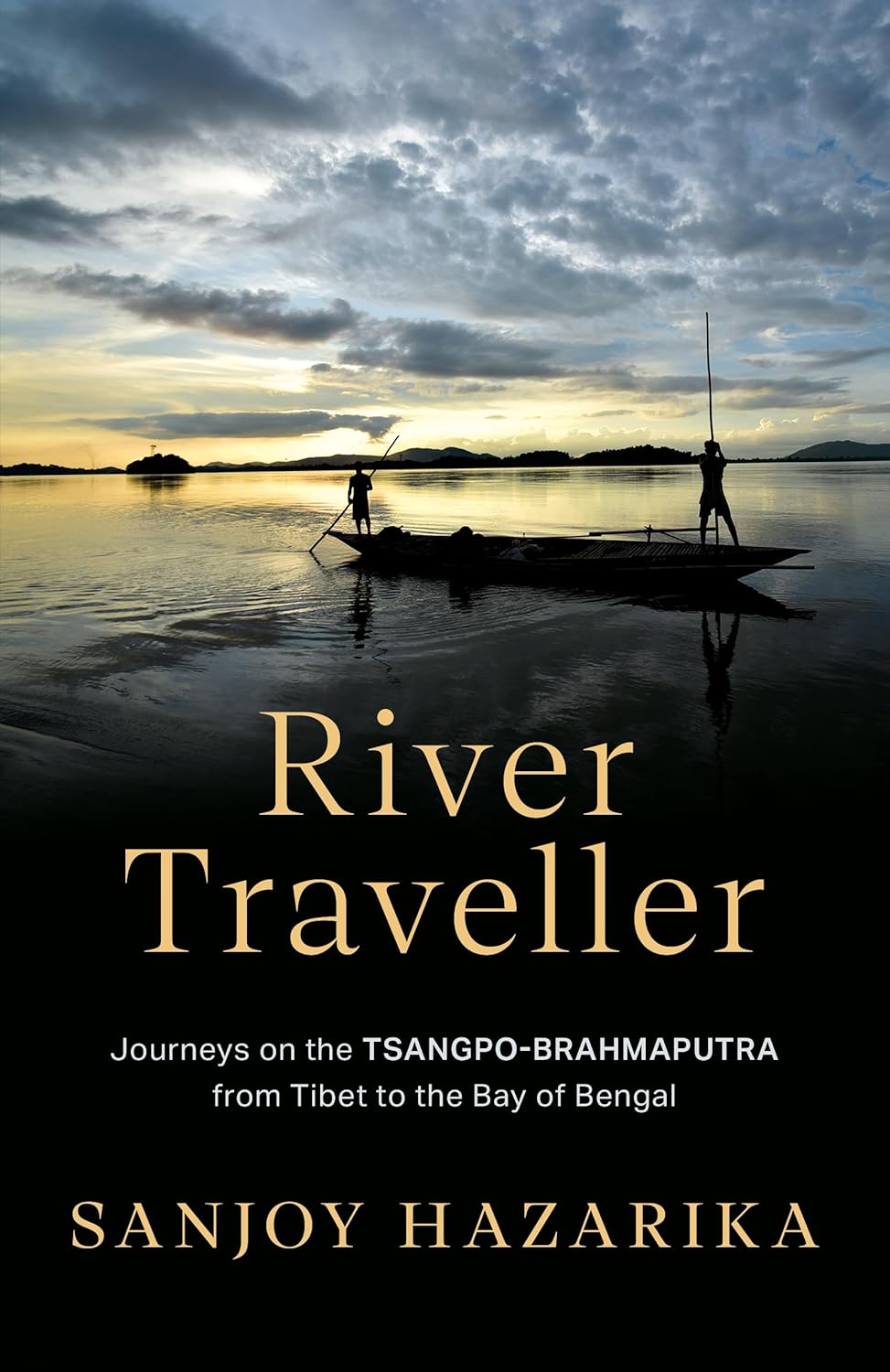
The Ganges may be more famous, but the Brahmaputra is arguably a far more geopolitically important river. By the time it reaches Bengal, it forms the largest delta in the world, having crossed through Tibet, India and Bangladesh. This river, and the people who live along its banks, are the subject of River Traveller, the new book by Sanjoy Hazarika. Hazarika has spent decades writing about India’s Northeast. A journalist, researcher, and filmmaker, he wrote Strangers of the Mist back in 1994, a landmark work on the region’s fractured politics, history, and identity, along with several other books. His newest work blends is part travelogue, part reportage, shaped by decades of fieldwork. Through a series of vignettes, Hazarika follows the river’s trajectory through Tibet, Arunachal Pradesh, Assam down to Bangladesh.
The Brahmaputra has long been a site of migration. Caravans have traversed its banks for centuries as part of the southern Silk Route linking Burma, Nepal, Tibet, Assam, and Bengal. As Hazarika notes, “For centuries, traders, smugglers, fighters, fugitives, goods, cuisines, languages and ideas as well as religions and religious people have travelled in either direction.” The river and its floodplains have also been at the forefront of geopolitical and domestic political developments. Colonisation and Christianity reshaped the region’s social, religious, and political fabric.
The early stretches of the river are muddy, silty, and unremarkable.
The book opens south of Lhasa in 1998, when Hazarika travelled to Tibet with a film crew attempting to document the Brahmaputra’s source. The early stretches of the river are muddy, silty, and unremarkable. Hazarika writes about Tibet and the Western explorers who claimed to discover what local hermits, monks, and travellers had long known. He also describes the risks faced by the pundits, Indian surveyors sent covertly by the British to map Tibet, who worked amid Tibetan suspicion and political tension on what would become the disputed India–Tibet, and later India–China, border. These challenges persist, as Hazarika himself faces difficulties travelling from India into China.
Then, in Arunachal Pradesh, he recounts how the state was important to British India. They imagined the Brahmaputra as a potential route to China and its fabled riches, but the violent river offered no easy route to the Chinese trade. During the Second World War the region was of key importance, with Allied pilots facing treacherous Himalayan weather while transporting supplies to Kunming or dropping them into Burma. More than 430 US airmen died in Arunachal’s mountains during the war. At the same time, the Stilwell Road was being carved across Burma from India toward China, only to be abandoned after the war and reclaimed by jungle. While China has since built a modern six-lane highway from Kunming to the Myanmar border at Ruili, the road deteriorates sharply on the Myanmar side, becoming slower, rougher, and dotted with checkpoints. Despite its size, twice that of neighbouring Assam, Arunachal remains sparsely populated and with limited connectivity to the rest of India.
In Assam, Hazarika writes about the devastating 1950 earthquake and the floods and landslides that followed. The earthquake reshaped the river, making it wider and shallower as rock and sediment shifted, increasing erosion and worsening future floods. It’s not just geography that has changed. Assam’s demography was also transformed by the migration of roughly 120 tribal groups from central and eastern India, brought by the British to labour in the region’s then-nascent tea industry. Many were deceived or coerced into service, and their poor working conditions have seen little improvement since.
In Bangladesh, in places the river is home to a network of criminality as river pirates seize vessels for ransom, and fish are illegally harvested outside the permitted season due to soaring demand and prices. The rivers also offer opportunities for irregular migration, as these rivers make a porous frontier, “an imaginary line snaking across shifting sands and a turbulent river that refuses to accept human markers and controls.” Migration from Bangladesh into Assam has driven deep political divisions, contributing to the rise of Assamese nationalism and the controversy surrounding the National Register of Citizens.
Much more change lies ahead.
The book is not only about the river itself but the wider region, its history, politics, and the author’s decades of experience working and travelling along its length. Hazarika shows how remote marketplaces became bustling international trading hubs, how governments have tried, with mixed success, to shape development, and how local communities both struggle and thrive amid the rapid transformations of recent decades. Public-health failures, private initiatives, and competing development visions all appear in his account. Much more change lies ahead. Climate change is already altering water levels and seasonal cycles. In the dry months, water has fallen to between one and five metres in places, too low for year-round navigation. This results from erratic Himalayan weather and increased sedimentation that makes the river both wider and shallower. Downstream impacts will grow with China’s new Medog Dam on the Brahmaputra, set to become the world’s largest, three times the size of the Three Gorges Dam. Its effects will be profound, not only for Tibet’s ecology but also for the Brahmaputra.
This river, which has seen such change in recent decades, is likely to see even greater change in the years ahead.