“Imperial Iran in the Eighteenth Century” by MAH Parsa
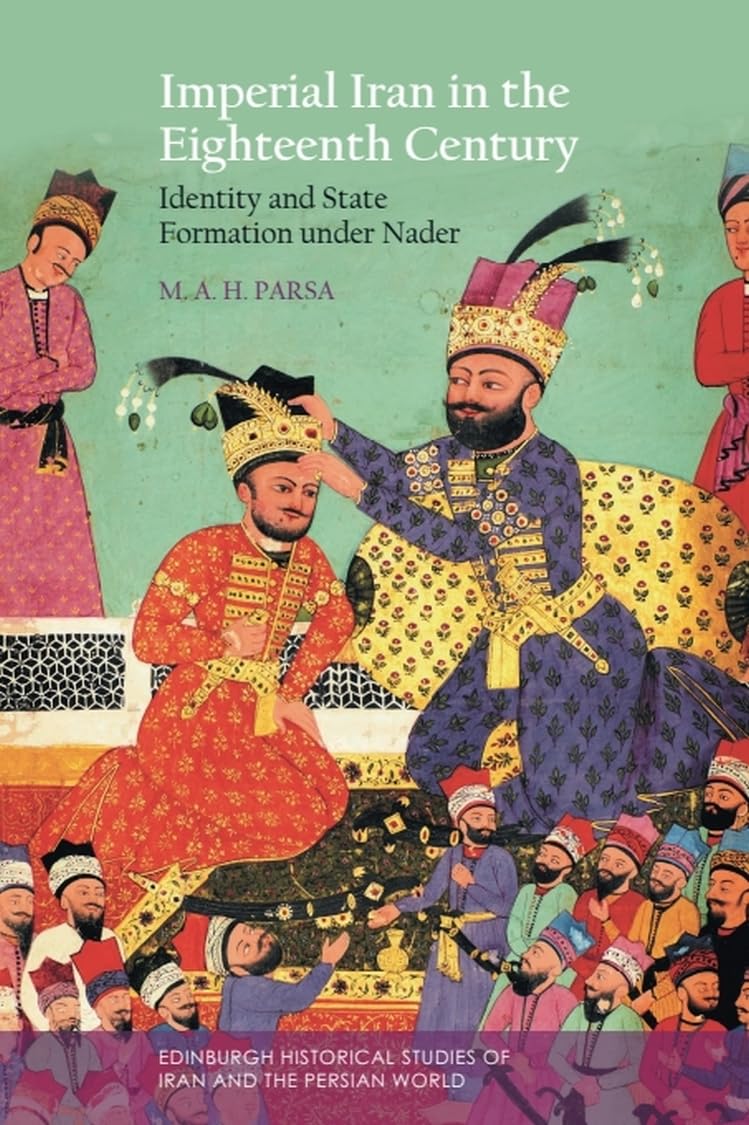
In 1722, a war band of grizzled Afghans battled their way from Kandahar to Esfahan and, after a grim siege, overthrew the 200-year-old Safavid dynasty. For the next 70 years, Iran suffered from non-stop civil and foreign wars. Not until the Qajar dynasty took control did the exhausted and impoverished country know some measure of tranquility. In the middle of this chaotic period, a warlord, Nadr Khan, proclaimed himself emperor, but after killing his heirs, he fell assassinated by his own officers. This story is well known, but, according to MAH Parsa, incomplete. The very turbulence distracts historians from seeing a fundamental transformation. Basing himself on memorials, chancellery documents, and diplomatic exchanges, Parsa argues that the 18th century saw the emergence of the notion of Iran as a country and Iranians as a people.
When the Safavid dynasty fell, intellectuals tried to make sense of their new situation. The incompetence and corruption of the dynasty left few people nostalgic for its return. The Sunni, Pashto-speaking Afghans lacked credentials for leading a country that had been fervently Shi’ite since the 16th century. The Afghans tried. They proclaimed themselves shahs of Iran; they did not overtly persecute or seek to convert the Shi’ites. They had served the Safavid dynasty long enough to understand the theory and practice of rule—but they could only hold power by securing resources, and that only by confiscating properties from the very people whose support they sought.
Many intellectuals fled to Ottoman-controlled Iraq, India, or parts of Iran safe from the Afghans. They began to define Iran as a country distinct from the realm of the Safavids. Its identity was tied up with that of Shi’ism, even if many inhabitants were Sunni (eg,, the Afghans). This led many to expect a millenarian event, the return of the Hidden Imam, the Imam Ali, or at least a descendant of the family of the Prophet. Notable is that the Safavids, who claimed to be Alids, lost any religious aura. This yearning for a saviour has continued to feature in Iran down to our times.
The Safavid pretender, Tahmasp II, realized that nostalgia alone would not bring him back to the throne—in this respect, he was more subtle than the current pretender. He knew that only by defeating the Afghans and expelling them could he hope to become shah. To do this, however, he had to ally with powerful warlords, and so became their puppet.
The ultimate puppet master appears—Nadr Bey, later Khan, musters an army in Khorasan, eastern Iran, and reconquers western Iran and Esfahan. Aureoled with his conquests, he calls a tribal assembly to sideline Tahmasp and proclaim himself Nader Shah. He then faces the essential problem that brought down the Safavids, handicapped the Afghans, and paralyzed Tahmasp: he had to centralize the resources of the country to support his powerful army. He also had ambitions to recover all the territory of Iran that had been lost in previous centuries: from the Euphrates to the Oxus. He also wanted to control the Straits of Hormuz— another perennial feature of Iranian statecraft.
Nader’s program enjoyed enthusiastic support by many Iranians. Unlike during previous regime changes in Iran, from the Timurids, the Ak Koyunlus, the Mongols, the Saljuks, and so forth back in time, people now saw the Iranian state as distinct from the dynasty. In the name of protecting Iran, Nader dramatically centralized Iran’s resources, destituting governors, executing tax collectors, hiring and paying good money for soldiers, and taking over religious foundations (vaqf/voquf). As long as he used his new power to expel foreign invaders—Afghan, Uzbek, Ottoman and Russian— from Iran’s soil, this centralisation was acceptable to the elites, local notables, religious scholars, and tribal chiefs.
Drawn on by his string of victories, however, Nader began to conceive of himself as a universal ruler, based on Iran, but exercising control over all his neighbours. 18th-century Iran did not have the human, commercial, industrial or military assets to sustain such an expansive mission. Waging wars of conquest, rather than of defence, did not appeal to the Iranian elite, who saw their own roles diminished. Elite resistance to Nader culminated with a string of revolts and his assassination, ushering in 50 years of civil war. Yet the new notion of Iran survived him.
The Qajar subsequently seized the Peacock Throne, but they made no attempt to restore the degree of central control that Nader had enjoyed. Fath Ali Shah Qajar famously married hundreds of women in order to accommodate the ambitions of local chieftains and mullas, but he had little say in provincial government. The Qajar state quickly lost most of the reconquests of Nader, in Azerbaijan (to the Russians), in the Persian Gulf (to the British) and in Khorasan (to the Afghans). Yet the legacy of Nader is that Iranians are a nation, not mere subjects of a regime. This enabled Iran to survive two centuries of humiliation, and explains much of the resilience of that besieged people today.
Parsa emphasizes the importance of discourse in Iranian political thinking, showing in many examples how legitimacy depends not only on naked power (else the Afghans might have had a chance), but also on the messages found on coinage, in inscriptions, and in poetry. For example, as a justification for his wars, Nader Shah used a line from Hafez, “now that I have conquered Shiraz (with my poems), next is Baghdad and Tabriz” (then under Ottoman occupation). Also telling is how Nader-favourable propagandists spread the tale that Nader uncovered treasure buried by the 14th-century conqueror, Tamerlane, to further argue for the inevitability of his regime. It is far from anecdotal that the gold dome on the shrine of Imam Reza in Mashhad, so emblematic of Iran today, is Nader’s work.
Much of this messaging is found outside the historical record in Persian or European languages, and so provides original insights not available in the standard histories by Lockhardt or Axelworthy. By listening to the perplexity, anxieties, ambitions and boasts of Iran’s 18th-century elite, Parsa shows us that issues of political identity and legitimacy are not new, and we can imagine that they will never get old.
