“Just Being” by Romila Thapar
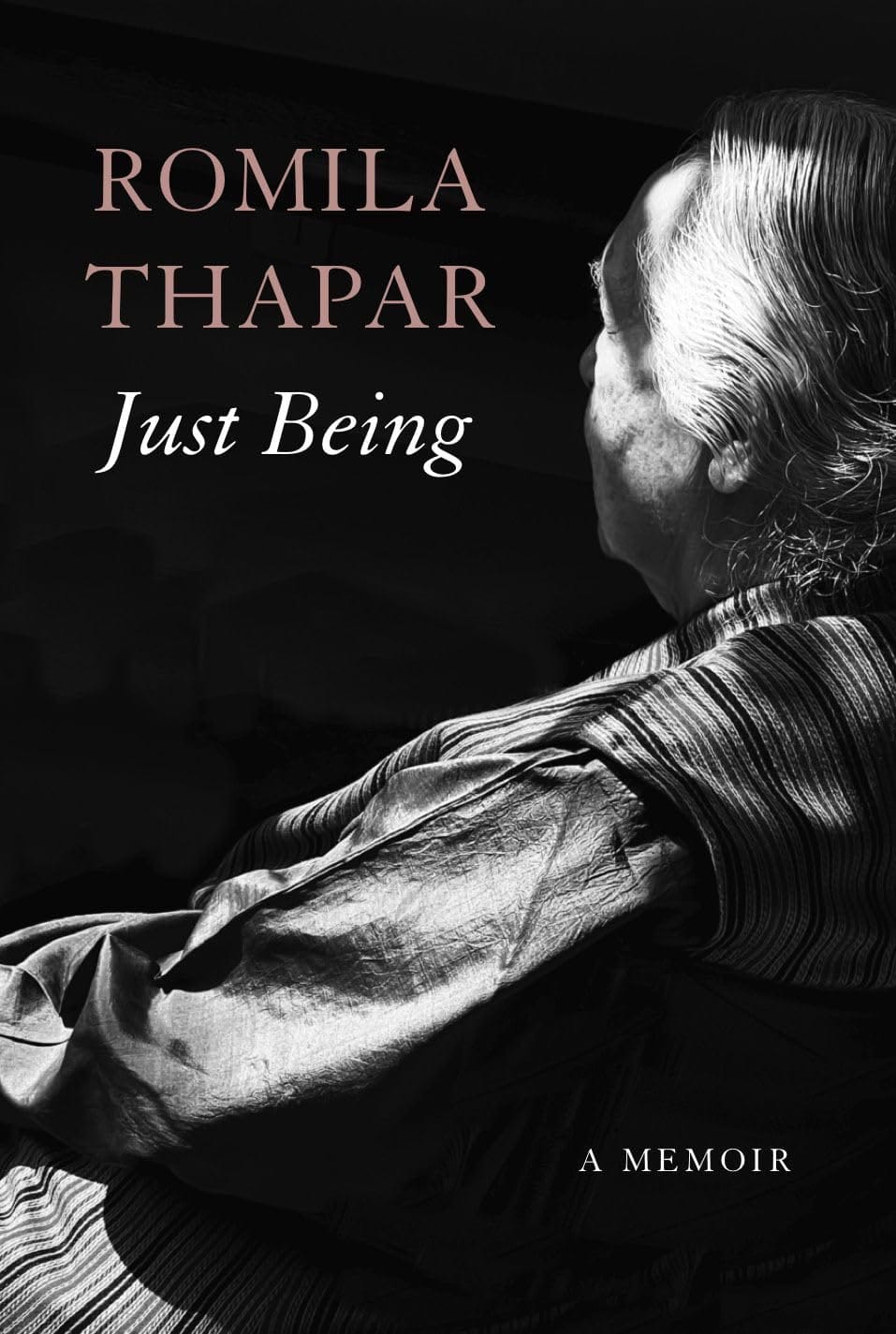
The first book I ever read about India was Romila Thapar’s 1965 History of India, published by Penguin. That little book dazzled with its sprawling scope and storytelling magic, but one also felt the presence of the author’s critical mind tackling perennial questions: what is history; how do we understand it; what is the purpose of writing it? Now Thapar reflects on her own nine decades of life, while addressing many of the same questions.
Her biography tracks the course of Indian history since independence. Brought up in a privileged, intellectual Punjabi family, she received remarkable encouragement to find her own way in the world, with studies in the UK, and living independently as a single woman. She joined pioneering, new universities, investigated the then new connections between history and archaeology, and travelled widely to enrich her perspectives on Indian history, benefiting from exchanges in the USA and the UK, but also China.
As Indian society and politics took shape, she saw the role of the historian in a specific light—-explaining how a certain people are connected to a place by the events of the past. British historians of India had constructed a narrative about India that she found unsatisfactory, that Hindu India had existed for millennia in a kind of history-less stasis. The more dynamic and warlike Muslims then invaded and persecuted them. Next, the British arrived to reduce Muslim persecution, after which history came to an end. Religious nationalists, very much a minority originally, started from this narrative and simply argued that by getting rid of the British, and greatly reducing the role of the Muslims, India would now be a better place. Thapar’s approach was to show that ancient India did not experience stasis—that society, culture, and economics exhibited as much dynamism in India as anywhere else, and that the idea of a return to the golden age was, of course, a myth.
This down-to-earth point of view, based on her archaeological and textual research, did not ingratiate her with the increasingly muscular religious nationalists, who have grown prickly about her findings. For example, in her edition of the middle-school history textbooks, she noted that the ancient, Vedic peoples ate beef, and that the prohibition on cow killing came in later. This contradicts the nationalists’ view that Hinduism has been an immutable, monolithic institution since antiquity. They have since removed Thapar’s books from the curriculum, along with the entire history of Islam in India. While Thapar’s India is cosmopolitan and ecumenical, her opponents see India as hermeneutically sealed off from its neighbours. She is enthusiastic about Central Asia, Buddhism, the Kushans, and the Silk Road. They view everything north of the Punjab as unworthy of study.
There is a poignancy in the contrast between the honours showered on Thapar in the rest of the world and the opprobrium she incurs at home. Some of the hostility, she notes, may be due to her gender. Her male colleagues can write the same things she does and not receive death threats or lawsuits. That is quite telling about the state of mind of the nationalist right. Thapar recounts all this with sadness, not rage, and considers herself lucky, as indeed she is, to have developed a network of friends and colleagues all over the world, who are constantly inviting her to this conference or that.
The result of all these travels is a Who’s Who in a variety of fields, music, the plastic arts, theatre as well as academia. Some of the names mentioned will raise a reader’s smile of recognition, others will be known only to specialists. One is left with an overwhelming feeling that only someone like Thapar could maintain such a vast catalogue of acquaintances.
Thapar is often accused of being a leftist. Indeed, she has made use of Marxist approaches to elucidate the past, not as a polemicist but with a pragmatic bent—does this deepen our insights or not? For someone of her generation, it was natural to wax enthusiastic for the march of liberation, for India from the British Raj, for women from traditional constraints. She sympathised initially with the Naxalites, a rural rebellion in eastern India. But, commenting on India’s intractable poverty, she notes, “in the more distant past, I used to wonder if revolutions are the answer, but after seeing what revolutions have done around the world, I no longer think so.”
As the memoir draws closer to the present, Thapar hopes against hope that the current ruling party will rein in its nationalist fringe. Many of her friends feel the threat of jail or job loss, in a system where currying favour with the top trumps any notion of human or constitutional rights. Only Thapar’s international renown, and perhaps her age, frees her to call them as she sees them, and she does.
She is not only a historian of the past, she has uncovered her own past through letters and diaries to an extent very few people in our own times could do. After a conference in Calicut, she recalls her conversation with a man who gave her a ride to her next destination. Apparently, no one is forgotten, no one is passed over. A security attendant at the airport gets a lengthy mention. Thapar’s indefatigable politeness and openness to one and all are striking.
Except for the parts about her childhood and studies, the text lacks a through-line narrative. Readers may want to dip into chapters, rather than read the entire 700 pages end-to-end, while wondering about the fact that her editors at Seagull encouraged her to cut out quite a lot. Nevertheless, this reviewer found himself stimulated, challenged, and forced to reflect on the uses and abuses of history. Far from being an issue for Indians alone, it is a matter of global concern. Either as a cause or a symptom, the misuse of history is correlated with some of the most intractable conflicts of our time. It is a shame that Thapar’s calm and pragmatic voice has not echoed more loudly in the halls of power.