“Taiwan Travelogue” by Yang Shuang-zi
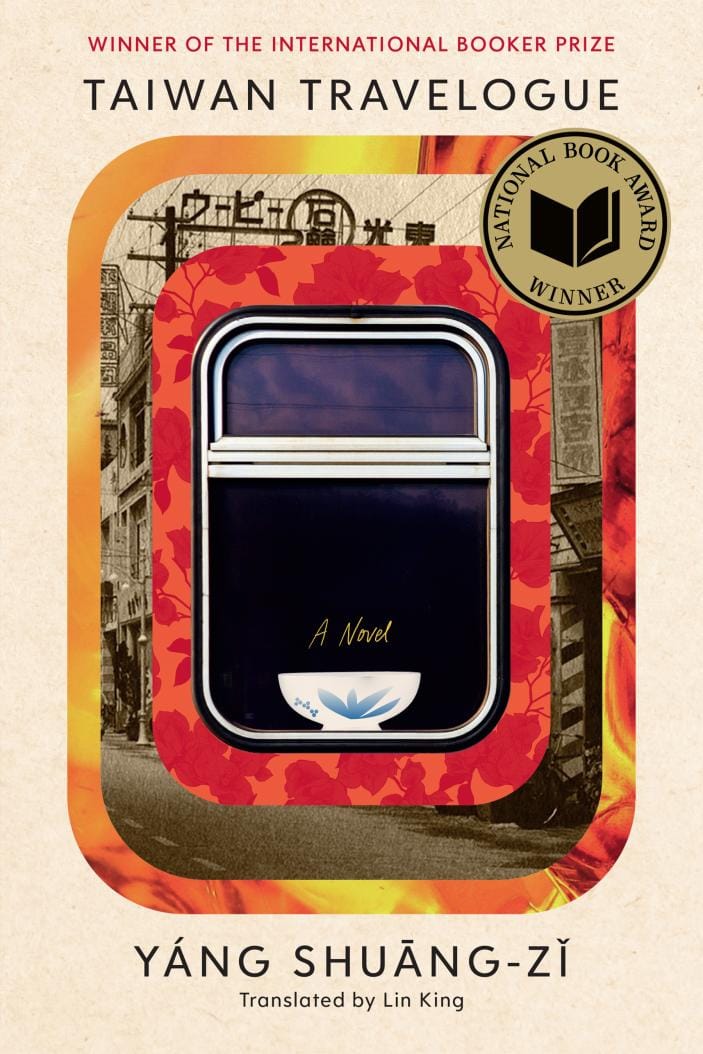
The winner of the 2026 International Booker Prize (and the 2024 US National Book Award for Translated Literature) is a piece of faux Japanese travel-writing, framed with an equally faux publication history. Aoyama Chizuko, an entirely fictional Japanese writer, travels to Japanese-occupied Taiwan in 1938 on an official lecture tour. After the War, her contemporaneous serialised essays are collected and edited into an autofictional novel published in 1954, essentially all copies of which were (somewhat conveniently) incinerated in a fire that destroyed the publisher’s warehouse.
The 1954 edition had some “poor” and censored translations in Taiwan until a copy of the original was rediscovered by Chizuko’s adopted daughter and—via a somewhat roundabout path involving the descendants of the Chizuko’s erstwhile Taiwanese interpreter, Ō Chizuru (Ông Tshian-hòh), now in the USA—ends up in the Chinese translation we (purportedly) see today. The pseudo-scholarly introductions and notes to the various versions are included in the “definitive” 2020 Taiwanese publication. Layered on top of this are the actual, rather than fictional, notes of the Chinese to English translator Lin.
This is not, of course, a new conceit, and has been deployed to great effect by many authors over the decades. This particular one worked so well that some Taiwanese purchasers of the original edition, thinking they had stumbled upon an actual 1938 travelogue of colonial Taiwan, accused the publishers of deceit.
This framing narrative allows author Yang Shuang-zi to make do with what might otherwise be somewhat less than a full novel. Although Chizuko is in Taiwan on an official visit, she makes little effort to promote official Japanese policy and instead focuses on eating: it is food—meals, stops at market stalls and takeaway snacks—that provide the narrative structure, a vehicle for a budding platonic, yet ultimately abortive, romance between Chizuko and her interpreter, whom she calls Chi-Chan. It is not always clear what Chi-Chan thinks of this; her true feelings are obscured by the coloniser-colonised dynamic that is omnipresent in narrative.
While expressing undeniable and presumably sincere affection for Taiwan, its food and culture, it is all for Chizuko exotic, something experienced with patronizing, albeit unwitting, condescension. She means well, or thinks she does. Chi-Chan, who is multilingual and whose evident experience of European things can make Chizuko appear provincial, accepts the condescension with a combination of polite deflection and expressionless reticence. Chizuko, in her role as first-world tourist, treats Chi-Chan as a puzzle to be worked out.
Chizuko’s singular fascination, one might say obsession, with food is a puzzle itself, despite the often evocative descriptions:
The deep-fried beans were exquisite in texture as well as taste. The thicker ones were airy and crumbly, the thinner ones crisp with a satisfying crunch; the garlic was quite simply addictive. I was worried about eating too quickly, being two handfuls in and already craving a third. It wasn’t embarrassment for myself that concerned me, but the fact that Chi-chan, who’d been shelling the beans, did not seem to have eaten a single one.
Author Yang Shuang-zi reportedly made use of period Japanese travel-writing and the novel (in Lin King’s translation) certainly retains the flavour of genre and time:
The notes that I’d been so diligently taking were on Taiwan’s railway system as explained to me by Chi-chan. Kīrun Station in the north, Takao Station in the south. At Chikunan Station, which was located in the south of Shinchiku Prefecture, the rail forked into two lines— the Coastal Line and the Mountain Line—that then merged again at Shōka Station. To reach Taichū Station as I did on my first day, one had to take the Mountain Line, which is also known as the Taichū Line.
In a book that can be as much about language and communication as food, translation—as Lin explains in a translator’s note—brought out issues that were not present in the original:
…because Mandarin, Japanese, and Taiwanese Hokkien all use Han characters, Yáng doesn’t have to specify the pronunciations of words. When Yáng writes, in Mandarin, that Aoyama says the word 台中, Mandarin readers understand that Aoyama is talking in Japanese about the place known in Mandarin as Táichūng. While I was rendering this into English, however, it felt discordant to me to use Mandarin pronunciations in supposedly Japanese speech and thoughts. I therefore chose to use Japanese colonial pronunciations, and therefore Aoyama stays not in Táichūng but in Taichū…
Readers may do a double take upon realising that “Mainlanders” here are the Japanese, not Chinese.
Taiwan Travelogue has a somewhat unexpected genesis: the Taiwanese Yang Shuang-zi (together with her late twin sister) was a writer of Japanese-influenced yuri (“girls’ love”) light novels, a legacy which those familiar with the genre will presumably recognise. Yang Shuang-zi is a pen name for the twins as co-authors, retained by Yang Jo-tzu after his sister’s untimely death from cancer.
Taiwan Travelogue is therefore a book of many layers, perhaps one or two too many. The matryoshka nature of the narrative, while clever, leads to a sort of conundrum: not only is Chizuko an unreliable narrator telling her story once removed in novel form, the entire narrative itself is unreliable: we are told in the pseudo-academic prologue that the events in the final chapter—the tale’s denoument—may be a complete invention. So we have a fictional author of a fictional novelised memoir whose provenance is questionable. Chizuko herself is shallow and not very likeable, and the artificial nature of the construct is an impediment to caring much about her. Chi-Chan is the more interesting character, but we only see her through the well-meaning but oblivious representative of the colonial power. Perhaps that’s the point.