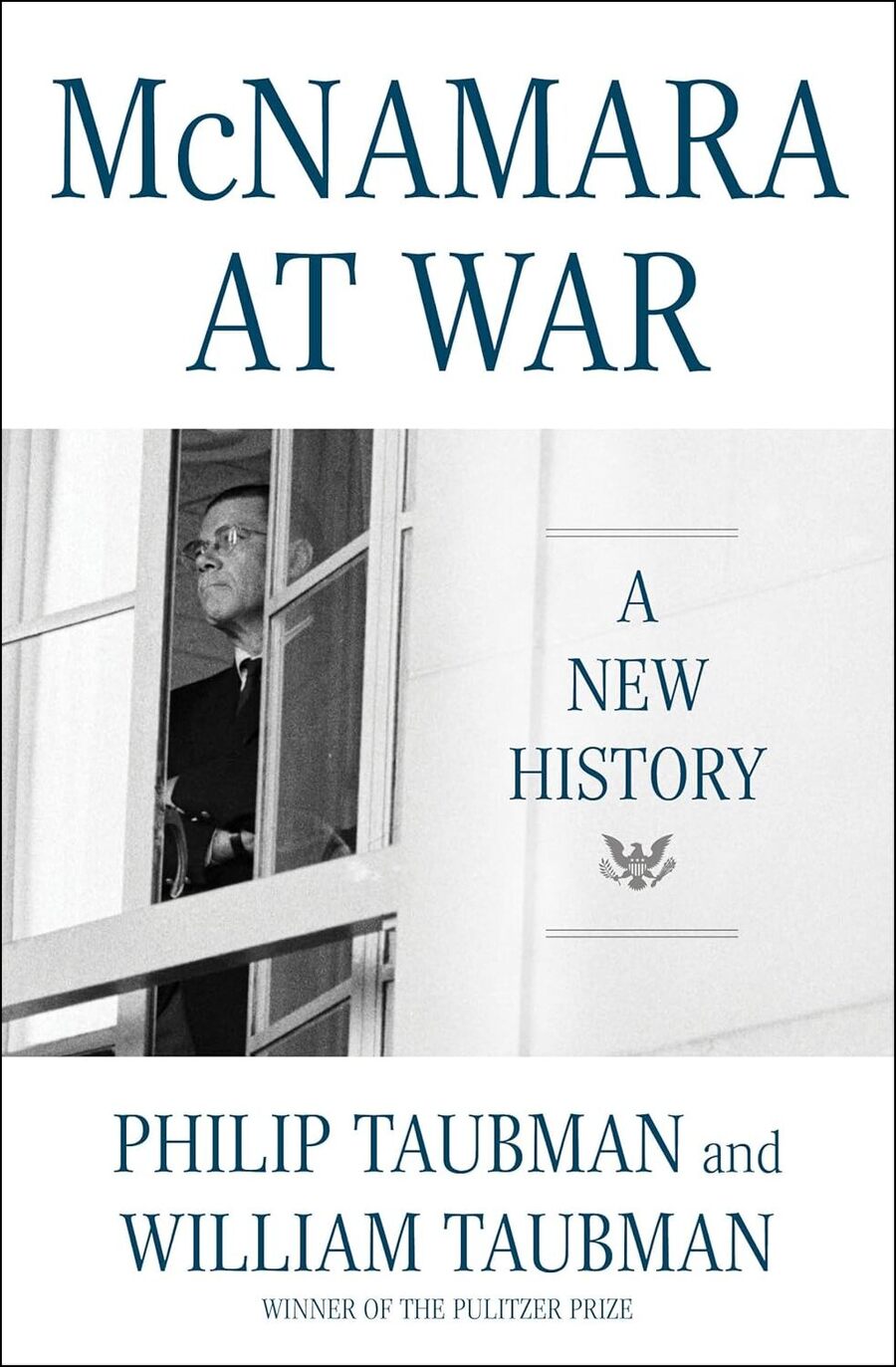
“McNamara at War: A New History” by Philip Taubman and William Taubman
Robert Strange McNamara was arguably one of the worst public servants in post-World War II American history. Decades after the Vietnam War ended, McNamara, who served as US Defense Secretary in the Kennedy and Johnson administrations, admitted that as early as 1965 he believed that the United States could not win that war yet he orchestrated and publicly supported the Americanization of the war, sending more than 500,000 American servicemen to fight in what he believed was a hopeless cause. All the while, he kept telling the American people that the US was winning, even as he quietly recommended bombing pauses, troop ceilings, and negotiations with the North Vietnamese.
The costs of “McNamara’s war” were staggering: more than 58,000 American dead (153,000 American servicemen were wounded); more than three million Vietnamese were killed; nearly 300,000 Cambodian (not counting those later killed by Pol Pot) and as many as 60,000 Laotian lives were also lost; and much of Southeast Asia was devastated. Philip and William Taubman in McNamara at War tell this tale of misjudgment and deception, and while they don’t absolve McNamara of his share of the responsibility for the debacle, they do endeavor to better explicate his actions and conduct by attempting to write a psychological portrait that purportedly explains how such a brilliant, decent, and admirable man became an accomplice in what they rightly characterize as a “terrible and costly failure of leadership”.
Had 21st-century American presidents or their advisers taken greater note of McNamara’s belated mea culpa for Vietnam, the US may have avoided the mistakes that led to the “endless wars” of Afghanistan and Iraq.
The Taubmans are respected scholars and authors. Philip worked for the New York Times for 30 years, serving as the Washington bureau chief, Moscow bureau chief, and deputy editorial page editor, and is now affiliated with Stanford University’s Center for International Security and Cooperation. William taught at Amherst College and has authored books on Khrushchev, Gorbachev, and Stalin. The authors benefitted from newly discovered diaries and letters, and interviews with family members and associates of McNamara. Their book is a well-sourced, crisply written, and fair-minded account of McNamara and his times. And the authors believe that had 21st-century American presidents or their advisers taken greater note of McNamara’s belated mea culpa for Vietnam, the US may have avoided the mistakes that led to the “endless wars” of Afghanistan and Iraq.
The authors describe McNamara as a “complicated figure riven by internal contradictions, suppressed emotions, periods of melancholy, zealous loyalty to the presidents he served, and a profound inability to understand and overcome his weaknesses.” Until Vietnam, however, McNamara’s weaknesses were dormant. In high school and college (Berkeley) and later at Harvard Business School, he was an excellent student. He exhibited ambition, an eagerness to learn, intellectual brilliance, solid ethics, and a “straight-arrow sense of duty and decency”. He very quickly, the authors note, developed an “aptitude for logic and statistics”. That aptitude would fail him in Vietnam when he and his “whiz kids” at the Pentagon substituted systems analysis for a Clausewitzian understanding of warfare.
After a stint teaching at Harvard Business School, McNamara became a civilian instructor and later a lieutenant colonel in the Army Air Forces during World War II, where, the Taubmans write, he “proved himself invaluable to four leading American generals as well as the assistant secretary of war, Robert Lovett.” Working for Gen Curtis LeMay, McNamara’s “statistical planning” for the Twentieth Air Force in the Pacific theater helped bring Japan to its knees with the massive firebombing of its cities. The authors believe that this experience “created an unacknowledged reservoir of guilt that deepened and eventually overflowed during and after the Vietnam War.” LeMay and McNamara would later clash during the Kennedy and Johnson administrations over how to resolve the Cuban Missile Crisis and how to wage the war in Vietnam.
When World War II ended, McNamara went to work for the Ford Motor Company and steadily rose through the ranks, ultimately becoming its president in 1960. That same year, the newly elected US president John F Kennedy selected McNamara to run the Defense Department. The authors characterize the JFK-McNamara relationship as a mutual admiration society. McNamara would become the “best” of a group of Kennedy-Johnson advisers that David Halberstam later sarcastically referred to as “the best and the brightest”.
McNamara, like so many in Washington and elsewhere in America at the time, became enthralled with the Kennedys, and soon became a Kennedy family insider who developed strong personal relationships with the president, Robert F Kennedy, Senator Ted Kennedy, and especially First Lady Jacqueline Kennedy. The Taubmans suggest the possibility that McNamara and Jackie Kennedy had a romantic relationship after the president’s assassination. It is clear, however, that they were very close, if not necessarily intimate with each other. McNamara also developed friendly relationships with many of Washington’s elite, including Washington Post publisher Katherine Graham.
The authors write that the transition from Kennedy to Lyndon Johnson “jolted McNamara in ways that directly and indirectly, consciously and probably subconsciously, impacted his handling of the Vietnam War.” The transition certainly complicated McNamara’s situation because he remained close to the Kennedy family, while Johnson hated them, especially Robert. McNamara wished to remain Secretary of Defense, but to do so meant transferring loyalty from the Kennedys to Johnson. McNamara, the authors note, did become loyal to Johnson—too loyal as it turned out—but he never stopped being loyal to the Kennedys.
In Washington, however, power is a very jealous master. And McNamara enjoyed wielding power most of all. To publicly turn against Johnson by criticizing the war policy in 1966 or 1967 would have meant resigning as Defense Secretary and the loss of that power. And it would have exposed McNamara then to the ridicule he was later subjected to—and so richly deserved—when he confessed that he sacrificed American lives in a war he believed was unwinnable.
Vietnam was not the only black mark on McNamara’s record.
Vietnam, of course, was not really just McNamara’s war. America’s involvement in the war in Vietnam began under President Eisenhower, expanded under Kennedy, vastly increased under Johnson, and ended under President Nixon. The authors spend very little ink on why the US was in Vietnam in the first place, but the origins of American involvement date back to the Truman administration’s efforts to support France in its post-World War II effort to maintain colonial rule there. When the French lost the “first” Vietnam War in 1954, the country divided between a communist-ruled North Vietnam and an American-backed South Vietnam. Like Korea, Vietnam became a pawn in the Cold War and a place where the US policy of containment would be tested.
Vietnam was not the only black mark on McNamara’s record. As Defense Secretary, he promoted the concept of Mutual Assured Destruction (MAD) and persuaded President Johnson to freeze the number of US intercontinental ballistic missiles, thereby allowing the Soviets to achieve strategic nuclear parity with the United States. In the early 1980s, McNamara co-authored a widely discussed essay in Foreign Affairs that advocated a US “no first use” policy for nuclear weapons, which if adopted would have called into question America’s willingness and ability to defend its NATO and Japanese allies against Soviet aggression.
McNamara later became President of the World Bank, where he worked to alleviate poverty in many parts of the world, but it was Vietnam that defined his legacy. And, as the Taubmans note, despite all of his efforts to expiate his sins there, Vietnam tortured his soul to the very end of his life.