“Privileged But Powerless” by Jieun Baek
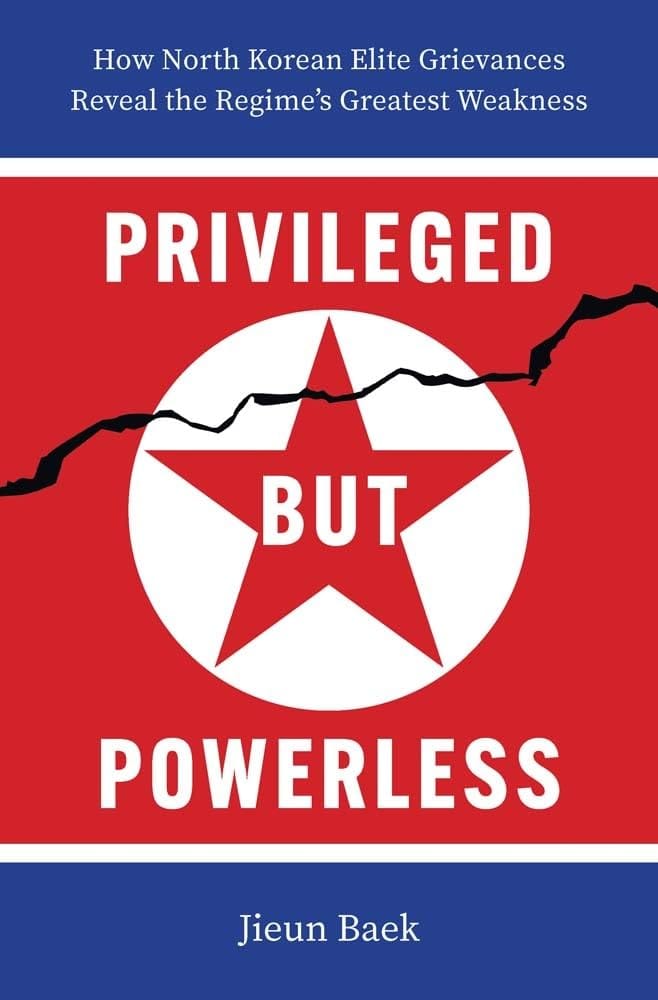
North Korea is the most tightly controlled country in the world. It is ruled by the Kim family and their control over the country’s 26 million citizens depends on the loyalty of elites of the Korean Workers’ Party (KWP)—the communist party that has brutally enforced the Kims’ hold on power since the aftermath of the Second World War. However, many of those North Korean elites, writes Jieun Baek in her important and revealing new book Privileged But Powerless, only remain loyal to the regime “out of self-preservation, fear, and strategic necessity”. Her evidence for this is based on interviews she conducted with named and unnamed “elite escapees” who provide a unique insider view of the totalitarian nightmare that is North Korea.
Baek, an adjunct professor at the University of Oxford’s Blavatnik School of Government and the author of North Korea’s Hidden Revolution, conducted interviews with
former deputy and acting ambassadors and other senior diplomats, high-ranking businessmen, senior KWP cadres, graduate students, senior officers from Bureau 39, a former bodyguard for Kim Jong Il, and a computer engineer who represented and won medals for North Korea in international programming competitions.
Almost half of the interviewees insisted on “off the record” status because they fear the prospect of retaliation against them, their family members, and former associates still in North Korea. The irony highlighted by the book’s title is that North Korea’s elite are afforded special privileges denied to most citizens, yet the regime watches them closely and subjects them to frequent “struggle sessions” and other control mechanisms to ensure their loyalty because “the regime relies heavily on the elites’ unwavering allegiance to sustain its control.” This has led to elite grievances that Baek contends expose the fragility of the Kims’ rule.
Baek characterises the North Korean elites as “the most privileged and powerful individuals in North Korea, specifically those groomed to serve Kim Jong Un and the Korean Workers’ Party … who enjoy exclusive access to power and resources”. In some respects, North Korea’s elite resemble the Soviet nomenklatura under Stalin’s rule—they enjoy privileges and power but their elite status, and in some instances their very survival, depends on the whims of the Dear Leader. None of the North Korean elite feel secure and safe. They are always looking over their shoulder in case the Dear Leader becomes dissatisfied with their performance or questions their loyalty.
Pyongyang, North Korea’s capital where most of the elites live, Baek writes, “concentrates prestige, power and privilege.” The elite escapees identified Juche as the “monolithic ideological” mechanism that enables the Kim family to exercise absolute control of North Korean society. They describe what Baek calls the regime’s “culture of fear and collective surveillance” which affects the elites even more than the common citizen. That culture is implemented by a vast and ruthless security apparatus headed by the Ministry of State Security—North Korea’s version of the Soviet KGB that imposes a “climate of fear and submission”. The highest level elites run the Organization and Guidance Department (OGD) of the KWP that oversees “the design, approval, supervision, and execution of policies that shape every facet of North Korean life”. But Baek points out that the most privileged and powerful elite are the most closely monitored by the regime which has informants seemingly everywhere. The elites, Baek explains, are “entangled in a web of political precariousness” in a “system that thrives on mistrust and elimination”.
As in all totalitarian regimes, North Korean elites are subject to periodic “purges,” stints in political prisons, and murderous executions. Especially under Kim Jong Un, elite defections have surged which indicates to Baek that the fragility of the regime’s hold on power has increased, too. Those who are unable to defect, feign loyalty for a variety of reasons. The number of “true believers”, Baek believes, is shrinking.
But the nature of the regime imposes barriers to collective opposition by North Korea’s elites. Those elites are, Baek writes, both victims and victimisers who fear that a political revolution would end their privileges and subject them to revolutionary justice. “The escapee community,” Baek notes, “is notoriously fractious” due to “social stratification and competition deeply embedded in North Korean society”. That serves as an additional barrier to collective opposition to the regime.
If there is going to be reform in North Korea, Baek writes, it will be brought about by the elites rather than the mass of the population. There have been assassination attempts against North Korea’s leaders, acts of dissent, a few stirrings of intellectual opposition to the regime, and economic catastrophes that caused mass starvation among the populace. Some external media pierce the totalitarian control of information. Students who travel abroad to study have experienced a taste of freedom. Baek concludes that democratisation is improbable in the near future, but North Koreans’ desire for greater freedom is real. Change, she believes, is possible.