Old post
This post was published before January 2026. Some links, images or other content may no longer display or work as originally intended.
“Schoolgirl” and “Sympathy Tower Tokyo” by Rie Qudan
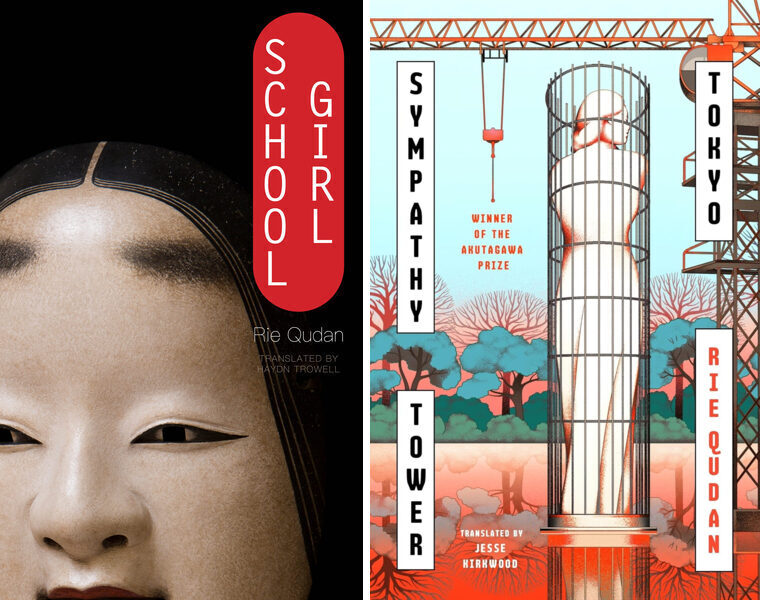
It never rains but it pours. From having no English translations of Akutagawa Prize-winning Rie Qudan, three of her novels have (or soon will have) become available in a matter of months, the first two—“Schoolgirl” and “Bad Music”—in a combined volume from Australian publisher Gazebo and Sympathy Tower Tokyo from Penguin in Britain and Summit in the US.
“Schoolgirl” and “Bad Music” are novellas by length, but feel like short stories. Both focus around a single incident, are tightly constrained in time and can—and in their intensity of focus, are evidently meant to be—read in a single sitting. They both have the sort of unresolved resolution (“and then what happens?”) that features in many short stories.
The titular schoolgirl of the first of the pair is not, as one might first think, the disgruntled, eco-aware YouTuber teenage daughter of the wealthy and somewhat discombobulated mother, but rather the 1939 novella by Osamu Dazai of the same title, through which they find an unexpected connection.
The protagonist of “Bad Music” is a music teacher whose famous composer father saddled her with the name Sonata.
Would a banker call their kid Account or Deposit? Did Steve Jobs name his daughter Apple or iPhone?
Perhaps understandably, she also has trouble connecting with the real world, or at least with the people around her, a difficulty manifested by unaccountably and unknowingly smirking when otherwise serious proceedings and discussions are underway. Her intervention in a (minor) fist-fight between two male students has consequences that tear the fabric of her class apart, but which seem to reinvigorate her sense of musical self.
Both stories make reference to modern technology, from the internet to AI-based appliances. Yet both also make references to art, literature, music and current affairs. Paul Gauguin, Greta Thunberg, Eric Satie, Yoko Ono, Sigmund Freud and João Gilberto rub shoulders with Osamu Dazai in these pages. This Western-Japanese cultural and intellectual fusion extends to language. The unnamed daughter in “Schoolgirl” feels more comfortable communicating in English than in what is presumably her native language. Her first video in Japanese (given in transcript) contains her musings about how she feels like a different person when speaking Japanese.
This focus on language, the nature of received wisdom and the role and effects of technology carry through into Qudan’s Akutagawa-Prize winning Sympathy Tower Tokyo. At twice the length, it is a more substantial work, but still hardly long enough to deal with all the ideas bubbling within it.
Sara Makina, a famous architect, has been commissioned to design the eponymous tower, which, despite its resemblance to a luxury residential development, is actually a prison where inmates are to be treated with compassion rather than punishment, justified by some faux socio-political treatises Qudan conjures up. Social policy aside, this is also a discourse about how architecture makes a city: Qudan’s near-future Tokyo is one where Zaha Hadid’s Olympic stadium actually got built: a “Tokyo of the mind”, as Qudan has called it.
She likens the tower to the infamous one of Babel; it has been given an English name, rendered phonetically into Japanese katakana. Sara disapproves, as she does of the general prevalence of English in Japanese and the resulting proliferation of katakana. This question of identity extends to humanity itself. Sara has, like her fellow protagonists in the previous two novellas, some problems with human relationships—she has taken up with a much younger shoe salesman who winds up working at the Tower once it’s constructed. She has also begun interacting, more than she should, with an AI chatbot, who has taken to censoring anything even mildly intolerant from her speech and thought. (This, unlike those English readers may be most familiar with, is a rather woke chatbot.)
All three works have an unsettling otherworldliness—sort of magic realism-tinged if not actually magic realism—that one finds in other Japanese writers; Yoko Ogawa and Hiromii Oyamada come to mind. But there is a sensitivity to the internal states of her female protagonists and an immediacy to her writing which results in a rhythm that can verge on the staccato, at least in translation. Given the volumes were translated by two different translators, Haydn Trowell and Jesse Kirkwood respectively, one can only include that the distinct voice is there in the original and that the translators have both managed to project it.
Of the three, Sympathy Tower Tokyo is the most Japanese in that it requires some modicum of Japanese- and Tokyo-specific information (admittedly all easily found online) to entirely comprehend the setup. The two novellas in Schoolgirl require no such background, allowing one to jump right into Rie Qudan’s mysterious, ironic and darkly-humorous oeuvre.