Old post
This post was published before January 2026. Some links, images or other content may no longer display or work as originally intended.
“The Art of Contemporary China” by Jiang Jiehong

One would hardly know there had been a pandemic in 2020 if one went by auction results in the contemporary art market. According to the 2020 Global Contemporary Art Market report, the top 10 artists by turnover sold 1530 pieces for a total of almost a half-billion US$. While down a bit from 2019, the price index has hardly budged over the last five year; the 2020 result is all the more remarkable given that international auction houses had to postpone or cancel most of their plans for spring auctions.
Chinese artists did particularly well, increasing their representation at the top of the leaderboard, continuing a growth trend that began some forty years ago, when, with the advent of the policy of reform and opening in the late 1970s, Chinese artists were suddenly exposed to western art history and practices, which led to an unprecedented and rapid transformation of artistic styles from which contemporary Chinese art evolved.
While the demand for contemporary Chinese art has undeniably burgeoned globally over the years, one nevertheless wonders how much understanding the general audience might have about contemporary Chinese art. And how, indeed, does one measure the success of it? After all, it was only in the late 20th century that scholars attempted to deploy western paradigms to define and formalize Chinese art; it remains an open question whether the western model is an appropriate yardstick to understand it. Some scholars have questioned the underlying influences and dynamics at play in Chinese art, as they seek to understand various complexities and multiple realities that contemporary Chinese artists have encountered or constructed for themselves.
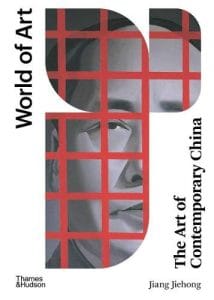
Covering contemporary Chinese art over the forty years since the end of the Cultural Revolution, Jiang Jiehong’s timely The Art of Contemporary China offers as a comprehensive, yet accessible, survey of contemporary Chinese art that situates China’s most up-to-date artistic output in the context of the wider, dynamic socio-political, cultural and economic conditions that surround it. Jiang provides a contextualized and critical mapping of concepts and practices that have shaped the development of contemporary Chinese art. The book features more than a hundred and fifty color images of artwork in various media by both established contemporary Chinese artists—including Ai Weiwei, Fang Lijun and Zhang Peili—as well as such emerging artists as Yu Ji, Zhuang Hui and Zhao Zhao. After a perceptive introduction on the origin of contemporary Chinese art, The Art of Contemporary China is divided into various themes: the collective, reinventing tradition, the art of urbanization, and art at large. Jiang employs art to suggest some of the idiosyncrasies and perplexities occurring in China at various stages.
The chapter on “The Collective” reviews several Chinese artists whose works expound the idea that the individual is subordinate to the group. During the Maoist period, art was made a part of the totalitarian political system and was a powerful political tool for educating the masses rather than “art for art’s sake”. That “collectivism” was valued as a tenet for selflessness was really a communist morality of the Maoist regime. This idea of the collective was so firmly implanted that it functioned as a state apparatus of political control to enforce conformity and compliance.
Yu Youhan, born in 1943, attended the Central Academy of Arts and Design for a year in 1965 before his studies were disrupted by the Cultural Revolution. During that period, a dominant artistic genre was the portrait, with huge portrayals of Mao glorified and installed in public spaces. In the 1980s, however, Yu focused on exposing the over-idealized relationship between the Chairman and his people, works he executed in political pop aesthetics. In Chairman Mao Talking with Hunan Peasants (1991), decorative flower patterns are applied to the canvas, seemingly adorning the piece but in the artist’s words, creating “an unreal and hollow environment”. It depicts a family of obliging peasants entertaining the leader Mao, smiling in unison and apparent ignorance as they listen to Mao’s guidance.
An artist of the younger generation, Zhuang Hui (born 1963), also expounds on the notion of collectivism in a photograph series, which emphasizes that every individual component of his group portraits belongs to a collection. His photographs of large group assemblies such as Group Portraits: Luoyang Cadre Police Academy Students and Staff (1997) reveal the intricate relationships between society and individuals, and by placing himself in these images, Hui blurs the boundaries between group and self-portraiture. His individualism is blended into the large groups, and his photographs raise questions about the individual identity and group conformity. Is outward conformity with the crowd a reflection of inner conformity?
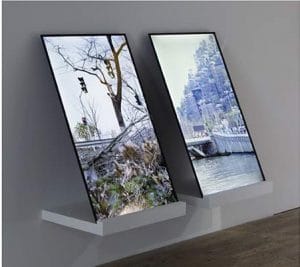
Memory as a subject has particularly become increasingly relevant as one confronts the astonishing rate of urban growth. In the photography installation The Window Blind (2019) from emerging artist Hu Weiyi (born 1990), everyday views of residential building blocks in the day or illuminated cities at night create urban scenarios both ordinary and strange. Having come of age as a new-generation artist in Shanghai, one of the most dynamic cities in China, Hu observes there is a sense of powerlessness, accompanied by nothingness, that results from the conflicting existential state of individuals in the city. In China, ceaseless demolition and reconstruction make way for next phases of urban development. Numerous old residential houses are left as ruins. Xu Zhen’s (born 1977) installation Calm (2009) consists of debris that alludes to the rubble of a house which has been torn down, or more metaphorically, the silence that follows a disaster. It exposes a specific state of “calm”—a pivotal point between might have already happened and what is to come, whereby the present is fragmented by urban changes.
In many of the featured artists’ works, one can sense their commitment to render an identity, an experience or a vision of life in an unbiased, sincere way that is idiosyncratic to Chinese singularity in an ever-growing China. Jiang has combined a good selection of pertinent artists of different generations with a discussion that is comprehensive and easily understood. The Art of Contemporary China is a concise survey that offers refreshing insights into the relationship of contemporary Chinese art to the past and present.
You must be logged in to post a comment.