“The Best of Urdu Short Stories”
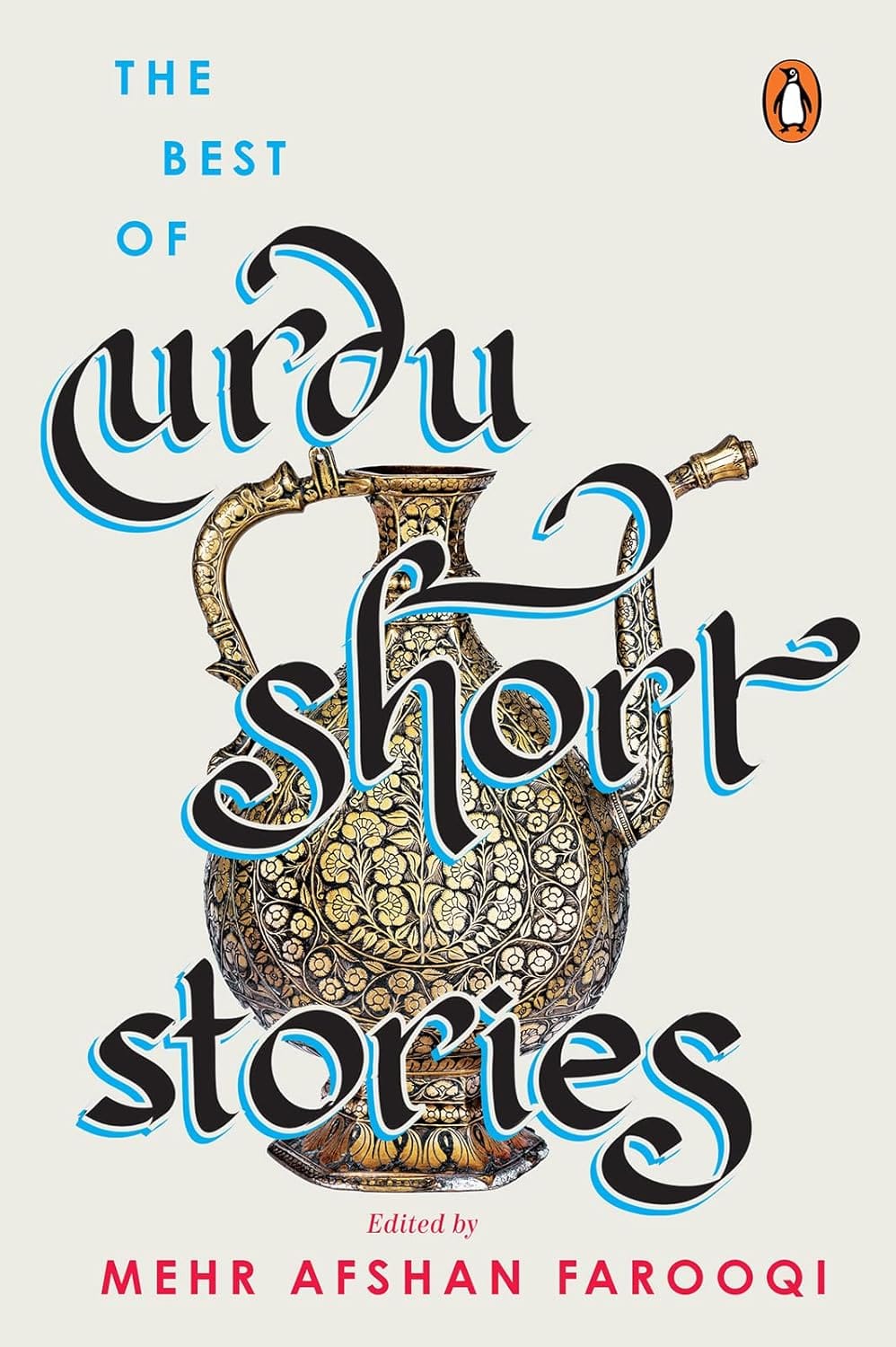
Anthologists are wont to label their collections “the best” or “the greatest”. In The Best of Urdu Short Stories, Mehr Afshan Farooqi does the same. With the focus on the a particular genre, called afsana or kahani in Urdu, she puts her spin on “best” by bringing together new writers along with the canonical Saadat Hasan Manto, Ismat Chughtai, and Premchand, who are perhaps the most well-known names within and outside South Asia. She includes writers from India and Pakistan, along with Julien Columeau, a French-born writer who writes in Urdu. Her “best”, in a way, stands for diversity and an intention of bridging the gap between the classical and the contemporary.
Farooqi describes Urdu as “a … hybrid of north Indian languages subsumed under the umbrella of Hindi with a generous sprinkling of Persian and Arabic vocabulary.” The introduction provides bio notes of the writers included and a brief overview of the Urdu short story, beginning with Premchand and the writers who identified with the left and called themselves progressive. These were writers committed to the project of representing inequality in society in their writing. Gradually, a new institution and movement called Halqa-e Arbab-e Zauq (Circle of those of Discerning State) became prominent: these were writers who were associated with the progressive movement but wanted to break free of it to experiment with new writing styles. Jadidiyat or modernism was the literary sensibility that followed as the influence of the Circle waned. Farooqi writes:
The jadids were not simply seeking new subjects for literature; they wanted to experiment with both form and content, break the structure of the story, or bend it out of shape so much so that it needed much intellectual effort and thoughtful unraveling by the reader to make sense of the narrative.
The volume contains 17 short stories, 6 of which are translated by Farooqi herself and one co-translated by her. Organised chronologically, it begins with Indian writer Premchand (born 1880) and ends with Pakistani writer Ali Akbar Natiq (born 1974). It takes the reader on a historical journey beginning with Premchand’s social realism, moving into the psychological explorations of characters in stories by Chughtai, Manto, and Bedi, further into the surreal writings of Intizar Hussain and Naiyer Masud among others, and ending with the contemporary stylistic experimentations by Columeau and Natiq. Farooqi avoids the classics by the canonical writers because they are heavily anthologised already. For example, “Toba Tek Singh” by Manto or “Lihaaf” by Chughtai could have been the “best” choice in the sense of being most well-known. Instead, she chooses “Kali Shalwar” by Manto and “Nanhi ki Nani” by Chughtai.
Two examples explain how Farooqi’s “best” brings into spotlight other qualities of the Urdu short story. One is the inclusion of her father Shamsur Rahman Faruqi’s story “Lahore ka ek Waqia” (“An Incident in Lahore”). Faruqi is a towering figure in the world of Urdu literary criticism. Even though he wrote fiction, he is not easily visible in other anthologies of Urdu literature and Urdu literature in English translation. His work is familiar to readers in English through his own translation. So his presence in the current volume might be the editor’s way of paying a tribute to her father along with other writers who deserve to be seen in a different light.
The story is framed as a recollection set in 1937 Lahore. Editor Farooqi explains in her introduction that it may or may not be true. The narrator, an educated railway engineer with a deep passion for poetry, decides to pay an impromptu visit to the legendary Islamic philosopher and poet, Allama Iqbal, at his residence on McLeod Road. Driving a sleek, off-white Ambassador car, he manages to navigate his way to Iqbal’s dilapidated yet imposing bungalow. Before entering the gate, the narrator notices a crowd of young boys and an older, sinister-looking man loitering near some betel-leaf (paan) shops across the street. As he exits his car, these young boys suddenly swarm around him. The narrator quickly realises with horror that these are not mere street urchins or beggars, but juvenile sex workers trafficking themselves under the guidance of a malicious handler. Shaken and deeply repulsed, the narrator breaks free from their grasp and retreats past the threshold of Iqbal’s bungalow, where the boys abruptly stop as if held back by an invisible electric current. Inside, the atmosphere is civilised and literary: The narrator enjoys a stimulating discussion with Allama Iqbal. They spend a quiet half-hour discussing literature.
Inside this bubble of high culture, the narrator feels immense bliss, completely insulated from the sordid world outside. However, the moment he leaves the sanctuary of the bungalow, he is back to the previous confrontation with the boys: they assault him and hold onto the car’s bumper and boot making it difficult for him to drive away. Somehow, he escapes. He pens the incident and shares it with a friend. The friend says that it’s a good story (afsana). The narrator is shocked because it was an incident, an experience and not a story. The friend points out a lot of discrepancies in the “incident”. For instance, there were no Ambassadors in Lahore in 1937; it was made by the Birlas in independent India. In 1937, Allama lived on Muir Road and not McLeod Road, the friend points out. The story ends on a note of debate about the blurry line between fiction and truth:
‘Shut up. Do you know that the word “incident” (waqi’a) also means “reality” and “dream”, and even “death”, I said with great pride, as if I was disclosing a great discovery to him.
‘Then I have nothing to say. But tell me, why did you give credit for Munir Niazi’s line to Kabir?’
‘What nonsense are you spouting?’ I yelled.
‘Well, nothing, just that the line of verse ‘An empty city stood awful all around’ is Munir Niazi’s, and you can find it on page twenty-five in his book of poems titled Dushamanon ke Darmiyan Sham (An Evening in the Midst of Enemies) published in 1968. You’ve attributed it to Kabir in 1937. Where did you see it in Kabir? Come now; accept the fact that you have inserted a story in your autobiography!’
‘All stories are true! All stories are true!’ I screamed after a moment’s silence, and then began to sob uncontrollably.
In her translation choices, Faruqi shows the usual mix of tools and devices. She translates Luqman, the Wise, a legendary sage in pre-Islamic tradition, in the story as Galen, the ancient Greek physician. In the passage quoted above, she retains the Urdu word “waqi’a” for its larger connotations such as Al-Waqi’ah, the Judgement Day or The Inevitable, which is closer to the horrors Farooqi depicts in the story.
The second example of Farooqi’s choice is Julien Columeau’s “Adil ka Safar” (“Adil’s Journey”). It helps break the mould of Islam or South Asia as spaces that Urdu is usually tied to. The story is, as Farooqi points out, among his earliest writings. The protagonist, Adil, is a young Kashmiri student at a university in Islamabad. One day, he is summoned to Lahore by his spiritual mentor and is tasked with carrying Islam to the indigenous Meitakichitire in the Xingu region of the Amazon rainforest before the Christian missionaries reach there. The journey is gruelling at many levels; he and the men accompanying him suffer from intense scrutiny at airports because of their traditional attire, a heatstroke and hallucinations. The rainforest is hellish: it rains for several days and they are trapped. Adil’s past emerges through his delirious outburst: the immense violence meted out to his family by the Indian army’s Jat Regiment. The story ends with Adil in a hallucinatory state caused by the smoking of a mysterious pipe: he rushes towards what seems to be the tribe he’s here to “convert” and is shot down with arrows. His spirit watches his fellow-missionaries meet the same fate.
The savages dragged Adil’s lifeless body to their bank. One of them pierced his eyes with a spear. Two other men cracked his skull into pieces with their wooden sticks. Then all of them took out their daggers and began peeling his skin.
When Adil’s soul departed to the realm of the dead, he saw the caravan of the volunteers from the heights of the skies. They were out searching for him and were headed towards the same banks of death where the savages had taken him. Now he could see his skinned corpse. They were chopping his limbs one by one. They were armed with daggers, bows, arrows, and sticks. The volunteers were only carrying some small machetes … Before he stepped into the world of no return, he took a long, deep breath.
If Urdu had a Heart of Darkness, it would read like Columeau’s story for its blend of the gore and the wilderness. Translator Farha Noor helps the story feel South American. She translates the Urdu for “small axes” as “machetes” (above) which makes more sense in the context and the word for “foreigner” as “gringo” elsewhere.
Farooqi has chosen to leave out the usual favourites among Urdu writers such as Krishan Chander, Qurratulain Hyder, and Jeelani Bano. Of course, as she admits in her introduction, she had to leave out quite a lot because she “did not want to make the volume too bulky.” As an introduction to Urdu literature, The Best of Urdu Short Stories will very well serve the intention of variety in subject matter and themes.