“The Bride at Sixty” by Kyoko Hayashi
On 9 August 1945, an American plane dropped a nuclear bomb over Nagasaki at 11:01 am local time. It exploded 47 seconds later, three kilometers northwest of its planned target. There is no consensus on the number of people killed, but immediate death estimates range from 22-75,000—with another 60,000 injured. Author Kyoko Hayashi was one of the victims, called a hibakusha in Japanese, and she spent the rest of her life telling the stories of hibakusha in her award-winning fiction. Arbaro Books published one of her late short stories, The Bride at Sixty, in an ebook edition in August 2026 to commemorate the 81st anniversary of the bombings of Hiroshima and Nagasaki.
The Bride at Sixty is the story of three older women who have been friends since they were schoolgirls: Ayako, Mako, and an unnamed narrator. Ayako is the story’s protagonist. It opens with a frame narrative—Ayako and her husband are being remarried to celebrate Ayako’s sixtieth birthday. The narrator is expected to give a speech and now reluctantly accepts, “I’m going to have to address August 9 after all.” And so she shares her thoughts, lovingly translated by Brian Bergstrom:
It’s something all us girls have in common, that bomb that fell on the 9th, something that changed the way we thought about our lives. And you [Ayako] were no exception. It was horrible, but if what we experienced that day had one saving grace, it was that it taught us to find joy in simply being alive.
It’s been over forty years since then. And look at the happy home you’ve made, Ayako-san—what allowed you to construct it? It’s that you’ve placed life at the center of everything you do. Your family’s life, the lives of those around you, and of course your own life too. For all of us who remember the 9th, watching you reach the age of sixty is such a happy occasion, like an arrow shot straight in the heart of that terrible day—
Within the frame narrative, the reader learns just how much the narrator has oversimplified Ayako’s story through a series of flashbacks. Ayako suffers from radiation sickness for months after August 9. After her wedding—her marriage seems to be a happy one—she leaves Nagasaki and becomes isolated from the community of hibakusha, driving her to a kind of lonely despair. (She calls herself a Woman Shunkan; Shunkan was a 12th-century Japanese monk who was so distressed by his banishment to an uninhabited island that he committed suicide.) In her teens, the bombing of Nagasaki destroys her home; in her thirties, a fire ravages the island where she now lives.
The narrator credits Ayako with placing life at the centre of everything she does, but it has been no easy task.
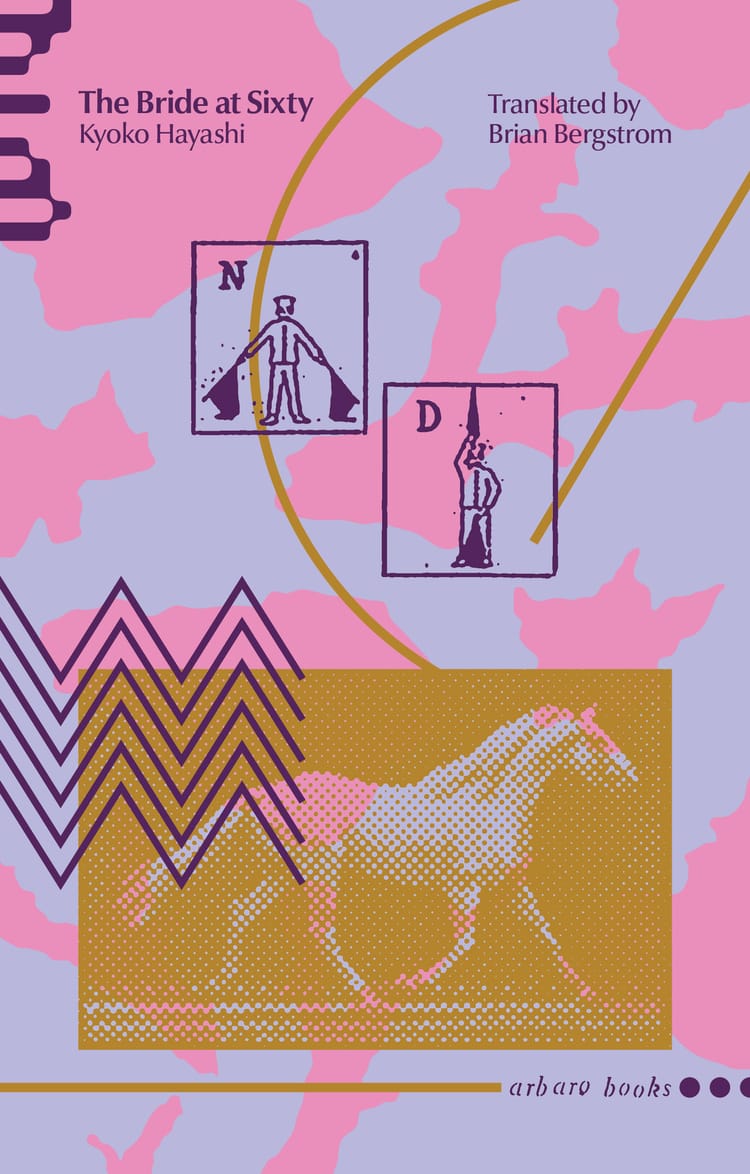
Arbaro says its version of Hayashi’s The Bride at Sixty is “reborn as a digital art book”. It includes an avant garde cover and drawings by Erika Kobayashi inserted by the book’s designer, Brennan Kelly. (Erika Kobayashi founded Arbaro Books. She is the author of Trinity, Trinity, Trinity and Sunrise: Radiant Stories, both also translated by Bergstrom, a frequent collaborator. She’s deeply committed to supporting the end of nuclear disarmament through literature.) Kobayashi’s drawings provide a kind of editorial section-break and are loosely inspired by the story—daffodils Ayako offers to the sea, red and white coral Ayako has gifted to the narrator, and stones atop a hill Ayako and her friends climb together. Even though The Bride at Sixty is only 31 pages, including art, it feels more like reading a brief novella in a single sitting than a short story; the final product is a beautifully cohesive whole. One can only wish the book were available as a tangible object for the reader to hold in their hands.
The Bride at Sixty is the story of a woman who has been the victim of circumstance for more than forty years, but who has chosen to forge her own path forward and find her own way to live in the present. “They say sixty is the age of rebirth,” Ayako tells her friends. The day she turns sixty, she has resolved to “bid farewell to the loneliness of the Woman Shunkan. And to August 9th as well.” The Bride at Sixty is a story of hope.