“The Dog Meows, the Cat Barks” by Eka Kurniawan
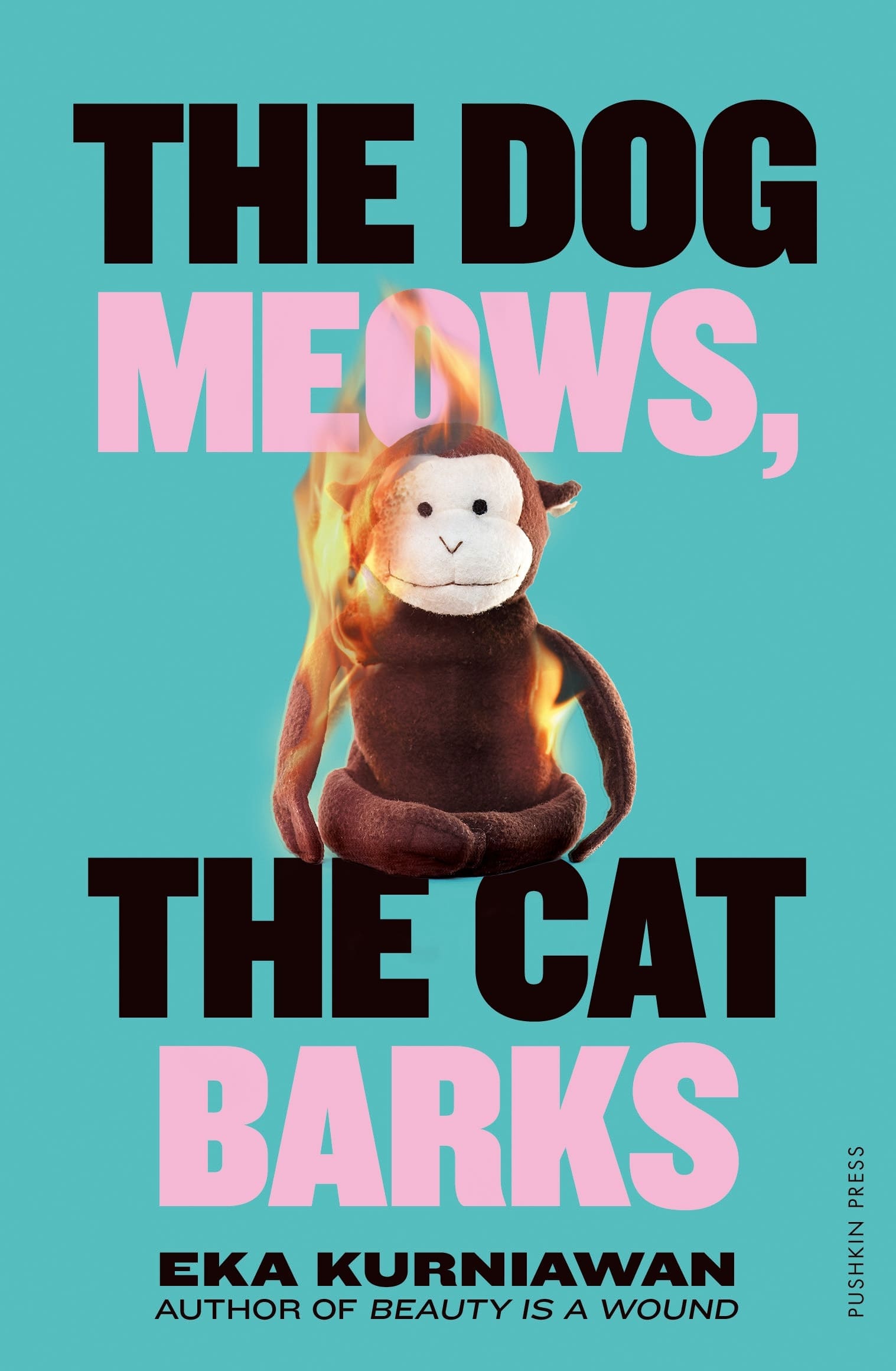
Eka Kurniawan’s The Dog Meows, the Cat Barks follows the coming of age of Sato Reang, a mischievous boy growing up in a small Indonesian town, whose life moves between childhood pranks, religious pressure, friendship with the deeply pious Jamal, and the consequences of choosing rebellion over obedience.
From the very beginning, Sato Reang announces his rebellion in plain, almost casual terms: “I stopped going to mosque. I no longer joined in worship. I never said my prayers before bed.” There is no drama in the declaration. What follows is even more telling. He waits for divine punishment that never comes: “No lightning struck me like a fire whip from the beyond. No earthquake came to knock my house down.” Religion, for him, begins to look less like truth and more like a set of exaggerated warnings.
This irreverence deepens in his interactions with Jamal, the pious boy. Sato’s attempt to “liberate” him is both comic and unsettling: “Come on, Jamal, commit one teeny tiny sin… You’ve earned so many heavenly rewards… No amount of sin could ever make even a dent.” The logic is strangely persuasive. It turns the moral universe into something like a ledger, open to manipulation. The language plays a crucial role in making all this work. Kurniawan’s prose, beautifully translated by Annie Tucker, is simple but remarkably fluid. The sentences move quickly, often mimicking the rhythm of thought.
Some of the novel’s most vivid humour unfolds inside the mosque itself. The boys compete to shout “amen” so loudly that it might “make the limewash on the mosque ceiling come crumbling down.” Sato delights in mischief: “If I got the chance, I’d tug a friend’s sarong so it fell off… or headbutt his ass… until half the congregation had collapsed on top of each other in a heap.” It is slapstick, almost cartoonish, but it also punctures the solemnity of ritual. Worship becomes a space of play, even subversion.
Sato’s reasoning is at once crude and oddly logical
The circumcision episode made me laugh out loud. Sato’s reasoning is at once crude and oddly logical. He decides the foreskin must go because, as he sees it, “a penis with its foreskin… resembled a turtle head… weird. Ugly and gross.” Even as the procedure approaches, the tone remains comic. Sato distracts himself with random facts, “Two plus four equals six… The capital of North Korea is Pyongyang,” trying to appear brave. When it is over, his embarrassment at the nurse’s attention is as vivid as his relief. But the real blow comes after, when his father declares that now he must become a pious child. What began as a humorous rite of passage turns into a moment of coercion. The body has been altered, and with it, a moral contract is imposed.
Kurniawan repeatedly uses humour to frame pain, especially in the shadow of Jamal’s life. Sato imagines the violence behind his friend’s obedience, recalling how a father might hack a soccer ball in two or burn a toy. These images are not lingered over. They appear briefly, almost casually, but they explain everything. Jamal’s piety is not serenity but fear.
The tragedy of Jamal reaches its peak in his death, after he experiments with mushrooms, beer, and pornography. The irony is devastating. The most pious boy, the one who fears sin above all else, is the one who falls hardest when he finally strays. Kurniawan does not moralize. Instead, he lets the absurdity speak. The boy who was protected by faith is undone by the very curiosity that Sato embraces so casually.
Throughout the novel, Sato’s voice moves quickly from one thought to another, often in long, breathless sequences. He lists the things he would rather do than pray, watching cockfights, swimming in streams, stealing fruit, as if life itself were overflowing. The effect is immersive. We are inside a mind that resists stillness, that refuses to be contained by rules.
What emerges, finally, is a portrait of childhood that is both funny and quietly devastating.
Even in moments of reflection, the tone stays grounded. Sato does not frame his rebellion in grand terms. He simply notes what feels true to him. Religion does not make sense. Authority feels arbitrary. Pleasure is immediate and real. This simplicity is what makes the prose so captivating. It does not try to impress. It draws the reader in through clarity and rhythm.
What emerges, finally, is a portrait of childhood that is both funny and quietly devastating. The jokes are never just jokes. They carry within them the weight of expectation, fear, and control. By letting Sato speak in his own unfiltered voice, Kurniawan allows the reader to see the world stripped of its usual justifications.
The result is a novel that makes rebellion feel natural, even inevitable. In the end, The Dog Meows, the Cat Barks is a story about the tension between innocence and control. It shows how childhood joy persists even in restrictive environments, and how humour becomes a way of surviving confusion and pain. Sato’s voice carries the novel forward with infectious energy, even as the shadows deepen around him.