“The Frigate Novara Around the World”
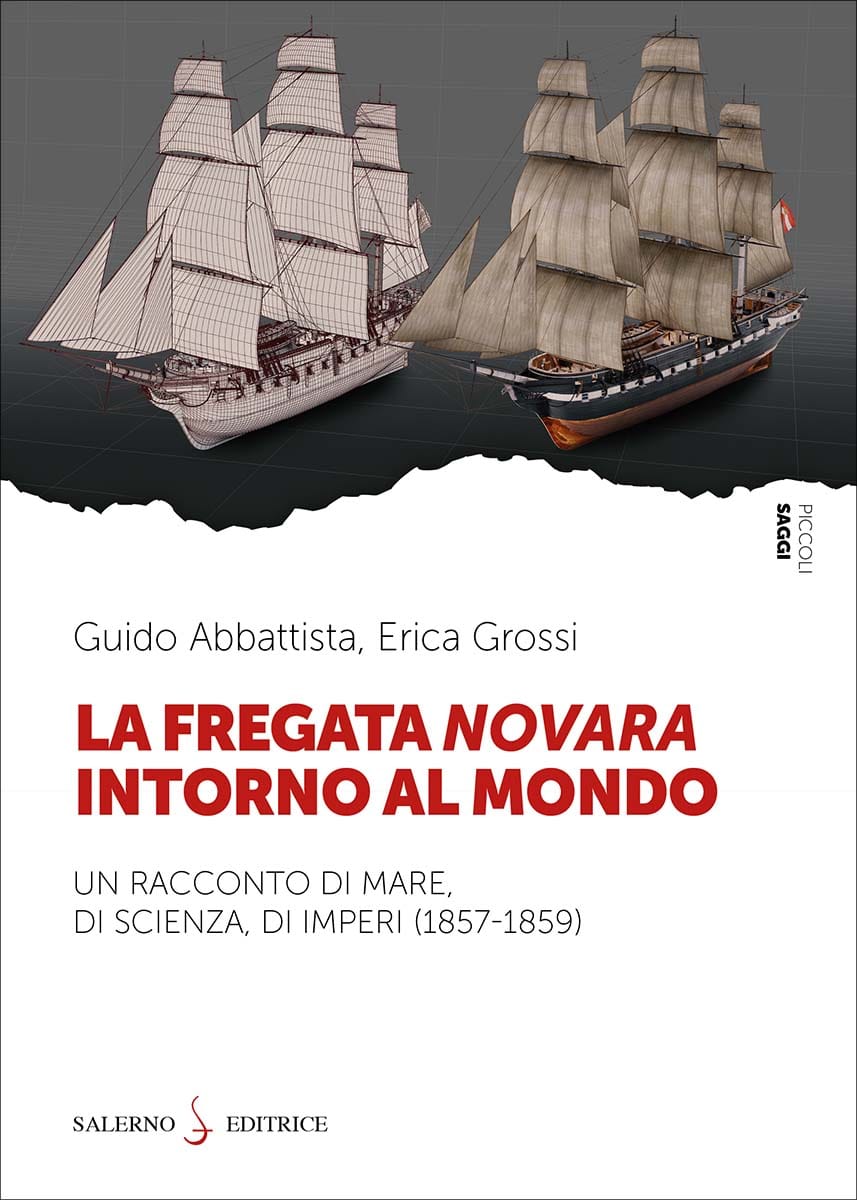
This is a translated excerpt from La Fregata Novara intorno al mondo — The Frigate Novara Around the World; reprinted with permission from Salerno Editrice and set to English by the ARB’s Editor, Peter Gordon.
On 24 June 1858, the Austrian travellers reboarded the Novara and on the next day left the anchorage of Cavite and set sail for China.
The frigate immediately encountered variable winds. The south-west monsoon made itself felt only once the ship was out in the open, in the South China Sea. In the end, it took almost twice as long as expected to cover the roughly 700 miles to Hong Kong, where the Novara arrived on 5 July 1858, finding a harbour crowded with ships of every kind and nationality, among them American vessels still fully dressed in honour of the anniversary of independence.
A few days later, on 10 July, a squadron of four Peking-bound Russian ships also arrived in the already packed harbour of Hong Kong. We have been able to identify them precisely: they were the corvettes Boyarin and Novik and the clippers Dzhigit and Strelok. The squadron, made up of seven ships in all, also included the transport Emperor Nicholas I, which had already arrived on 21 June, the corvette Voevoda and the clipper Plastun, which arrived a few days later. This was clear evidence of the continuity of Russian initiatives in this part of the world, following on from the more famous voyage of the frigate Pallada a few years earlier, between 1852 and 1854—in which the writer Ivan Goncharov had taken part as secretary to Vice-Admiral Evfimiy Putiatin—and which had remained at Hong Kong from 26 June to 20 July 1853.
For the Austrian travellers, there now began the long Chinese interlude, lasting for much of the summer and 37 days in all, which would prove extremely rich in experiences.
The island of Hong Kong, situated on the eastern side of the 29-kilometre-wide mouth of the Pearl River—on whose banks, about 70 kilometres inland, stood Canton—had recently become one of the most important emporia of world trade, when, at the end of the First Opium War in 1842, a defeated China had been obliged to cede it to the British: the first territory of the empire ever to be subjected to the dominion of a European colonial power. Hong Kong had taken over the role that for 250 years, despite all the limitations imposed by the Chinese imperial administration, had previously belonged to Canton.
It had become the principal gateway of Western commerce with the Celestial Empire, passing in a very short time from being a semi-deserted island, with little more than 7,000 inhabitants, to a lively colonial city of Victorian architecture, which, at the time of the Novara‘s arrival, counted a little less than 80,000 inhabitants. By comparison, nearby Canton had about 1 million inhabitants and New York, at that time, 780,000.
China was also then convulsed by two terrible events, of which the men of the Austrian ship could not fail to be well aware: the Second Opium War, begun in 1856, right around nearby Canton, by Britain, determined as it was to obtain full freedom of action in Chinese territory for its merchants; and above all the devastating civil war known as the Taiping Rebellion against the Qing dynasty, which raged from 1851 to 1864, especially in southern China, causing an appalling number of deaths, between 20 and 30 million.
It was decidedly therefore not the most tranquil moment for the visit of the Austrian frigate. And yet, the stay in Hong Kong, which in essence was substantially a European enclave, proceeded serenely and pleasantly, thanks to the hospitality and attentions that various personalities on the island reserved for the Austrian guests: first and foremost, the British governor, John Bowring, a figure of great importance in British commercial policy, but also in the culture of the time; and then the Austrian consul Georg Wiener, the Prussian Gustav von Overbeck, the German Lutheran missionary and sinologist Wilhelm Lobscheid, members of a community of German merchants and clerics who, as the geologist Ferdinand von Hochstetter recalled, “constitute a very important part of the local European society”.
All were of great help in procuring ethnographic materials, Christian religious texts translated into Chinese, dictionaries, books and Chinese manuscripts destined to enrich the imperial collections in Vienna and gathered following the instructions that the Viennese Academy of Sciences sinologist August Pfizmaier had prepared before departure. They are in large part still present in the holdings of the Österreichische Nationalbibliothek, heir to the Imperial Court Library to which they had been delivered at the journey’s end.
Anthropological research also benefited from the stay, thanks to the good offices of Dr William Harland. A young medical officer of the Colony, already responsible from 1846 for the Victoria’s Seamen Hospital, Harland was a well-known figure for having performed, some years earlier, the first surgical operations in Hong Kong using anaesthesia by means of chloroform; and also for having played a leading role in assessing the serious case of malicious poisoning of bread with arsenic carried out by a Chinese baker in January 1857, fortunately without causing deaths—evidence of the strong anti-British sentiment that simmered among the Chinese residents. In his correspondence, Hochstetter in fact greatly insisted on the insecurity that reigned in the areas of Hong Kong inhabited solely by Chinese and on the mainland, where no European could go except armed and in a group. Harland—who would incidentally die of fever less than two months later on 12 September 1858 at the age of 39—enabled them to visit the great prison of the island, where there were detainees from every part of the empire, and to carry out anthropometric measurements on those whom Harland himself very inappropriately defined as “fine specimens of the Chinese race”: all data that would flow into the scientific volumes published after the voyage. The impression gained of the lower-class Chinese of Hong Kong was by no means positive for the Austrian travellers: Hochstetter was explicit in defining the Chinese proletariat as belonging to the “most base, wretched, false race, the most fraudulent and the most devoid of every nobler sentiment”.
From Hong Kong, moreover—and despite the intolerable heat of the month of July—officers and scientists of the Novara made two excursions, the first to Canton and the second to the nearby Portuguese colony of Macao. At Canton, where they went aboard an English gunboat, Commodore Wüllerstorf, Commander Pöck and four officers were able to see for themselves what the material consequences had been of the two wars unleashed by the British, the second of which was still underway, with one of the most important theatres right there in Canton. The city, once a flourishing commercial port with European offices and warehouses, now presented—after the Anglo-French assault of six months earlier in December 1857—ubiquitous heaps of rubble, abandoned dwellings, and streets where only patrols of British soldiers were to be seen. It was “mute as a cemetery,” wrote the scientist Karl von Scherzer.
A few days earlier, a treaty had been imposed on China that temporarily put an end to a war that would then shift northwards, to Peking: Canton was in fact a city under British and allied French military occupation. The inhabitants had largely withdrawn into the interior of the country, anti-Western sentiment was rampant, groups of Chinese resistance fighters sought to conduct actions against Westerners. Mandarins and imperial commissioners circulated proclamations and set bounties on the head of every one of the ‘barbarian’ invaders, also disparagingly called the “red-haired dogs”.
The contacts that the Austrian officers had were with the British commander of the Hong Kong troops who had led the taking of Canton, Brigadier-General Charles von Straubenzee, and with the British consul Harry Parkes. It does not seem, however, that at the moment they were particularly interested in the politico-military situation or wished to comment on it. They met the representative of the imperial government at Canton, the mandarin Pihkwei, and noted his complete submission to the British—”guided and directed like a little lamb by the small and unobtrusive consul Parkes,” said Hochstetter—so much so as to compare him to the “regents” of Java, instruments of the Dutch colonial government.
Once back in Hong Kong, the significance of the moment was made plain to the travellers upon reading the North China Herald, the official weekly published from 1850 in Shanghai under the auspices of the British consular authorities. The newspaper had reported the signing of the Treaty of Tientsin on 26 June. Despite their being fully aware of the content of an unfair, unequal treaty that imposed on China conditions equivalent to complete submission to British will in commercial matters and that in fact legitimised the controversial opium trade, the Austrians—evidently because of their condition as guests—took no position. Or at least Scherzer did not, when he wrote the account, offering a precise and complete report on the facts, but without expressing an opinion, something for which he was later reproached by the anonymous Italian translator: how could it be, the latter asked himself, that they are such admirers of liberal English institutions and have nothing to say about the shameful drug traffic that hides behind those commercial practices that are supposed to be a vehicle of civilisation? Scherzer would use apparently more sympathetic words later, after the journey was concluded: in October 1860, commenting on the treaty that had definitively ended the war, he would in fact speak of a grave humiliation inflicted on the Celestial Empire. At the same time, however, and with evident ambiguity, he would almost justify it, maintaining that that hard blows would end up “awakening the Chinese Empire from its long lethargy, forcing the peoples that compose it to take part in the progress of civilisation, which victoriously carries its torch into the remotest corners of the world.” It was a fine apologia for what is called “liberal imperialism”, whose faults we have come to recognise even in very recent times. It is interesting to hear Hochstetter’s point of view, who in his correspondence also dwelt on the critical situation of imperial China, without concealing at all the violent impositions that the Middle Kingdom was undergoing. But his conclusion about the inevitability of the forced opening of China was no different from Scherzer’s:
To the giant the wrists are cut and the entrails are rummaged with fire and sword, not so that he may die, the colossus, no, but so that he may awaken to new life. It is world history that beats with an iron fist at the gates of China, so that a third of humanity, 360 million people, may free itself from a thousand years of seclusion and begin to live also for the rest of humanity.
In these words, one hears the distinct echo the writings of the great Enlightenment figure Denis Diderot from the 1770s and ’80s in his penetrating contributions to the celebrated Abbé Raynal’s history of European colonial expansion Histoire philosophique et politique […] des deux Indes, with all the accompanying interrogatives, doubts and hesitations.
While the officers went to visit Canton, the naturalists made a second excursion, going for two days to Macao, the colony founded by the Portuguese in the mid-1500s on lands leased from the Chinese rulers and which would remain under their authority until 1999.
Scherzer recounts the details in his usual lively style, emphasising above all two aspects: the first is that Macao had by now been eclipsed by Hong Kong from the commercial point of view, after having once been the preferred residence of the Europeans who traded at Canton; the second is that, in that city, populated 90% by Chinese, the atmosphere was not good for Westerners, towards whom hostility was palpable and the risk of aggression concrete. Despite this, the men of the Novara, thanks to the help of the Prussian consul Richard von Carlowitz, were able to visit, as tourists, the places of greatest attraction, and meet interesting local personalities, such as the Chinese doctor Wong Fun, educated in Edinburgh and returned to Macao to practise medicine, “Chinese in all his outward appearance, European in mind and education,” says Hochstetter: a unique case of its kind.
They did not fail to record, this time with very critical words, the fact that Macao was the centre of collection and dispatch of Chinese labour transported in bestial conditions to Central America and the Caribbean by a Cuban company and on ships of every flag: another case of true “traffic in human flesh”, in the words once again of Scherzer, something which the Austrians had had occasion to document on previous occasions as well. And in this case the British government was praised for the effort put into opposing this oppressive and inhuman practice, forgetting, however, that that government was the very same one that protected the opium trade and held its bayonets to the throat of the Celestial Empire.
At the end of the two days, they returned to Hong Kong, where—while waiting to depart again—they set about ordering and packing the considerable scientific and documentary materials of every kind gathered up to that point. A curious episode occurred on the eve of departure, when one of the ship’s cooks, Wilhelm Vollhardt, a German from Frankfurt, asked for and obtained permission to leave the ship and interrupt the voyage. He could no longer bear the hardships of navigation amid stormy seas, above all because they prevented him from cooking properly. Of Vollhardt it is known that, once having disembarked at Hong Kong, he went to Japan in the service of a rich English businessman and subsequently returned to Hong Kong, where on 28 April 1860 he married a Portuguese woman, Guilhermina de Silveira, later moving to Shanghai where he led a comfortable life as proprietor of the Hotel d’Europe, in Woosung Road: a spare, but suggestive multicultural biography among empires, colonies and global affairs.
Having left the cook on shore, therefore, on 18 July the Novara set sail directly for Shanghai.